
The Hidden Health Benefits of Squash
With autumn now well and truly under way, and its usual train of seasonal ailments, squash (a member of the cucurbit family) is one of the options for naturally strengthening the immune system. It is a tasty vegetable that is easy to prepare, and a must for your menu if you want to enjoy its anti-ageing effects, notably for keeping skin and bones in good health.
Translated from French. Original title: “Les bienfaits insoupçonnés des courges”
Why eat squash?
Subject to various factors such as age or certain menopausal symptoms like stress, the immune system tends to weaken. Squash can help to address this thanks to its many minerals (calcium, iron, magnesium and more) and vitamins (C, B1, B2, B3, B5, E and more). Its composition also gives it antioxidant powers (1), thanks to its richness in beta-carotene and provitamin A. This is a valuable contribution to neutralising free radicals and slowing the cellular ageing of the skin (1 and 2), with the result that skin looks healthier and more radiant.
The presence of carotenoids (lutein and zeaxanthin) and vitamin A, for its part, helps to keep bones healthy and reduces the risk associated with certain eye conditions such as cataracts or macular degeneration. A protective effect has also been observed for dry eyes, which are often a problem during the menopause.
The fibre in squash promotes healthy digestion and reduces constipation and bloating. As for the seeds, which are perfectly edible, they are a source of protein and magnesium that is ideal for combating chronic fatigue and for enjoying an optimal feeling of fullness (2). Eating the seeds is also said to help reduce inflammation of the urinary system.
How to choose a good squash
Without the advice of a greengrocer, it is not always easy to pick the right vegetable. Squash can be bought whole or cut up and packaged. So how should you choose one? First of all, look for squash with the stalk still attached, a sign that it will keep well. The second step concerns appearance and texture. The skin should be even, with no cracks or visible bruises, both to the eye and to the touch.
Squash will keep for up to 6 months in a dry place at room temperature (between 15 and 20 degrees). It can also be frozen or preserved in jars.
A versatile vegetable in the kitchen
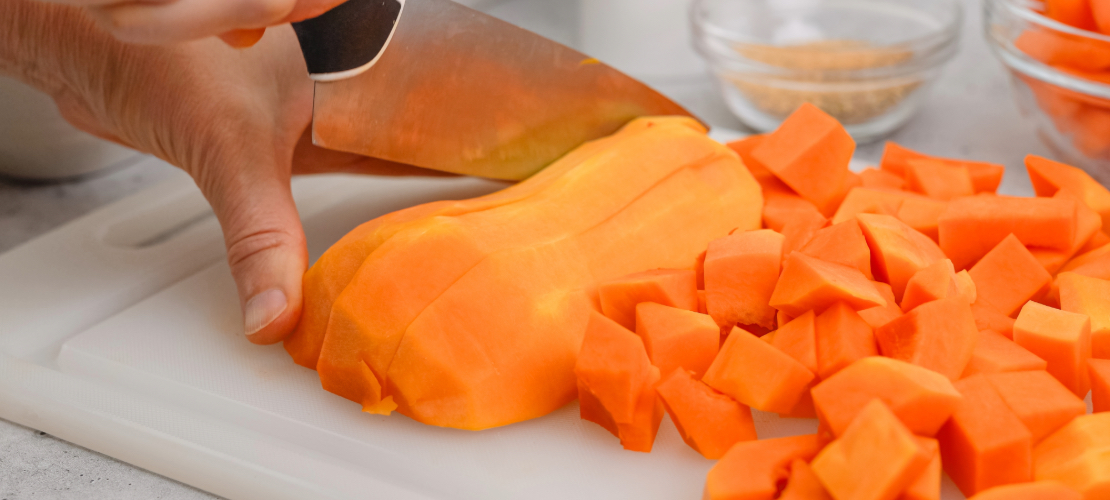
Squash is good for your health, but it is also delicious on the plate. It lends itself to recipes that are both simple and quick, perfect for the woman in a hurry. Use it in soup or alongside a risotto, in a gratin, roasted in cubes in the oven, or in tarts. For (grand)children who love chips, squash can replace the potato: cut into chips, cook for 20 minutes, then season with salt or spices.
One last tip? Toast the squash seeds as a nibble with drinks or as a topping for mixed salads. Delicious.
References:
- (1) https://pubmed.ncbi.nlm.nih.gov/34487849/
- (2) https://www.myfoodresearch.com/uploads/8/4/8/5/84855864/_43__fr-2022-161_chaudhary.pdf
 Health
 Health
 Health