
Menopause, the Virginie Hocq way
There is no question of her donning the costume of the woman who fades into the background. She would rather take on the clichés with what she does best: humour. Virginie has, in fact, started dreaming up sketches about the menopause. She first appears as that ‘old lady’ whom the collective imagination still all too readily associates with this stage of life, buttoned into an itchy woollen garment, body stiff, struggling to climb onto a stool. Then, layer by layer, the disguise falls away and, with it, an entire image of the menopausal woman. For that is exactly what she is questioning: why should the end of periods suddenly tip a woman over into old age?
Translated from French. Original title: “La ménopause autrement avec Virginie Hocq”
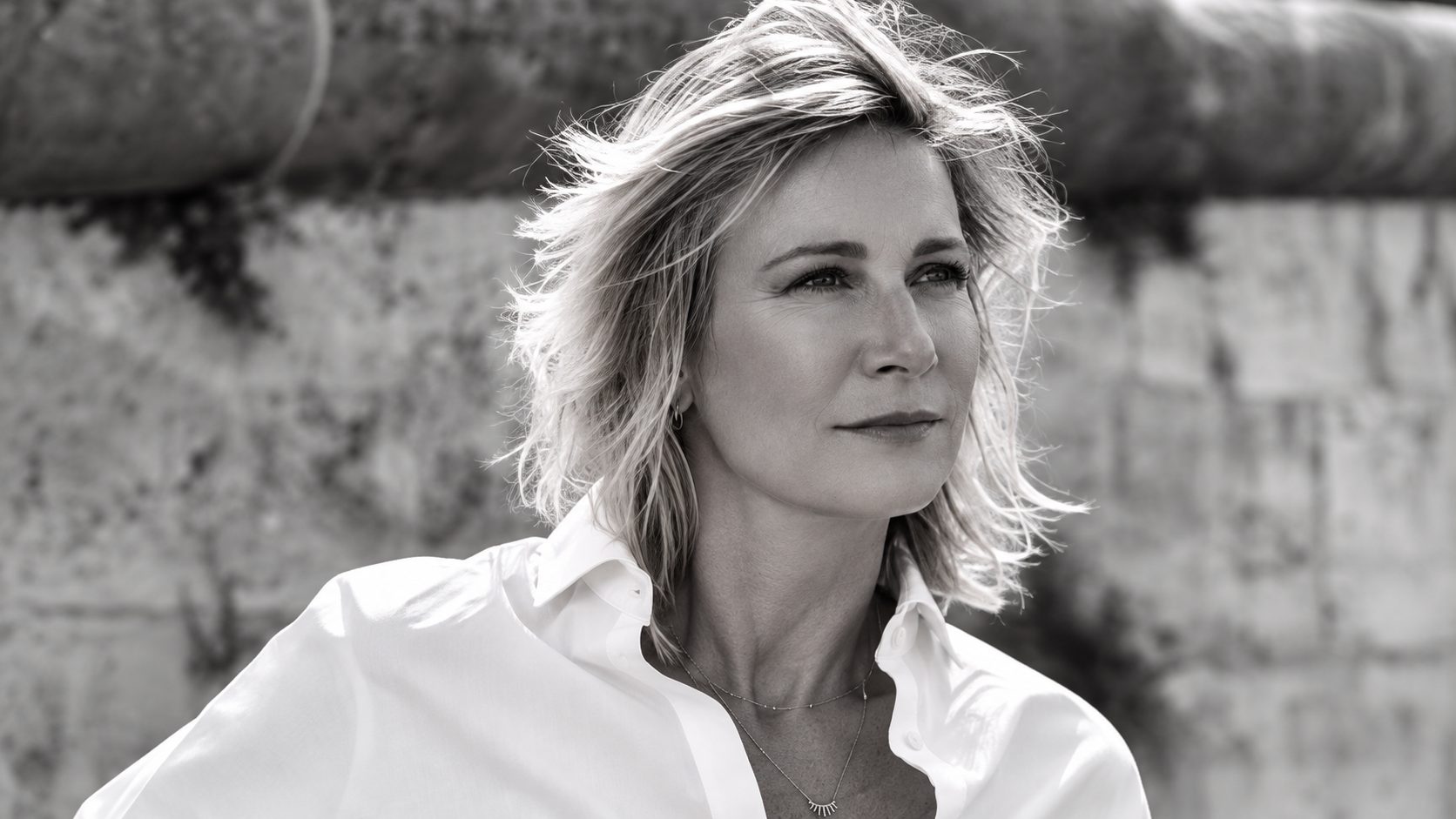
Getting to know yourself (again)
The menopause also touches on something far more personal: our relationship with our bodies. A body that changes shape, sometimes rhythm, and that we can’t help comparing with the one we had before. Virginie doesn’t hide the fact that she has been through seasons when she no longer recognised herself physically. Today, she happily tells of having lost weight, rethought her diet and found clothes she feels good in. But her loveliest victory lies elsewhere.
‘In the morning, I try to be kind to myself, because if I’m not kind to myself, who will be?’ Being kind to yourself. Valuing yourself. Treating yourself to a perfume, a cream, a little pleasure. It may seem trivial. It isn’t, in a society that for a long time taught women to look after everyone else before thinking of themselves. Virginie readily lays claim to a certain form of selfishness. ‘I think I’ll be loving myself for a long time yet.’
It’s a beautiful phrase. Because it isn’t about narcissism, but about being allied with yourself. So she gives herself ‘me time’ moments: a workout, a café latte on a terrace in Paris, a walk in the woods in beautiful light glimpsed in the middle of an ordinary day… ‘I really try to be at ease with myself, not to be self-sufficient, but at least to be in tune with what I feel like doing.’
The menopause without taboos
The menopause isn’t lived only in the mirror of our private lives. It goes with us to the office, into our relationships, and even into the way we look at ourselves. Fatigue, hot flushes, joint pain, fluctuating energy… Some women still go through these upheavals in silence, as if above all nothing must show. For behind the taboo of the menopause lies a deeper one: that of female ageing. To say that you are menopausal is also to say that time has passed. And our society still struggles to see that time as anything other than a loss: of youth, of desirability, sometimes even of visibility.
Virginie dreams of a time when the subject will have become so natural that it will no longer need explaining. To women, to men, but also to the generations that follow. ‘That’s what we must teach our children too: to welcome everything that happens in the body […] so that it isn’t hidden, isn’t taboo.’ Talking about it today, so that we no longer have to apologise for it tomorrow.
Postcards from our libido
When the conversation turns to sexuality, Virginie Hocq immediately returns to her favourite playground. Asked about desire after 50, she instantly turns the subject into something to laugh about. Her libido? She compares it to an old acquaintance who now only sends the odd bit of news from afar. Behind the quip, though, a subtler reality emerges. Virginie talks about conversations between friends, the changes in desire, and the need today for more attention, more compliments and more availability for desire to appear. Desire hasn’t necessarily gone. Sometimes it simply speaks another language.
And above all, there is no ‘right’ way to live your sexuality after 50. What matters lies elsewhere: being able to say what you want, what you don’t want, what you need. Remaining in charge of your body and your desires.
‘Sport is my life’
If there is one subject on which Virginie would like to convert the whole world, this is it. ‘I think I’m a professional motivator!’ Sport has been with her for a long time, but her practice has evolved. Less cardio, more strength training, with a new priority: preserving her strength and her muscles. Her advice? ‘Lift heavy, challenge yourself!’
Behind the enthusiasm, her goal is not aesthetic. Virginie wants to stay mobile. To climb up, to go down, to do squats, to keep full use of her body. Movement is also her antidote to grey days. ‘You’re never in a bad mood after sport.’ Those fifty minutes become an appointment with herself, a way, she says, of ‘pumping myself right back up’. And when the motivation is completely missing? She goes out for a walk. ‘I force myself and afterwards I feel good.’ No miracles. No performance at any price. Simply this conviction: keep moving in order to keep living fully.
Nourish rather than punish
Her relationship with food has undergone the same (r)evolution. Like many women of our generation, Virginie long took on board an equation as simple as it is frustrating: to lose weight, you have to eat less. Until the lightbulb moment.
‘I realised I wasn’t eating enough, that I wasn’t eating well.’ She rebalanced her meals and paid more attention to protein, notably to support her strength training. Even on film sets, she now plans ahead for hunger pangs with a handful of almonds rather than automatically reaching for sugar.
But one thing remains non-negotiable. ‘I don’t want to deprive myself. I love eating, I love cooking.’ Pleasure stays at the table. Because, after all, to bite into life with gusto, you have to acquire a taste for it. Eating better, moving, preserving your strength and energy: behind these everyday gestures, another vision of longevity takes shape. Not trying to hold back time, but giving yourself the means to go on savouring it. Not adding years at any price. Adding life to years.
Friendship, a vital energy
When her batteries are flat, Virginie spontaneously names her other chargers: her girlfriends. The ones she phones to laugh, to tell what’s irritating her, to share a joy or simply to recover some lightness. She also mentions her mother, with whom she says she has shared some of her biggest fits of laughter. That bond means a great deal. But age has also taught her that not every relationship has to be kept at any price. ‘I always believed friendship was for life, but I understand that friendship is like love.’ Some relationships pass, others appear. And with time also comes the freedom to choose the people you want around you. Not to close your life off. Quite the opposite. To let in those who match the person you are becoming.
Invisible at 50?
There are the changes we feel. And then there are those that other people’s gaze seems suddenly to decide for us. For an actress, turning 50 has a particular resonance. ‘People kept telling me that at 50, you’re invisible and you don’t work any more.’
It’s less funny when Virginie talks about doubts that are sometimes ‘abysmal’ and the contradictory demand made of actresses: accept growing older, but above all without showing any signs of it. Until another face appears on screen. A face that moves, creases, looks surprised. A living face. And what if the real revolution were simply that: finally letting women be the age of their experiences, of their story? Virginie, for her part, won’t wait for the film industry to decide what happens next. ‘I’ve decided I’ll be an actress who works for a long time, because I’m going to create things for myself.’
And suddenly, the reflection goes beyond cinema. What do you do when people begin to suggest that you should take up less space? Invent your own. ‘I’m also the creator of what I’m going to do with my life,’ says Virginie Hocq, no longer joking. Not waiting for someone to write the next chapter for us. Not letting age decide what we can still become. A mantra that resonates well beyond the stage.
Tomorrow belongs to us
The body changes. The children grow up. Some friendships drift apart. Careers transform. Desire evolves. So do priorities. We could see only what disappears. Virginie Hocq looks instead at what is left to invent. She denies neither the lows nor the doubts. She knows that life never follows a straight line. But she refuses to let the fear of ageing define the next chapter. She moves, laughs, creates, looks after her relationships and above all learns to stay on her own side.
And when she is asked what helps her through difficult times, she goes back to the essentials: ‘Actually, I’m fine.’ Her body works. She is in good health. She can still make plans.
And perhaps that is where everything is decided: in that ‘still’, not as a countdown of what remains, but as the keen awareness of everything that is possible. Growing older with lightness does not mean taking age lightly. It may mean ceasing to count what time takes away, so as to look at everything there is still left to live.
 Health
 Health
 Travel