
Siwak sticks: the 100% natural toothbrush
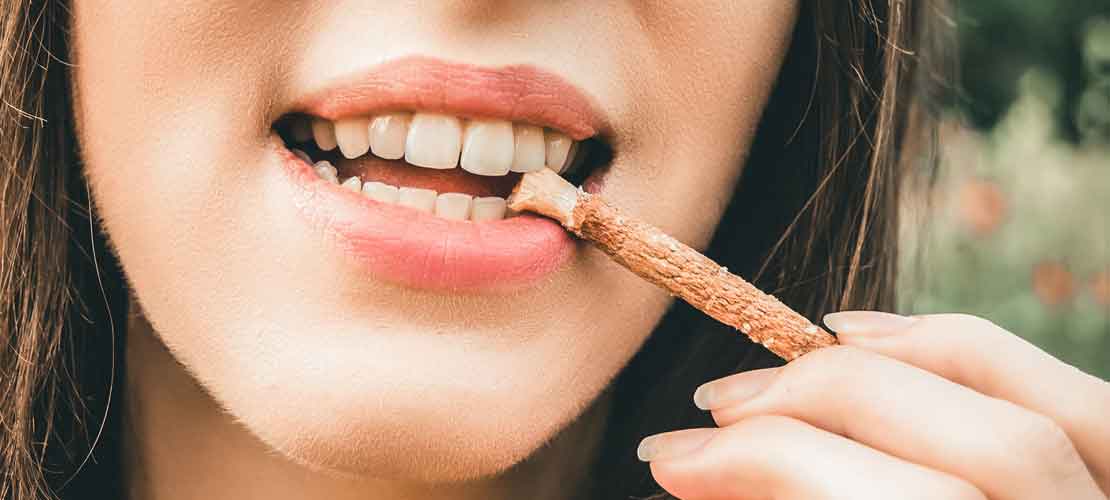
Which of us over 50 never chewed on a liquorice stick as a child? A nostalgic memory? Certainly, but one that is back in the news, as the success of a practice from the East shows: using a siwak stick to brush your teeth. It is an effective solution thanks to its benefits, but also an ecological and economical one. What exactly is it? Here is everything you need to know.
Translated from French. Original title: “Découvrir le bâton de siwak, brosse à dents 100% naturelle”
The origins of the siwak stick
Widely used throughout the Arab-Muslim world, the siwak stick comes from a tree known as the arak (Salvadora persica). Absent from our latitudes, the siwak or arak tree is found in North Africa, the Arabian Peninsula, India and South-East Asia, among other places.
The siwak stick is an alternative encouraged by dentists, both for its natural qualities and as a remedy for our excessive use of toothpaste. European studies have indeed denounced the harmfulness of its fluoride content over the long term, including discolouration of the teeth. Using a siwak stick also helps to cut down on plastic: old toothbrushes cannot be recycled and are burned.
It is good for the purse too. Around ten euros is enough to buy 5 sticks, available in organic shops or online.
A valuable ally for oral health
Although science has yet to carry out conclusive research, health professionals are unanimous about the benefits of the siwak stick:
- A natural antibiotic, thanks to its anti-decay and anti-germ ingredients
- Preventive action against gingivitis
- An effective fight against dental plaque, a major cause of tooth loss
- A guarantee of fresh breath
- Protection of the teeth against cavities
- A reusable, 100% biodegradable product
- A whitening action on the teeth
- Minerals that are good for dental health: potassium, sodium chloride and sodium bicarbonate
- Practical too: no need for water or toothpaste
- A feeling of smoother teeth
How do you use a siwak stick?
It is best to say from the outset that the taste of a siwak stick is not delicious. Quite the contrary. In the mouth, the first use can come as a surprise, with a bitterness and a sharp, peppery taste like a spoonful of mustard. In practice, the siwak stick looks rather like a pencil. Simply peel off the bark for an inch or so (one or two centimetres), then chew the stick until it forms bristles, just like a natural toothbrush. The stick is then used to clean your teeth, just as you would with a traditional toothbrush. Between uses, the stick is left to soak in fresh water. When the bristles are worn down, simply repeat the first step to produce new ones. It could not be simpler. There is no need for toothpaste or rinsing, so the stick can stay with you all day, allowing you to clean your teeth after every meal.
Photo Shutterstock.
 Health
 Health
 Health