
Rooibos: the antioxidant-rich infusion
Introduced and popularised around the world since the 1990s, rooibos, the veritable national drink of South Africa, is winning over more and more consumers. A success that is far from undeserved, thanks to its naturally sweet flavour and its positive effects on health.
Translated from French. Original title: “Le rooibos, infusion super antioxydante”
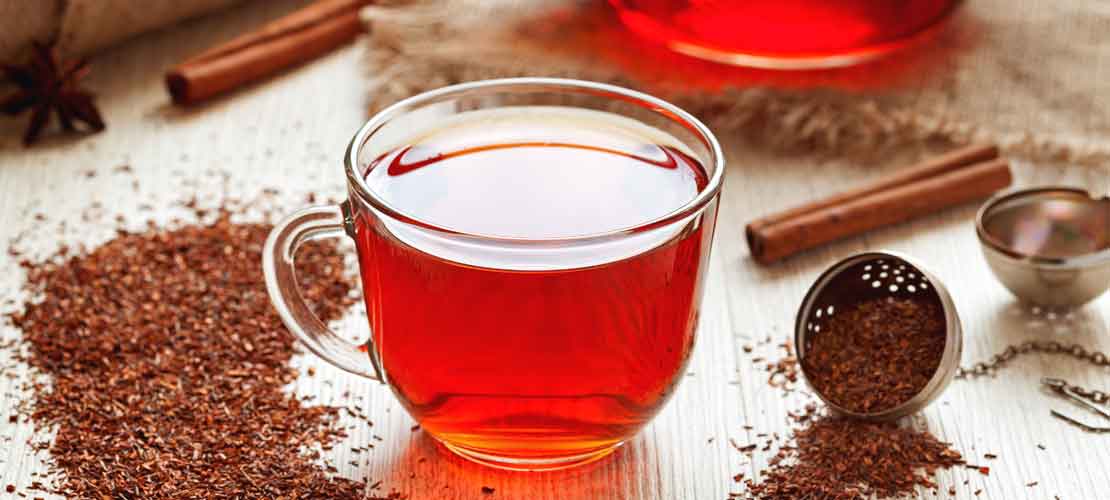
Its history
Ubiquitous in South Africa, where it serves as a traditional drink, rooibos is not a tea from the tea plant family. Rooibos is a shrub (Aspalathus linearis) of the Fabaceae family that thrives in arid, mountainous regions. To enjoy an authentic, quality product, it must therefore have been harvested in South Africa. It is drunk as an infusion.
Its benefits
- Anti-free-radical properties to protect the skin against pollution and the effects of ageing
- Detoxifying properties
- Remedy for digestive problems
- Healing properties
- Rich in antioxidants (around 50 mg/20 cl)
- Preventive action against cardiovascular and degenerative diseases (Alzheimer's or Parkinson's)
- Helps the body to absorb iron well
- Contains fluoride
- Anti-colic remedy
- Anti-allergic properties (for external use)
- Important source of trace elements (magnesium and potassium)
- Action against bad cholesterol (LDL) thanks to the presence of polyphenols
How do you prepare a cup of rooibos?
First tip: choose leaves that are a good, deep red, a sign of the product's quality. Rooibos is available in tea bags or loose.
Unlike tea, rooibos contains no caffeine or theine, so it can be drunk at any time of day. The drink can be enjoyed plain or with milk and sugar. It leaves a hazelnut aftertaste in the mouth. It can also be enhanced with the addition of spices (cinnamon in particular) or dried fruit. But without added sugar, since rooibos already has a sweet flavour. How do you prepare the infusion? One spoonful of rooibos is left to steep for 5 to 10 minutes in a cup of bubbling hot water. This infusion time allows the drink to take on its lovely red colour. It can be drunk hot or cold, as you prefer. It can even be served iced in summer. Unlike tea, rooibos contains few tannins, which will prevent your teeth from yellowing. Rooibos should be stored in a tin, away from light and moisture.
Are there any contraindications?
The studies, which are rather scarce, report no negative effects linked to moderate consumption of rooibos. Medical advice can nonetheless be useful, just for peace of mind.
Photo Shutterstock.
 Health
 Health
 Health