
Beating Cancer Together
What will the fight against cancer look like in the decades to come? Between research breakthroughs, prevention and patient support, hopeful possibilities are multiplying
A foundation active for 102 years
Every year, cancer affects more than 78,500 people in Belgium. The Fondation contre le Cancer is fully committed to helping build a world where the disease no longer kills and where more patients recover. A world where incurable cancers would be transformed into well-managed chronic conditions, with minimal impact on quality of life thanks to effective treatments. To achieve this, the Foundation has made funding research its absolute priority, investing in the most promising projects.
Professor Pierre Coulie, an eminent immunologist, professor emeritus at the Faculty of Medicine at the Université catholique de Louvain (UCLouvain) and vice-president of the Foundation, is widely recognised as one of the pioneers of human tumour immunology and the discovery of tumour antigens. He kindly took the time to explain the three main areas of work his organisation focuses on, battles that are of course also being fought by all the other players present at this event.
1. Research: the engine of change
"The most significant area in financial terms is research. We fund both fundamental and clinical research projects," explains Professor Coulie straight away. "It's an obvious driving force, because anyone who becomes a patient one day sees their life turned upside down. It's like an earthquake, and things will never be quite the same again. It has enormous consequences on people's daily lives, on their state of mind, on how they view the future. I think you have to go through it to truly understand."
He continues: "For all these people, the only thing that really matters is that we make progress. If we don't make the effort to cure more people in 10, 20 or 30 years' time, nothing will change. Of course, Belgium isn't fighting this battle alone, it's happening on a global scale. The results are public and shared. Taking part in this effort and being involved for the sake of patients is crucial. That's why such a large proportion of our donations go towards research."
2. Prevention: 40% of cases are avoidable
"The second absolutely crucial element, perhaps even more so today than in the past, is prevention. We know that 40% of cancers are avoidable, which is huge! Tobacco alone accounts for 20% of cases. Then come alcohol (8%), UV rays, a sedentary lifestyle and poor diet. We know the risk factors, so we need to act on them. It's a challenge, because we need to reach a much younger audience, one whose mind is often far from concerns about cancer. The role of over-50s is to become aware of this and to raise awareness among the generations that follow them, who trust them," the professor insists.
3. The patient experience: easing the ordeal
"The third area concerns the patient experience directly: we need to help the sick, those in remission and their loved ones get through this ordeal as well as possible. It's a matter of wellbeing and quality of life," explains Pierre Coulie. "In this area, our role is more about sparking initiatives and generating interest so that projects can be organised on the ground. We can't do everything ourselves, it would be financially impossible for a foundation; that's usually the role of public authorities."
He concludes on this point: "Many patients tell us afterwards that what helped them most through the difficult moments was sharing experiences. Meeting people who are going through, or have been through, the same difficulties is essential. The diagnosis and treatments bring about such an intimate upheaval that it's hard, if you haven't been through it yourself, to find the right distance. You try to understand, but it's almost impossible without having lived it. Allowing these people to come together and share activities is an invaluable help. That's why we shine a light on what already exists."
Supporting patients: original and innovative methods
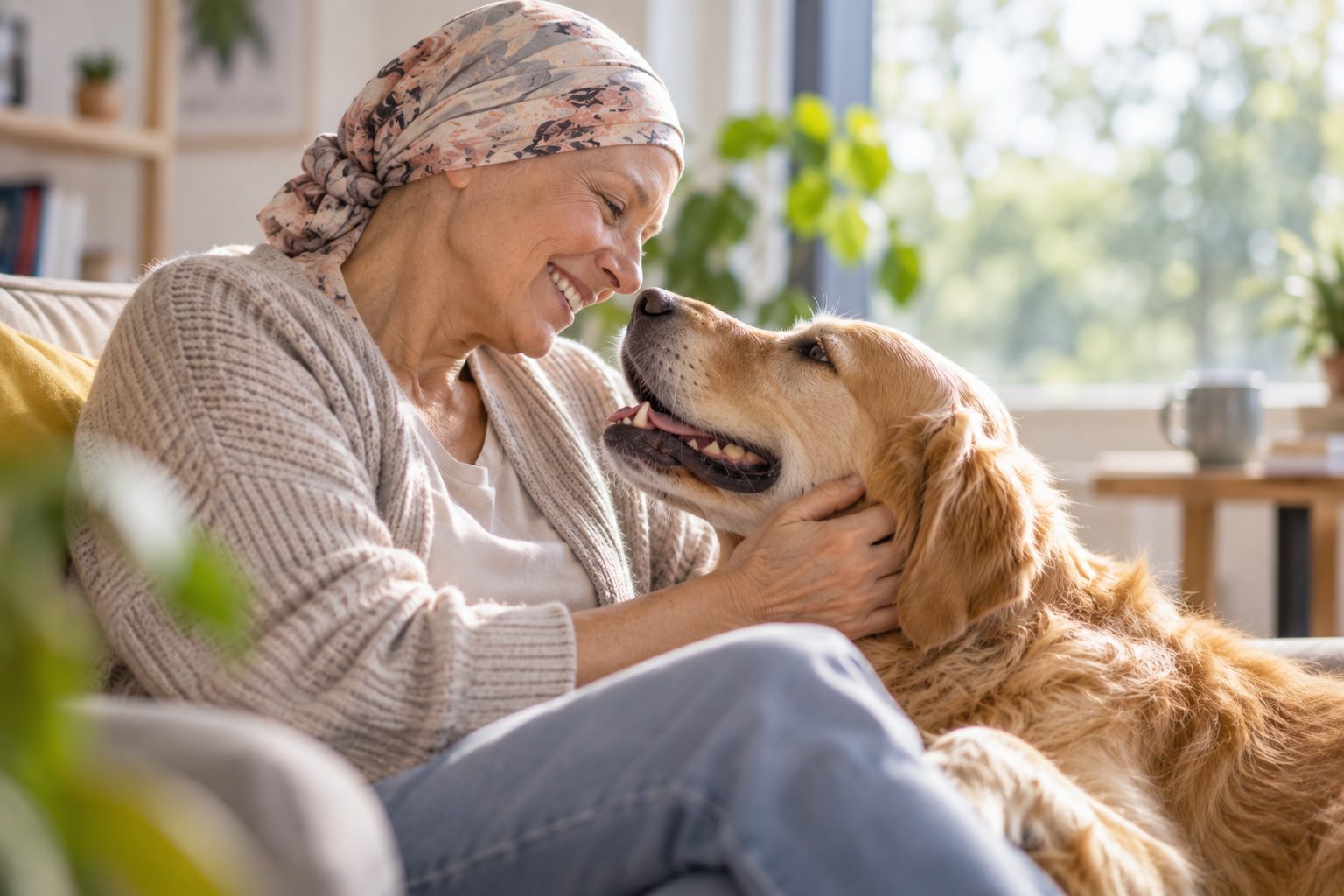
Wonderful projects are springing up on the ground. One such example is the programme set up by Lora Bertrand, a nurse with the mobile support and continuing care team at the Centre Hospitalier du Bois de l'Abbaye in Seraing, in the province of Liège. She coordinates the logistics of the "Animal mediation: a dog's visit, a link to wellbeing" project within the oncology department.
This project, run in partnership with a specialist non-profit organisation, allows dogs to visit patients who wish to see them. "It's a project that required a great deal of groundwork and solid organisation," she says. "Bringing animals into a hospital setting is never simple. We had to work closely with the hygiene committee and the medical management to show them, backed up by studies, that there was no health risk."
Since March, the dogs have been visiting patients once a week. This programme is inspired by the "A Dog for a Smile" initiative run by the Fondation de la Citadelle, which has been running since 2002 and now has 19 dogs.
These animals, chosen for their extremely sociable nature, live with foster families where they learn a series of precise commands with the help of a dog trainer. Their profiles are highly specific (depending on temperament, coat or breed): some are suited to paediatrics, others to geriatrics or oncology.
"My role mainly involves welcoming the charity every Thursday, scheduling visits and selecting patients who are happy to receive the animals, since the dogs obviously can't go into every room," explains Lora Bertrand.
"We first do a round of the wards. Then we prepare the ground in terms of hygiene, for example by covering catheters with bandages. We also set up a small trolley for the dog handlers with clean linen, to protect bedsheets or armchairs if the animal settles there."
Reconnecting with one's body
Beyond animal mediation, other approaches are being developed to help patients reclaim their self-image. Adapted massages, body treatments, beauty therapy and make-up workshops are all essential initiatives to help patients regain confidence in a body that has sometimes betrayed them, and with which their relationship has become particularly complex and delicate.
A focus on young researchers' work
The next generation is ready to take over. An excellent example of this was given during the plenary session by Dr Céline Grégoire (CHU de Liège), who explained how to optimise immunotherapy in the treatment of multiple myeloma.
Dr Céline Grégoire is seeking to improve the effectiveness of CAR-T cell therapy for blood cancers. Her work focuses on why these innovative treatments sometimes fail, particularly because the reinjected cells disappear too quickly. She is studying the negative impact of previous chemotherapy on the quality of a patient's lymphocytes. By targeting and enriching the product with early memory T cells, she aims to increase their survival and long-term persistence. Her clinical research primarily targets aggressive forms of multiple myeloma and leukaemia.
She is, of course, not the only one whose work has been highlighted. "Tomorrow's research and the great medical advances of the next 15, 20 or 25 years will come from them, from these young researchers," Professor Coulie points out. "But for now, the key people for passing on these messages are the older generation, because they know what they're talking about and have the necessary perspective to raise awareness among younger generations."
Technological advances: powerful reasons for optimism
Although many uncertainties remain, future prospects look particularly encouraging. "In 50 years' time, our grandchildren, who will then be the new fifty-somethings, may well realise that the greatest advance against cancer in recent decades came from a discovery we know nothing about today," suggests Professor Coulie. "We must always stay open to the unknown. What lies ahead may well be far beyond anything we currently understand."
While waiting for these future revolutions, tangible therapeutic approaches are already changing the game. "The current buzzword is personalisation through targeted therapies," he says happily. These are drugs designed to act very precisely on the consequences of a specific genetic abnormality, identified beforehand in the patient through genetic diagnosis.
"We no longer give the same standardised treatment to everyone with breast or colon cancer. We only target the subgroup of patients whose tumour has the specific abnormality in question, which could be anywhere from 1% to 30% of cases. These targeted therapies carry enormous hope, and artificial intelligence is helping us a great deal in developing them."
AI is now establishing itself as an essential accelerator. Asked whether it might one day become a "creator" of purely medical technologies, Professor Coulie prefers to focus on the current progress being made in genetic diagnosis.
"We will soon have tools capable of detecting cancer at an ultra-early stage, well before any symptoms appear. Genetic abnormalities or circulating cancer cells will be identifiable through a simple blood test. Such progress will change everything. Treating a tiny tumour the size of a pea or a cherry is nothing like operating on a mass the size of an orange or a grapefruit. The prognosis is completely different."
At the same time, overall patient care continues to evolve thanks to:
- the robotisation of surgery;
- greater precision and simplification in radiotherapy;
- advances in immunotherapy, which has shown consistent clinical success since 2010 and promises giant strides in the decades to come;
- the rise of mRNA-based therapies, popularised by the Covid-19 crisis, which are now opening up applications in oncology that would have been unthinkable just twenty years ago.
"These are genuine 'quantum' leaps, giant steps being taken," the professor enthuses. Although the disease remains complex and won't disappear overnight, the statistics speak for themselves: "Today, the 5-year survival rate for breast cancer stands at 98%. For prostate cancer, the rate is between 85% and 90%. Forty years ago, the situation was nothing like this. Clinical prospects are infinitely richer today than they were 25 years ago."
It affects us all
In her major work Illness as Metaphor (1978), written while she herself was battling breast cancer, the writer Susan Sontag wrote that illness is the night-side of life. She explained that every human being, at birth, holds dual citizenship: a passport to the kingdom of the well, and another to the kingdom of the sick.
Although we would all prefer to use only the first, the reality of the human condition means that, sooner or later, each of us is forced, at least for a while, to acknowledge ourselves as citizens of that other, darker and more painful kingdom.
So let's act, each of us doing what we can, whatever our means.
 Health
 Health
 Health