
Looking after yourself through cancer: the right habits
Translated from French. Original title: “Les bons gestes pour prendre soin de soi pendant un cancer”
Living better with cancer
Facing illness with courage and grace. Staying confident and true to yourself. All of these qualities can only help to build a winning spirit while feeding your strength and energy. Working with ESKIMO (European SKIn Management in Oncology), the European working group made up of dermatologists and an oncologist specialising in cancer treatment and its associated skin problems, La Roche Posay is launching #fightwithcare. This international support programme for people with cancer offers us practical recommendations and targeted advice.
Over the past few years, treatments have transformed the outlook for patients with cancer. However, more than 80% of patients with cancer develop skin side effects linked to their various treatments, and nearly 50% face, to one degree or another, severe skin problems caused by radiotherapy. Yet these consequences can be prevented and eased through simple habits.
Feeling good in my skin
Because of treatment, the skin can suffer side effects such as severe dryness, radiodermatitis (skin problems caused by radiotherapy), hand-foot reaction, folliculitis and so on. These conditions can cause discomfort and make it even harder to cope with other people's gaze or your own perception of yourself. According to Dr Emmanuel Rio, a radiotherapist, following preventive advice and applying suitable dermatological care helps to limit the intensity of side effects and to ensure better adherence to treatment."
"My doctor recommended acupuncture for the hand-foot skin reaction. I could no longer hold objects; they kept slipping out of my hands without my even realising it. After six sessions, I felt real relief, with less tingling and burning in my fingertips."
6 tips to adopt in your daily routine:
- Opt for a short shower rather than a bath that is too hot and too long, which could irritate your skin or cause itching.
- To cleanse your skin, choose cleansing oils (without essential oils) or soap-free cleansers that respect your skin's pH, which is close to 5.5.
- Dry your skin by gently patting it with a towel, especially on sensitive areas, before applying an emollient, cream or balm.
- Avoid shaving for a while, and avoid deodorants, perfumes or lotions containing alcohol, as well as exposing your skin to chlorinated water.
- To wash your clothes, use a fragrance-free hypoallergenic detergent.
- And finally, moisturise your lips with a repairing balm.
Hydration and protection
Daily moisturising is one of the most important habits to adopt during your treatment, as treatments are often likely to make your skin more fragile. It helps to restore your skin's "barrier" function and to soothe discomfort, itching and cracks on the hands and feet. The most suitable textures are balms and creams. As for their formulation, they should contain ingredients whose structure is inspired by the natural lipids of the stratum corneum (shea butter, ceramides and so on). It is also best to use fragrance-free products.
Choose the best moment to take care of yourself! Why not after your shower? Or at the latest 6 hours before your radiotherapy session. Look after every part of your body, from head to toe. Don't forget the area behind your ears, your eyelids, your neck, the soles of your feet and your scalp, if you have lost your hair. Before you start applying, leave the cream or balm somewhere cool, as the cold will help to relieve itching.
If you are having radiotherapy, the area exposed to the rays will be very sensitive to sunburn and will need to be protected for the rest of your life. As for surgical scars, which are particularly sensitive to the sun, they are prone to hyperpigmentation. That is why it is essential to protect your skin – during your cancer treatment and for up to a year afterwards – by choosing suitable sun protection with an SPF of 50+, against both UVB and UVA rays. It should be applied after your moisturiser, without forgetting sensitive areas such as the eye contour, lips, hands, feet, nape of the neck and scalp.
Taking care of your scars
Many major operations can leave scars. In addition to suitable hygiene, which means regularly cleaning the affected area with a cleansing gel or a soap-free cleanser, surgeons and physiotherapists recommend massaging the scar twice a day, as soon as it is dry, clean and fully closed, once the stitches or staples have been removed. Before any manipulation, it is advisable to seek professional advice. Worried about getting it wrong? "After my mastectomy, my physiotherapist showed me how to massage my scar at home with a repairing balm. To reproduce the movements correctly, I filmed him and watched the video several times," shares Céline, 50.
"To protect my scar, a nurse advised me to place compresses directly inside my bra." Caroline, 49.
It is worth knowing that a scar evolves over a period of 12 to 18 months. It is strongly recommended not to drink too much alcohol. The same goes for smoking (known to slow down the healing process). Also avoid friction (from an unsuitable bra, for example, in the case of breast cancer). Finally, applying antiseptic products to wounds and scars is not always specifically recommended.
And what about hair loss?
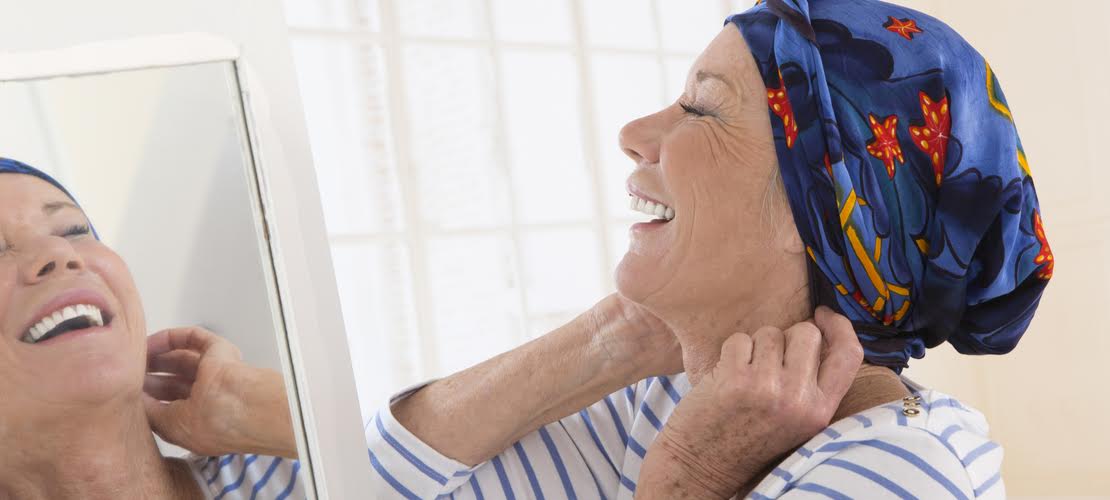
To soften the psychological impact of hair loss, you can consult hair prosthesis specialists or medical and social hairdressers who specialise in this area. They can suggest the most suitable haircut before your treatment begins and a range of available solutions, such as synthetic or natural hair prostheses, cotton turbans, fringes and more. Or you can simply wear a hat, a cap, a beret, a knitted beanie, a scarf, or nothing at all.
"Five years ago, I was diagnosed with an aggressive cancer that meant 18 months of chemotherapy, during which I was completely bald. I tried wearing a wig, but it just wasn't me. So I started tying turbans around my head because they made me feel as though I was styling my hair. But as I had no eyebrows or eyelashes, it was a bit too stigmatising. Step by step, I came up with the idea of a false fringe that stays on the head thanks to a patented system, over which you can wear a cap or a turban. Thanks to this invention, I felt I was sharing the creation of Franjynes with other people. It allowed me to regain my identity and my self-esteem. I hadn't chosen my illness, but I now had the choice of finding a new way of coming to terms with these visible, heavy-to-bear signs." Julie Meunier, founder of Franjynes – lesfranjynes.com
Throughout your treatment and until your hair grows back, wash your hair with an ultra-gentle shampoo the day before your treatments and wait at least 4 to 5 days before washing it again. If your hair is very dry, use a repairing lipid-based shampoo (or a conditioning shampoo for very dry hair). To dry it, gently blot it with a towel. Avoid anything that could weaken your scalp (such as hairdryers, straighteners, curling tongs, heated rollers, perms, colouring, plaits and buns), even for several months after your treatment ends. If you have lost your hair, you may feel itching or the sensation of having "sore hair". In that case, gently massage your scalp every day with a nourishing treatment or an anti-itch emollient. This massage is particularly good for stimulating circulation and helping you to relax.
In the majority of cases, hair grows back once treatment has finished. It generally reappears 4 to 6 weeks after the last chemotherapy session, sometimes even earlier, depending on how long the body takes to completely eliminate the strongest drugs used in the treatment. Hair will continue to grow at an average rate of one centimetre a month. Don't be surprised if, at first, your hair no longer has the same colour or texture. It may be thicker and curlier, and sometimes turn grey. Although the colour may not change back, your hair will regain its original texture after a few months. As hair is often fragile during this regrowth period, it is important to take good care of your hair, or of the fine down that appears at first.
Care: an essential support
Taking care of your body, your well-being and your image is far from superficial during an illness. On the contrary, care teams have noticed that it can even have beneficial physiological effects, such as lower blood pressure and less muscle tension, reduced general stress and nausea, better acceptance of treatment and, above all, the chance to bring a smile back to people's faces.
Source: Practical Guide – Cancer Support by La Roche Posay
 Health
 Health
 Health