
Hearing loss knows no age: Lauren was barely 17 when she got her hearing aid
In our frantic society, silence is a prized commodity. But what if you are hard of hearing, and soundlessness turns from a blessing into a curse? The ordeal of hearing loss is a problem that affects people of all ages, as Lauren testifies – some four years ago, she learned first-hand that hearing damage is not necessarily a preventable affliction. Yet on that fateful Thursday she should really have been somewhere else: "I had an appointment in Brussels, but in the end I wasn't given permission to miss the lesson. It's rather painful when you think about how it could all have turned out differently."
Translated from Dutch. Original title: “Gehoorverlies is van alle leeftijden: Lauren was amper 17 toen ze een hoortoestel kreeg”
Something was badly wrong
On 17 May 2018, the spring sunshine offered a perfectly good excuse for a game of baseball. The heat, after all, wasn't as sweltering as it is in the summer months. Lauren quickly joined her teammates and chatted with the teacher for a while before the game began. But people are competitive creatures, and the opposing team was growing less patient. "I didn't see the ball coming until it was too late. A shockwave of pain tore through my right ear, which took the full force of the blow. Then everything went black."
A little later, Lauren woke up in a wheelchair. Her eyelids felt heavy, her head was shrouded in fog, and every breath felt like climbing a steep mountain. Dazed, she tried to work out what was going on. "Walking quickly proved out of the question, because the blow had badly knocked out my sense of balance. Around my ear there was a pressure bandage with ice, which muffled every sound. We raced to the car like a shot and headed for the hospital, where I was immediately given painkillers." She still didn't realise just how serious things were.
The penny only dropped later that day, when she went to see the ear, nose and throat specialist. "All the tests pointed to considerable hearing loss, and to make matters worse I was suffering from a nasty high-pitched tone that made the sound of fingernails scraping down a blackboard seem like child's play. Tinnitus." She was operated on almost immediately, took medication and was given a cortisone injection directly into the eardrum. For the period that followed, fortnightly hearing tests marked her calendar. "And meanwhile the nights were hellish, because there was no escaping the racket in my head."
Reluctance
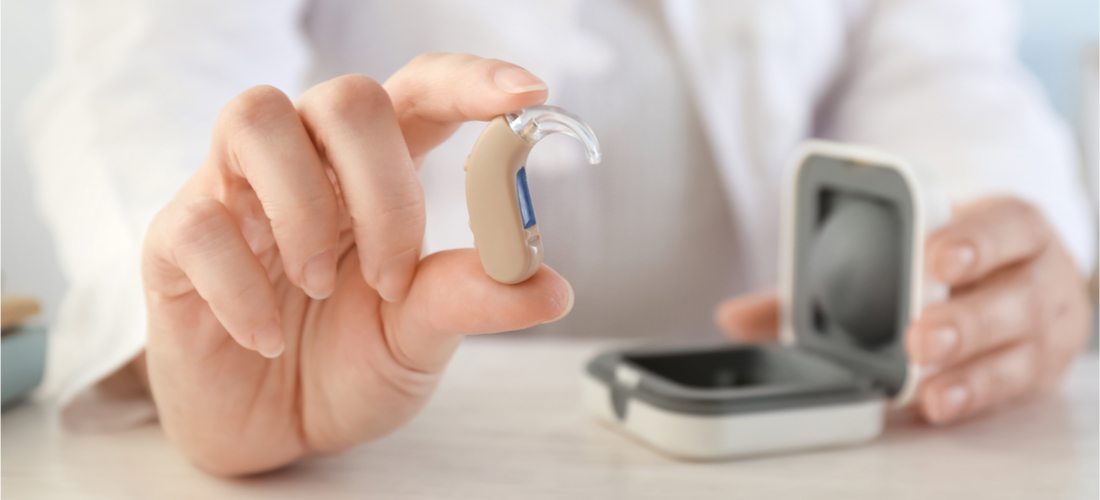
At first, Lauren was hopeful. But as the weeks went by, a cloud of helplessness and frustration took over. For as great as the joy was when the tinnitus finally faded, so intense was the disappointment when her hearing continued to deteriorate and recovery proved to be nothing more than a vain hope. "I ended up with a loss of 95 decibels, could hear almost nothing and could only rely on my left ear." The final verdict? A hearing aid. "And no, not one of those little darlings that nestles in the ear canal without too much fuss. The only thing that would work for me was one of those colossal contraptions that sits behind the ear."
"I resisted it for a long time. A hearing aid doesn't exactly have a trendy image, and as a self-conscious teenager I found that hurdle insurmountable." Meanwhile, she tried to push aside the fact that the need was real. "Watching television at a 'normal' volume was no longer an option, and during hockey matches every ball suddenly seemed to come from the left. On top of that, I could barely follow conversations in the pub, while I myself kept talking louder and louder – with all the snippy remarks that came with it."
Psychological counselling taught Lauren that the situation was becoming untenable, and the realisation sank in mercilessly: a hearing aid would, in spite of everything, spare her a great deal of misery. With a heavy heart and a good dose of reluctance, she headed to the hearing centre, where her eye fell on a device that blended seamlessly with her brown locks.
Ponytail
The hearing aid became her most loyal ally, but also her greatest enemy. For although the benefits are keenly felt to this day, the problem has not been solved: "Everyday, mundane things are less straightforward, and the slightest lapse of attention is punished severely. No batteries on you? Bad luck. Took the device into the shower with you? Double bad luck, especially for your wallet." On top of that, the sound of a hearing aid is reminiscent of the soundtrack of a pre-war French black-and-white film, and she still regularly jumps at the amount of unfiltered stimuli. "Noisy places are then a no-go, which is far from ideal when you work in a restaurant like I do. So now and then I choose not to use my device. Fortunately, I'm quite good at lip-reading, although the mandatory face masks of the past few years threw quite a spanner in the works."
Yet that is not where the shoe really pinches. Lauren remains downright allergic to the unflattering sight of an electronic aid behind her ear. And that personal unease grows in direct proportion to her fear of the reactions of outsiders, whom she prefers to keep in the dark. "For that reason, I will never put my hair in a ponytail while wearing my hearing aid, for example. Not even at home, in front of my family. I simply don't feel strong enough for that yet."
Lack of understanding
"Do I harbour resentment? No, I've come to terms with it by now. Admittedly, for the first few months I blamed the classmates who were responsible for throwing and hitting that ball. One of them was a good friend of mine, which made her part in the incident hit all the harder. But that has been talked through now, because I realise it wasn't done on purpose." Whether the other person felt guilty, however, remains a mystery to her. "Not once did the word 'sorry' slip from his lips, let alone any sign of compassion."
What Lauren does find a pity is the general lack of understanding. "And I'm not just talking about so-called funny remarks like 'put your machine in!' when I have trouble understanding something. After the accident, the school kept insisting that it bore no blame whatsoever, so as to have to share as little as possible in the medical costs. With an average price tag of €3000, after all, you don't just buy a hearing aid on a lunchtime shopping trip, and after four or five years it's due for replacement again. But when we took the case to court, the judge sided with the school. That was hard to swallow, because it felt as if my pain was being played down."
According to Lauren, people often underestimate the impact of hearing damage because it is an invisible ailment. And that ailment reaches further than impaired hearing: "It's a continuous process of grieving, accompanied by a host of mental worries. Along with my hearing, I also lost my self-confidence."
Want to receive the nicest stories from Fifty & Me in your inbox? Then sign up for the newsletter.
 Health
 Health
 Health