
Dermatoporosis: the "osteoporosis of the skin"?
The word dermatoporosis may come as a surprise. Yet it describes something very real: like our bones, our skin can gradually lose its density. That is precisely why dermatologists chose a term modelled on osteoporosis. In both cases, a tissue loses its resilience. Here, though, it is not the bone that weakens, but the skin.
Translated from French. Original title: “Dermatoporose : l’« ostéoporose de la peau » ?”
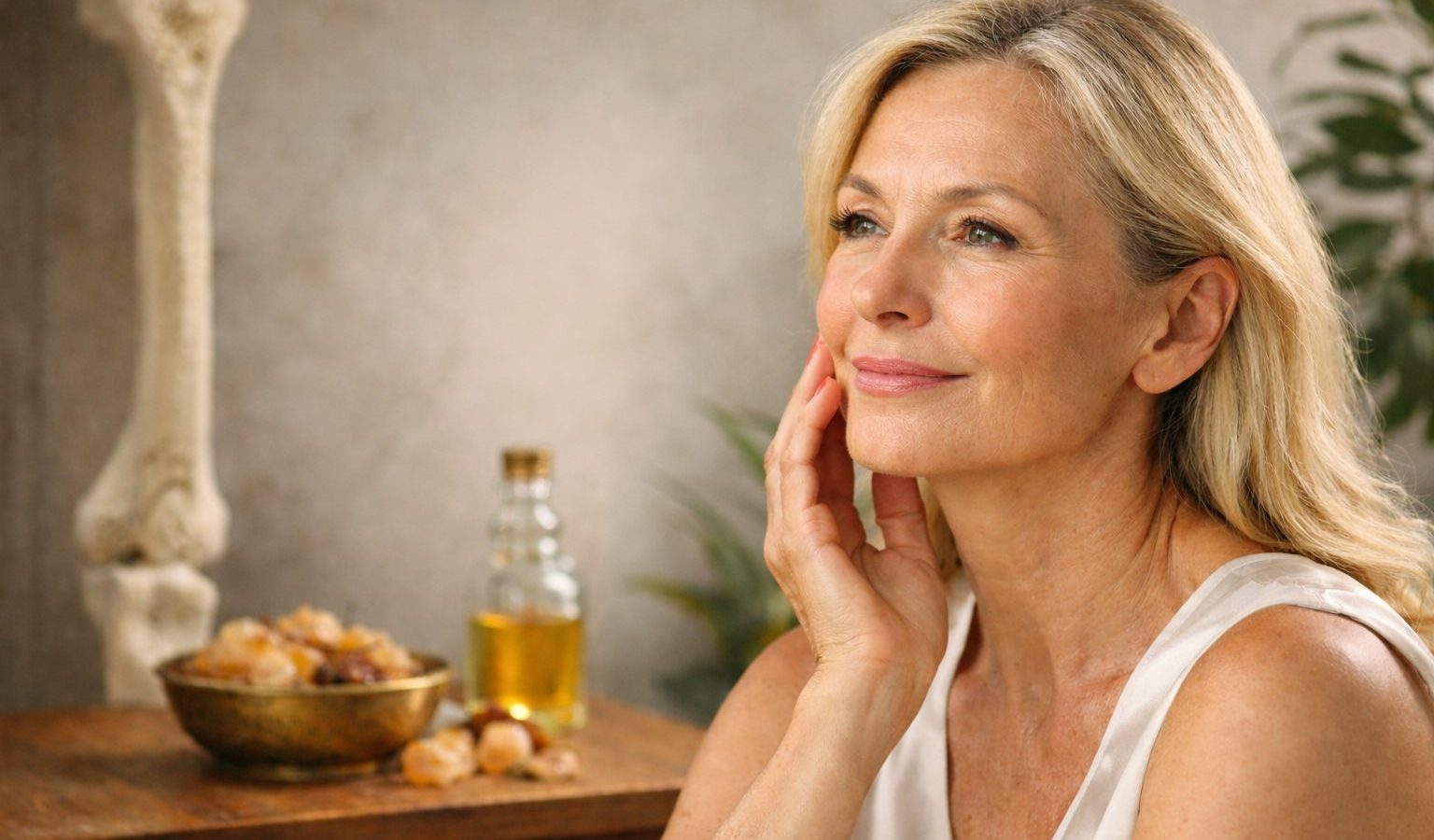
From the perimenopause onwards, the drop in oestrogen brings about a profound change in the extracellular matrix. This invisible structure acts as the framework of the skin. It is made up mainly of hyaluronic acid, collagen and elastin – three essential components that give skin its density, elasticity and firmness.
When this matrix becomes depleted, the skin changes in character. It becomes thinner, more fragile and drier. It marks more easily and can crease readily. Bruises also appear more quickly, particularly on the forearms and the décolleté. Dermatoporosis is therefore not simply a matter of wrinkles: it reflects a structural weakening of the skin.
A common condition after 50
Long overlooked, dermatoporosis is now better recognised by dermatologists. Studies suggest that it affects nearly 30% of women by the age of 60, and that it progresses naturally with age.
Some areas of the body are particularly affected: the face, arms, décolleté and inner thighs, where the skin becomes thinner and more vulnerable.
As with osteoporosis, prevention plays a key role. Specialists now recommend acting from the age of 40 or 50, in order to preserve the quality of the skin's matrix and slow the loss of density.
Hyaluronic acid, the key to skin density
Hyaluronic acid sits at the heart of the skin's structure. Naturally present in the dermis, this molecule acts like a sponge, holding on to water and maintaining the skin's density.
With age, its production gradually declines. But something else happens too: its breakdown speeds up under the action of specific enzymes. The skin is thus caught in a paradoxical situation: it produces less hyaluronic acid and destroys it faster.
This is why some experts now recommend low-density hyaluronic acid, which can reach the dermis and support the skin's matrix more effectively at depth.
Boswellia resin, an ancient beauty secret
Boswellia resin is attracting growing interest. Used for centuries, it was already known as a beauty ointment among Indian princesses.
This resin has natural anti-inflammatory properties that help limit the activity of the enzymes responsible for breaking down hyaluronic acid. By protecting this vital molecule, it helps maintain the balance of the extracellular matrix and preserve the skin's density.
Another notable advantage: this natural ingredient is well tolerated and has no side effects.
A new approach to skincare after the menopause
Dermatoporosis is changing the way we think about skincare after 50. The aim is no longer simply to smooth wrinkles or moisturise the surface of the skin. It is now about strengthening the skin's structure, by supporting the extracellular matrix and protecting the hyaluronic acid already there.
Some recent formulations therefore combine hyaluronic acid with protective active ingredients, working both on supply and on preservation of this key molecule. Textures are generally light, non-occlusive and well tolerated, out of respect for the sensitivity of skin that has become more fragile.
Prevent rather than repair
Dermatoporosis is best tackled early. Understanding it makes it possible to adopt preventive strategies from our forties: supporting the skin's matrix, preserving hyaluronic acid and choosing products suited to the needs of skin in transition.
Because after the menopause, beautiful skin no longer depends only on hydration or radiance. Above all, it rests on the strength of its foundations.
 Health
 Health
 Health