
Beetroot juice: 5 reasons to raise a glass
Usually eaten raw, beetroot proves just as delicious in juice form. Admittedly, it doesn't offer quite the same pleasure as a good glass of champagne, but its many benefits work in its favour.
Translated from French. Original title: “5 bienfaits du jus de betterave”
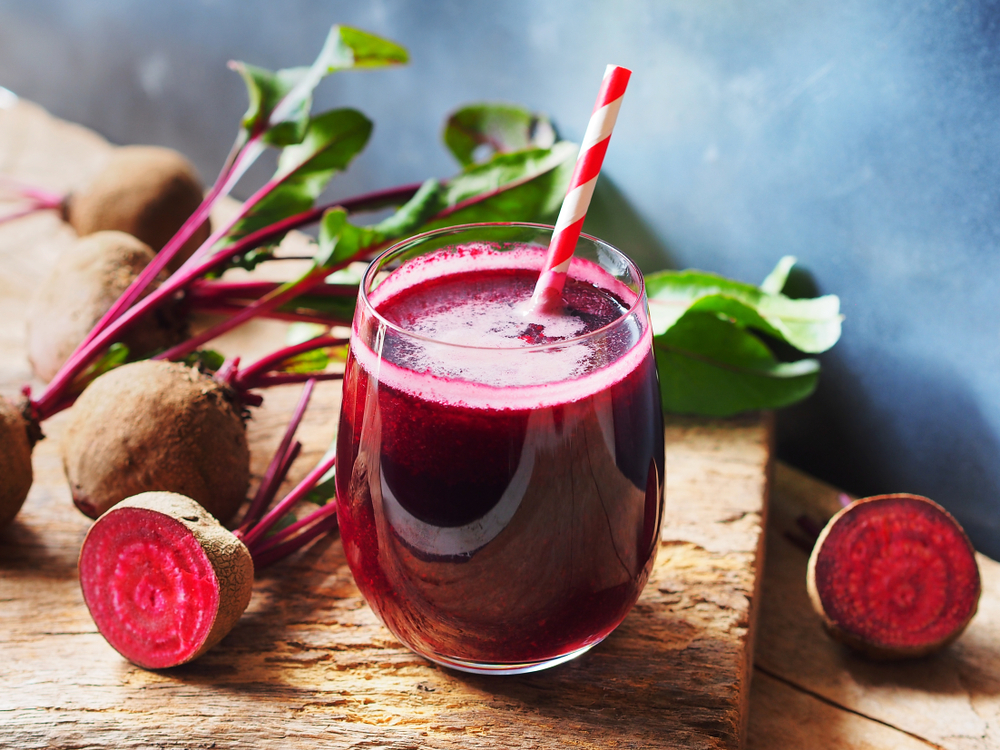
A generous vegetable
A subspecies belonging to the Amaranthaceae family, the beetroot, with its many uses, is a root vegetable that deserves its place on our plates. Less for its taste than for the richness of its components: vitamins, antioxidants, minerals, nitrates... Beetroot contains betalains, powerful antioxidants that give beetroot its red colour, vitamins A, B1, B2, B5, B9, C, E and K, fibre, but also minerals and trace elements. These include magnesium, potassium, manganese, iodine and iron.
As for the leaves, which are rich in chlorophyll and nutrients, they can be prepared like spinach. They have, in particular, a positive effect on vision and its disorders.
The 5 benefits of beetroot
This root vegetable is far from stingy when it comes to supporting our everyday health. As these five positive points show:
A low-calorie vegetable. With barely 40 kcal per 100 g, the vegetable fits perfectly into a slimming diet.
Rich in antioxidants. Betalains and vitamin C work together to fight free radicals and slow cellular ageing.
Stimulation of appetite and digestion. A useful effect after an operation or an illness, when you need to rediscover the desire to eat. Beetroot also aids digestion.
A detoxifying effect. Beetroot promotes the elimination of toxins and the cleansing of the body. An ideal juice to counter any excesses over the festive season.
A reduced risk of cardiovascular disease. An effect reinforced by the presence of nitrates (more than 150 mg per 100 g of vegetable). Thanks to their vasodilating properties and their protective action on the cardiovascular system, nitrates help reduce the risk of stroke and high blood pressure.
Beetroot juice: how to make it
Nothing is simpler or quicker than making yourself a beetroot juice. After an indulgent spell, after a workout (to help you recover from the effort), or simply for everyday upkeep of the body, any occasion is a good one for making a juice. All you need is a juice extractor to hand. The appliance helps to preserve more of the nutrients and vitamins. Beetroot can be combined with other vegetables to boost its effects. Carrot, for example, is antioxidant and rich in B vitamins. For a little tonic, sweet touch, adding lemon juice and apples works perfectly. And to increase the detox effect, choose ginger. For two glasses, you will need: 1 beetroot, a cup of water, two carrots, two apples, one lemon and about 5 centimetres of ginger.
Beetroot juice keeps for up to four days in an airtight bottle. But it is best drunk immediately.
Photo Shutterstock.
 Health
 Health
 Health