
All the Benefits of Lime Blossom
Admittedly, for a bon-vivant fifty-something, a cup of lime blossom tea will never taste quite like a glass of champagne. But when it comes to health benefits, the lime tree wins hands down. From leaf to flower, every part of it has something to offer.
Translated from French. Original title: “Tous les bienfaits du tilleul”
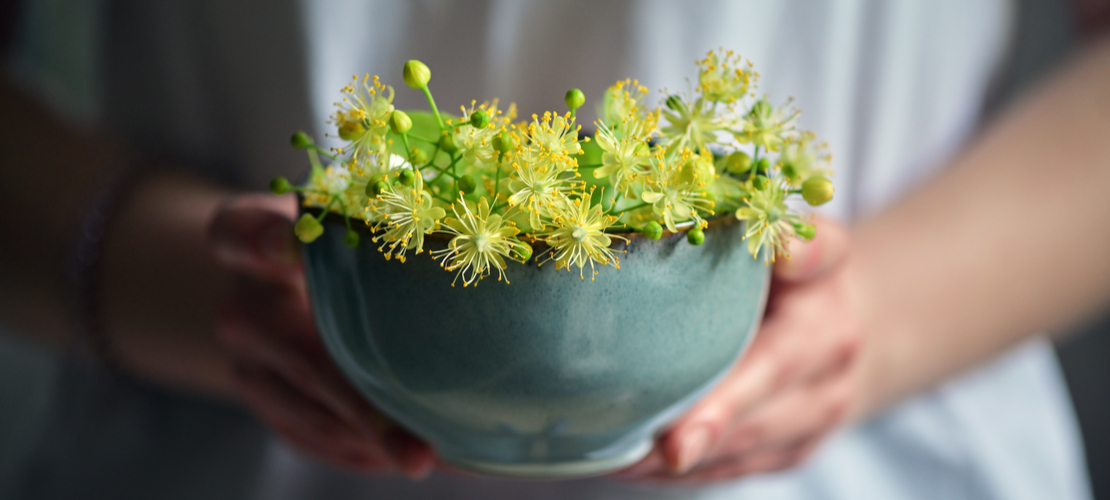
The lime tree at a glance
From the Latin tilia, the lime tree can be planted just about anywhere in our green spaces. Common and easy to grow, it stands out for its great height, which can reach 30 to 40 metres, and for the delicious scent of its blossom (from mid-June to mid-July), which is similar to honey and very attractive to insects. In herbal medicine, three species of lime tree are used in particular: the small-leaved and large-leaved limes, as well as the variety known as Dutch lime.
A heavyweight ally for beautiful skin
Used externally as a decoction, lime blossom reduces and removes impurities from the skin thanks to its flavonoids. These pigments also soften those notorious hyperpigmentation spots. For drier skin, applying lime blossom helps to retain water and keep the skin well hydrated. The skin is also protected by antioxidant polyphenols, which work against skin ageing. This protective effect can also be found in lime blossom shampoos.
Other benefits of the lime tree
For anyone who suffers from sleep problems or anxiety, two complaints that often go hand in hand, lime blossom proves more than beneficial. A cup of lime blossom tea is perfect for easing mental overwork. Yours, or your children's during exam time.
As for the sapwood, used as a decoction, it is not to be outdone, with a purifying action on the intestines, liver and kidneys. The sapwood also improves digestion thanks to its beneficial effect on bile production. Taking it also helps to reduce and relieve nausea, bloating and flatulence. The sapwood is often recommended as a detox course to follow at every change of season.
How to take lime blossom
With the lime tree, two parts are mainly used in herbal medicine: the leaves and the sapwood. Both are easily available from pharmacies, herbalists and the organic aisles of shops. You can even gather the leaves yourself, straight from the tree out in the countryside, then dry them or even eat them fresh, in a salad, for example. Lime blossom can be taken as a decoction, as an infusion, in capsules or as a macerate. It can also be added to your bath water as a decoction, for a soothing effect that is perfect before bedtime.
Any contraindications?
The lime tree poses no particular danger and has no known interactions with medication. However, if you are prone to kidney problems, it is best to ask your doctor for advice before relying on lime blossom as a health ally. This applies especially to those who easily develop stones (kidney or gallbladder). The same advice applies to your dermatologist, as lime blossom can cause skin rashes in some people.
 Health
 Health
 Health