
Why padel is worth a try at 50
Sport and its constraints. A cliché that padel is firmly putting to rest. A sport that has become hugely popular with the over-50s, who for so long stayed loyal to tennis. Easy to learn, inexpensive and packed with benefits. A sociable sport that quickly becomes addictive. Should it be dismissed as a passing trend? Not at all: it is rather a genuine revolution in the way we exercise, recommended for staying in top form. Physically and mentally.
Translated from French. Original title: “Pourquoi miser sur le padel à 50 ans ?”
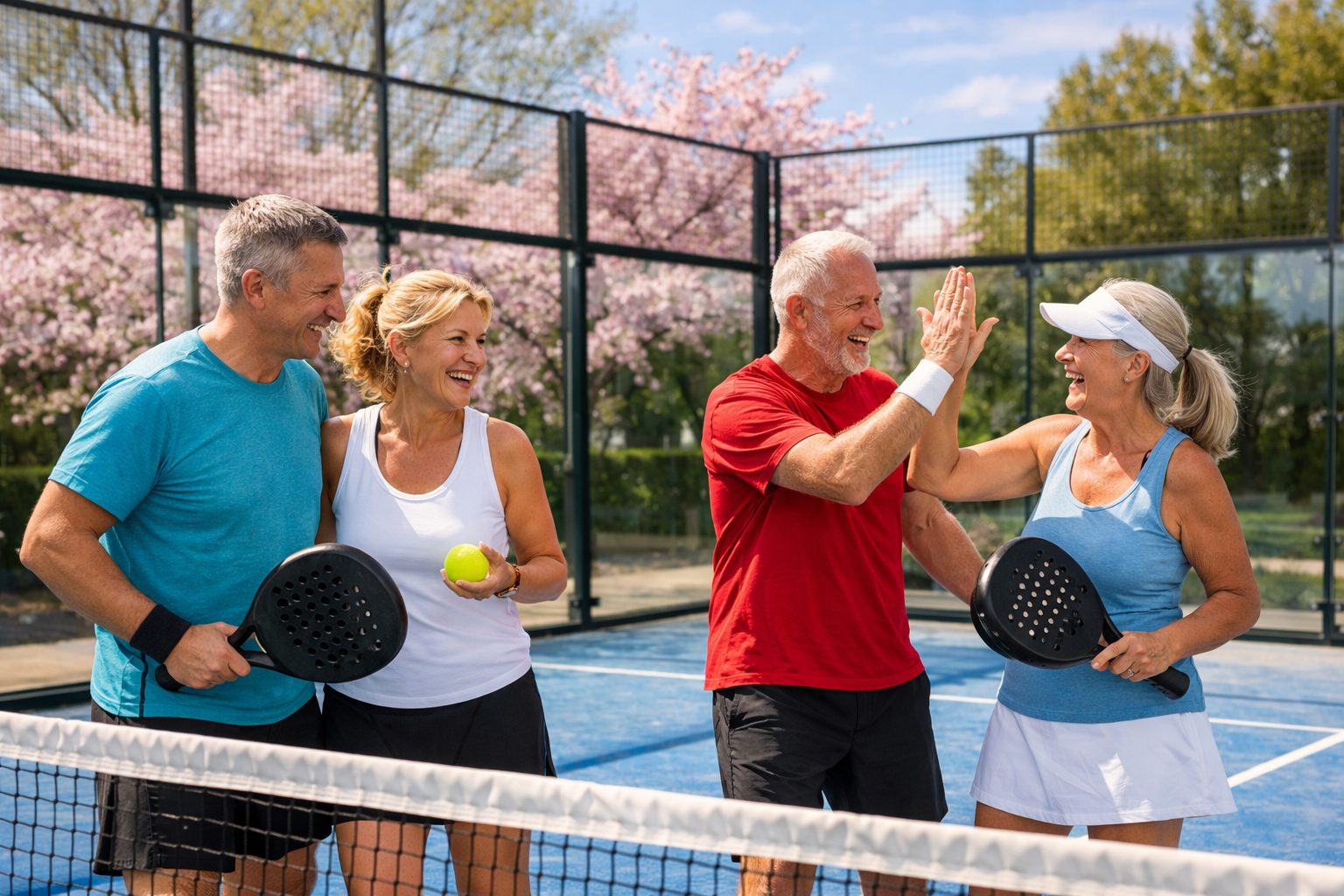
A worldwide success
Unlike many of today's trends, padel is nothing new and did not come from the United States. Its roots go back to 1969, and more precisely to Mexico. It all began with a lack of space in a garden for playing tennis. Resourceful as ever, Mexican businessman Enrique Corcuera decided to create a small court measuring 20 x 10 m, surrounded by walls some 3 metres high, to avoid losing his tennis balls. His racket was nothing like those used today. It was a simple flat wooden paddle. This new sport, still on the fringes, spread first to Spain and South America before arriving in France, and then elsewhere, in the 1990s. Initially seen as a curiosity, padel has now become THE sport of the moment.
A discipline with many benefits
Is padel really accessible at every age and level? We put the question to David Moens, a sports coach: "Without a doubt. There is no need for a solid sporting background to get started. At fifty, or even older. On the contrary, it is especially well suited to beginners or those who are out of training, thanks to the smaller court and the fact that the effort of a match is shared between two players. Unlike tennis, which is very technical, played on a larger court and usually one against one. Taking up padel is easy, as the rules can be picked up in just a few hours of lessons."
As for maintaining physical fitness and boosting mental wellbeing, the sport makes a great contribution, thanks to its many assets. David Moens explains: "An excellent cardio sport, padel improves flexibility and endurance. It also strengthens the muscles of the arms and legs, which are prone to sarcopenia, the loss of muscle mass that sets in from the age of fifty." Playing padel, in pairs and in a confined space, can also help to reduce certain cognitive difficulties linked to the menopause, such as problems with coordination, concentration or spatial awareness.
It is also a positive discipline for boosting mental wellbeing, which is every bit as important. As a match is played in pairs, padel stands out for its conviviality. You meet people, play with friends and/or make new ones. On court, but also over the traditional drink shared by the players after the match. Ideal for people on their own looking to build a social circle. And perfect for forgetting the stresses of daily life, whose harmful effects on health are well known.
"A match can also be played across the generations, with the (grand)children up against the (grand)parents. A fun way to strengthen family ties. You just have to adapt your game," the coach points out.
Where and how to start playing padel
Where can you find a club to start playing padel? With the exceptional enthusiasm the sport has generated, clubs are springing up all over Belgium. To find the club closest to you, go to www.afpadel.be/les-clubs/. Simply enter your postcode to get the contact details of all the clubs and courts available in your municipality.
And what about the cost? The hourly price of padel lessons is not fixed and depends mainly on the options chosen, such as a group or individual lesson. The average hourly rate is 50 euros, with group lessons costing less. As for equipment, the price of an adult (beginner) padel racket can range from 90 to 190 euros depending on the brand. Choose a light, round-shaped racket to begin with. Balls will not break the bank either, with a budget of 5 euros for a set of 3. Shoes should have good grip and offer solid support for the feet. This is the one purchase on which not to skimp on quality, at the risk of possible injuries. The clothing is the same as for tennis.
 Travel
 Beauty
 Beauty