
Scuba diving after 50: take the plunge
Summer is often the ideal time to turn dreams and desires into reality. To try a new sport or discover new sensations. Like scuba diving, a discipline that is growing fast. It is a wonderful way to explore the silent world so dear to Commander Cousteau. And one that suits fifty-somethings perfectly, provided they prepare well and are guided by professionals.
Translated from French. Original title: “Découvrir la plongée avec bouteille après 50 ans”
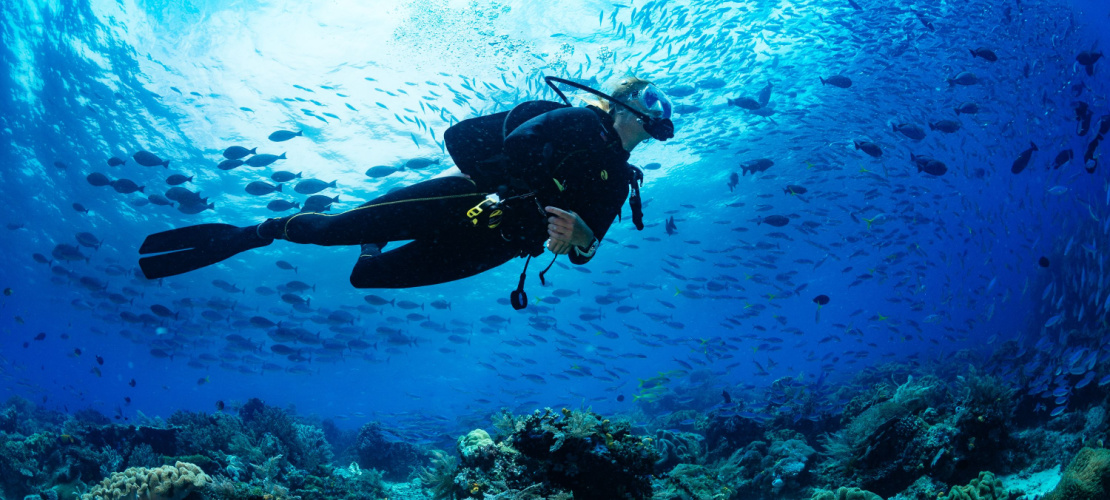
Diving: a sport open to all, whatever your age
Is it still possible to learn scuba diving in your fifties, or even later? "Yes, absolutely, but you have to take your physical limits into account, and a lower level of endurance than in your twenties," explains Jacques Lorient, sports coach and experienced diver. "An older diver, supervised by an instructor, will have to respect what is known as a safety stop, at a maximum depth of 30 to 50 metres. And avoid diving too quickly, so as not to damage the eardrums, which are more fragile. Lung function is also less good with age. As is the cardiovascular system, which copes less well with exertion. Finally, beyond a certain age, there may be a risk of decompression sickness. The basic principle is always to listen to your body and never to force it." It is also a sport that means adapting your gear to the season, the temperature and the depth of the dive. This helps to avoid any risk of hypothermia, which increases with age. Many divers therefore favour destinations with warmer waters, which allow them to wear a lighter suit, known as a wetsuit (3 mm neoprene).
Tips to make the most of diving
"Diving is a complete and magical sport, but let us not forget that the environment in which you are moving is dangerous. Divers follow one unchanging rule: listen to your body and your instinct. If you feel tired, or if you simply don't feel like diving, it is better to abstain and put the dive off to another day. Before diving, you should always make sure you are well hydrated, because a one-hour dive causes the loss of nearly a litre of water," explains Jacques Lorient.
The need for a positive medical opinion
Scuba diving requires good physical fitness and, above all, a visit to the doctor. Preferably a diving doctor, or one who specialises in hyperbaric medicine, as they are more used to handling the examinations linked to the sport. The standard check-up includes an ENT examination, an electrocardiogram and an exercise test (known as the Ruffier test). Further tests may be prescribed depending on the patient's physical condition. The state of your back will also be examined. It must be able to bear the weight of a tank (10 to 15 kg). The doctor will also ask about any medication you take, as some can have potentially dangerous effects when diving. Such as neuroleptics and antihypertensives. This compulsory annual medical examination also includes an eye test. A diver must be able to read the readings on the instruments underwater correctly.
Photo Shutterstock.
 Travel
 Beauty
 Beauty