
Restorative yoga: the perfect way to release tension
Looking for a resolution that is pleasant and easy to keep? Here is one: set aside more time for yourself and rediscover a greater sense of calm. Nothing could be simpler with restorative yoga, a welcome pause in the middle of your day. A laid-back practice with just one aim: to bring you to a state of optimal relaxation. Sound appealing?
Translated from French. Original title: “Le yoga restauratif, idéal pour éliminer les tensions”
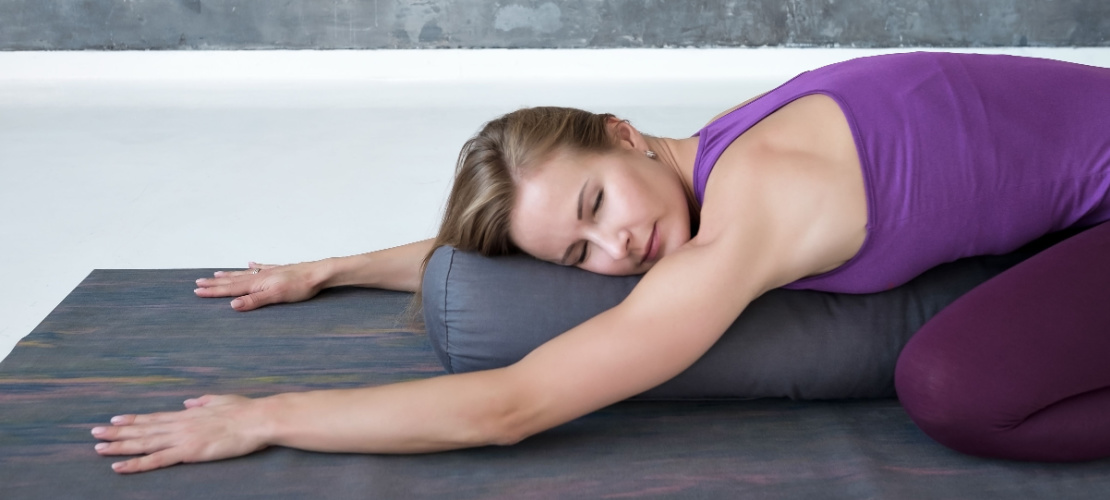
What is restorative yoga?
Good news for those in their fifties who are not keen on strenuous exercises that put joints and muscles at risk. Restorative yoga is a gentle practice that is not meant to build muscle, only to relax the body. It consists of a series of simple exercises combined with breath control. It is ideal for anyone who enjoys a little cocooning, with cushions and thick mats. These make perfect alternatives to classic yoga props, such as the meditation pad or the bolster (a sort of long cushion used in yoga). A pair of leggings and a T-shirt are all you need to wear.
What are the recorded benefits?
To better understand what this variation of yoga can offer, sports coach David Moens explains: "As its name suggests, restorative yoga helps you find a good climate of serenity. It is a zen journey undertaken with yourself, a kind of rebalancing between mind and body. It is an excellent antidote to stress in a busy, anxiety-inducing daily life. Practised at the end of the day, this yoga also brings you to an ideal level of relaxation to encourage sleep, which can sometimes be hard to find during the menopause. Restorative yoga is often recommended to people prone to anxiety or depression, with real, proven effectiveness." It takes up little time and is flexible. It can be practised at any moment of the day, as a relaxing break for those who work from home.
How does a session work?
This variation of yoga is defined by its simplicity and ease of execution. It is therefore suitable for a wide audience, whatever their age, and requires no prior experience. As a precaution, you may wish to seek medical advice before you begin, to identify any contraindications linked to your state of health. For a full session, a little under an hour is enough to complete a sequence of several postures, but the length can be adjusted to the time you have available. What matters is to practise regularly. A session consists of a series of 4 or 5 postures (asanas), each held for around ten minutes, performed after Pranayama exercises (breathing work). These exercises are explained and demonstrated on YouTube channels dedicated to restorative yoga. As David Moens explains, "a session generally ends with a position well known to yoga enthusiasts: savasana, translated as the corpse pose. It is a vivid name that sets the tone: you lie on your back, eyes closed, body completely relaxed. Be careful not to fall asleep. This position, held for around ten minutes, requires a state of awareness so that you can enjoy the sense of fulfilment reached during the session. It is a conclusion that lets you listen to your body and relax fully, in a state of total letting go, before gently resuming your everyday activities."
Photo Shutterstock.
 Travel
 Beauty
 Beauty