
Karate for health: the ideal anti-ageing sport
Forget the clichés about karate peddled by the cinema. Yes, karate is perfectly suited to women over 50. With the right supervision, it brings wellbeing and self-confidence. It is a combat sport, but without the stakes. It does, however, call for medical advice before you step onto the tatami.
Translated from French. Original title: “Le karaté santé, le sport anti-âge idéal”
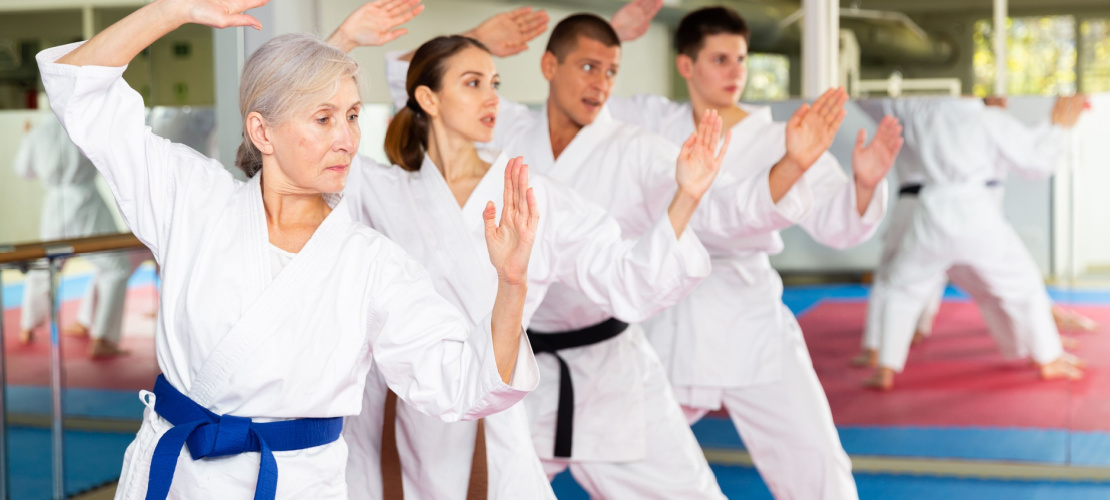
Karate for health: what is it?
Derived from karate, karate for health is aimed at a mixed audience aged 50 and over. It is for those who want to enjoy the benefits of a martial art without the risks inherent in the discipline. The exercises are adapted and free of movements that are too intense or likely to cause falls. It is a non-traumatic sporting activity that requires no previous sporting experience. To find a club near you, visit the website of the Fédération francophone de karaté.
What are the benefits of karate?
Why is karate recommended for people in their fifties and beyond? This martial art works every muscle in the body, through the various techniques to be learned and performed. But karate for health also helps to correct or eliminate problems linked to the passing of time:
Improved balance through better body posture, with a reduced risk of falls and therefore of fractures.
Sharper cognitive abilities, such as the coordination of movements and the work of memory needed to absorb and reproduce them.
Greater alertness and quicker reflexes, to parry the (pretend) blows delivered by partners and to react faster in a given situation.
Greater joint flexibility and the maintenance of muscle mass.
It is a perfect sport for people who live alone and want to build social connections. It is also ideal for gaining self-confidence and learning a few self-defence moves.
What happens in a session?
At the mention of karate, clichés can dampen enthusiasm: the fear of getting hurt, of a fall or of a bad blow. Sports coach David Moens is reassuring: "This fear, though quite understandable, is unfounded. With karate for health, there is no competition to prepare for and no blows are landed. The coach focuses mainly on the technical side of karate, with the right movements performed gently. Everything starts with a series of warm-ups. The session is then built around three phases: technical movements learned as a group (khions), movements and postures performed alone, facing an imaginary opponent (kata), and finally simulated fights in pairs, but without contact (kumite)." Several YouTube channels give you an idea of this sport before you push open the door of a club, such as TV78, which offers a full report here.
What precautions should you take beforehand?
A medical check-up is sound advice before starting this discipline, in particular to gauge your resistance to exertion and to detect any cardiovascular problems. Medical follow-up will then help you manage any minor ailments that may arise, such as a dislocation or a fall.
Photo Shutterstock.
 Travel
 Beauty
 Beauty