
Fifty reasons (and then some) to take up golf
Since the start of the health crisis, outdoor sports have been enjoying a surge in popularity. They are easier to practise and carry less risk of infection. And golf is one of them. It is often labelled a rich person's sport, a mostly male one, an exhausting one. These are all misconceptions that the golf federations are working hard to dispel. With some success, judging by the variety of players on the courses. Women, men, young and old. Forget the outdated, sexist acronym that once did the rounds in golfing circles: "Gentlemen only, Ladies forbidden." Today, women have won their place on the course, with handicaps equivalent to those of men.
Translated from French. Original title: “Plus de cinquante raisons de commencer le golf”
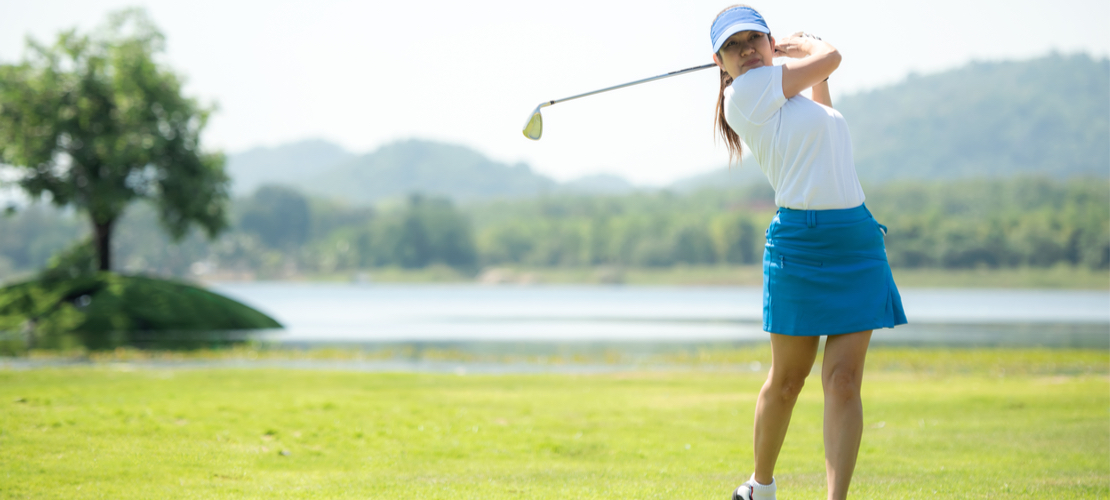
So why not join the 63,000 or so Belgian women golfers (2016 figure)? They make the most of the 90 golf clubs in Belgium open to them. Their game is admired by their male counterparts, who rate their swing as smoother, more harmonious and more consistent. As yours no doubt will be after a little regular practice.
If you are thinking of taking up golf, keep this quote from Marilyn Monroe in mind: "A smart girl is one who knows how to play tennis, golf and the piano." Even if her screen performances remain more memorable than her swing.
How do you get off to a good start?
The first mistake is trying to learn on your own. As sports coach Adrien Schollaert explains: "Going it alone is certainly not the right way to start golf. There are several reasons for this. The first, and the most important, is that you risk picking up bad techniques right from the outset. This is what we call muscle memory, and it is hard to correct afterwards. You end up playing with imprecise, ineffective movements that are also potentially harmful to your health, with a risk of tearing a muscle. And that is without mentioning the damage you could do to the course with badly judged shots. Without wishing to preach to the converted, you are better off taking at least a few hours with an instructor, if only to benefit from their advice on the right movements to adopt."
A sport with many health benefits
Why take up golf in your fifties? And what will it do for my health? These are probably two questions that women in their fifties ask themselves while still hesitating to step onto the course. Yet there is no cause for concern, given the low risk of injury. "There is no recommended or maximum age for starting golf. I coach players both young and old, some well into their seventies. The nice thing about golf is that it can bring generations together. It is not unusual to see grandparents playing with their grandchildren," Adrien Schollaert adds.
Getty Images
Physically, golf is an endurance sport based mainly on walking. A round of 18 holes generally covers a good ten kilometres. It is perfect for strengthening joint and cardiovascular health, and ideal for the heart, helping to reduce high blood pressure and cholesterol. Isn't it said in golfing circles that playing regularly can add five years to your life expectancy? Why not take advantage?
What is more, between the shots and the walking, you will burn calories, all to the benefit of your figure. Another benefit of golf is improved balance, which often becomes more fragile with age. Better balance directly reduces the risk of falls and fractures.
As for muscles, golf gives a wide range of them a real workout, called upon by the technical movements. These include the glutes, shoulders, wrists, thighs and calves in particular. It is a well-rounded sport, generous with its benefits.
And the benefits are not only physical, but mental too. Playing golf is not just a matter of hitting a little white ball from one hole to the next. The game also demands constant concentration and thought, excellent exercise for keeping the mind sharp and slowing the effects of neurological ageing.
The soothing setting of a golf course and the fact of playing in the open air also have an anti-stress effect, capable of making you forget the worries of daily life. At least if you remember to switch off your smartphone at the start of the round.
It is also a sport that guarantees social contact between players. By playing at the same club, you will end up getting to know other players. This is ideal for people who are isolated, who will find people to share a round with on the course or in the clubhouse. Many business partners also discuss contracts or deals on a golf course, enjoying the fresh air as well as total discretion, far from prying ears.
As for drawbacks, there are none to speak of. Nevertheless, it is advisable to consult your doctor, just to be on the safe side, if you have heart, joint or lung problems. And be sure to warm up properly before you start. Don't forget to follow the safety rules set by the club either, or you risk being hit by a stray ball, the only major risk of this sport.
What equipment do you need?
To play effectively and make progress in the best conditions, you need to get the right kit for the perfect little golfer, with the benefit of sound advice from specialist sales staff or experienced players. To get started without spending too much, you can opt for a complete starter set (seven clubs is plenty), specially designed for the female physique, with shorter, lighter clubs that are perfect for women's golf. Although clubs hire out equipment, it is still better to buy your own, so that you can play whenever you feel like it, anywhere. Allow an average budget of between €500 and €1,500.
To carry your equipment, you will also need a bag. Choose a light one so that it does not become a burden on the course. A useful accessory, the pitch repairer is a must for anyone who wants to look like a pro who respects the condition of the green. Finally, don't forget tees (to raise the ball) and balls. You will lose a lot of them at first, so there is no point buying expensive ones, such as Penfold balls, reproductions of those used by James Bond in Goldfinger. Instead, go for ranges of balls suited to women's striking power, such as Wilson or Callaway.
You cannot, and are often not allowed to, play in just any sportswear. Think about an outfit suited both to the standing of the club and to your comfort during the round. Women's collections are available to keep you elegant right out on the course. Trousers should have deep pockets to hold the balls. A polo shirt is very often compulsory, so choose one in a breathable fabric. In summer or when it rains, a cap will prove useful. So will a golf glove, which protects you from irritation and ensures a secure grip. It is worn on the left hand if you are right-handed and on the right for left-handers. The key items of the outfit, golf shoes can be chosen with or without spikes. It doesn't matter which, but they must let you keep your balance without any risk of slipping.
You're ready to start. What next?
For anyone wanting to take up golf, the best way to go about it is to seek advice from several clubs, to find one near you with facilities that will help you progress, with a coach and a good practice range. A good tip is to look at the Belgian Golf Federation's website, https://afgolf.be/trouver-un-club/ and, for the Dutch-speaking side, https://www.golfinflanders.com/nl/clubs to compare clubs. Don't limit yourself to a single choice, but try several clubs to compare what they have to offer beginners, such as free introductory sessions, then individual or group lessons.
What type of training should you choose? It all depends on what you are looking for. To learn quickly and well, individual lessons remain the best solution. For a smaller outlay, group lessons let you meet other beginners and progress together. A third option combines all the advantages: the course. It offers theory lessons and intensive practice. Costs differ from one club to another. It is up to you to visit a few near you and compare the prices asked against the facilities and courses. These clubs let you practise on the driving range or begin rounds of 6, 9 or 18 holes depending on your level, or rather what is known as your playing handicap, a number that indicates a golfer's ability at the start of a round. The lower the handicap, the better the player. But let's close that parenthesis.
As with any sport, it can be wise to take out golf insurance, to cover you in the event of theft of your equipment, damage to your vehicle from a ball, injuries, damage caused to the course, and so on. Please note that all holders of the federation card are insured with Ethias by the Flemish and French-speaking golf federations. This insurance is valid worldwide and covers both civil liability and personal injury. Some insurance companies offer an additional policy that provides compensation for damage to golf equipment, refunds your membership fee (after an accident, for example), pays out for a "hole in one" (when it is customary to buy a round of drinks!) and covers equipment hire (in the event of theft, for example). Your broker will be happy to tell you more!
Before you play: a few guidelines to follow
First of all, you must have a federation card to play at a club. As a beginner, the club will get you a startpas. This is a trainee card, which you will receive if you have opted for a course (of at least one month) at your club. It gives you all the benefits of the federation card (for a maximum of one year). The federation card (€60) is compulsory to have access to your club's facilities and to be covered by the insurance. It is tied to your club (if you change clubs, you will need to apply for a new card). How do you get one? Nothing could be simpler: you just need to join a club (recognised by the Royal Belgian Golf Federation), which will order your card for you (valid for three years). But the card is not everything. To have access to the 18-hole course, you will need to prove that you have passed the technical, practical, 4-hole and theory tests. To learn the basics and the techniques you need to obtain your certificate of proficiency (BAG), several associations offer introductory courses. The certificate of proficiency is regulated by the FRBG (Belgian Golf Federation, https://golfbelgium.be/fr/ and https://golfbelgium.be/nl/), the AFG (French-speaking Belgian Golf Association, https://afgolf.be/) and, for the Dutch-speaking side, the VVG (golfvlaanderen, https://www.golfvlaanderen.be/).
Your club will also ask for an annual membership fee, the amount of which varies according to age. Some clubs also ask for a (modest) contribution towards the club's investments.
The federation card lets you play in Belgium and abroad. It also lets you support your club and take part in competitions. You may be offered what is known as a Mifare card, a smart card with an electronic chip and various options designed to make life easier at the club. It used to be customary to pay an entrance fee to join a club. This practice has become a minority one, with only one club in ten still requiring new members to be sponsored.
Finally, you still have a choice to make: join a club or opt for green fees (the price a player pays to access the golf course). It all depends on you. If you plan to play often at the club near you, membership is better value, since it lets you play as often as you like. Allow around €600 for six months. On this score, the green fee works out more expensive, at an average of €80. Playing regularly on the same course thanks to membership will also let you meet regular players, get to know them and share rounds with people of the same handicap. Your loyalty is also rewarded by promotions and the club's coaching. As for the green fee, its main advantage is that it gives you access to other courses, for a change of scene and to avoid getting stuck in a routine.
 Travel
 Beauty
 Beauty