
Aerial yoga: a gentle way to work on your emotions
If you think you have tried everything yoga has to offer, a fast-growing variation may well prove you wrong. Aerial yoga, or fly yoga, combines benefits for the body with benefits for the mind. It is ideal for refocusing on yourself and building confidence.
Translated from French. Original title: “Le yoga aérien pour travailler sur ses émotions”
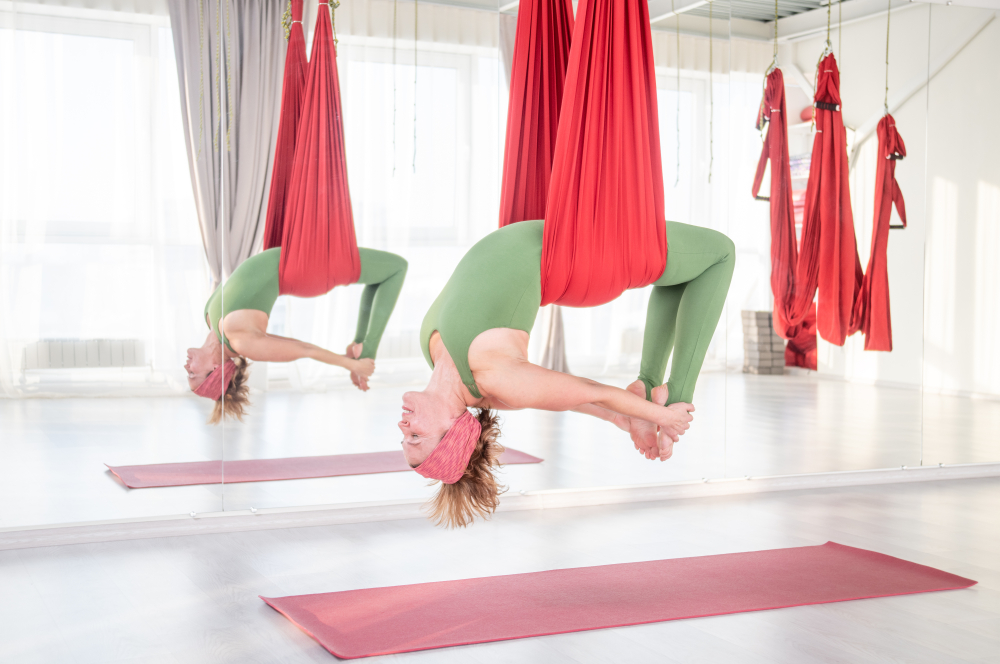
What is aerial yoga?
Fly yoga or aerial yoga: two names for a playful discipline created in 2008 by a sports instructor, Florie Ravinet. Drawing on her passion for yoga and circus arts (with a speciality in aerial ribbon), she had the idea of combining the two practices into a single sport. Aerial yoga involves performing traditional yoga poses, but suspended in a hammock. The concept can seem daunting because of its acrobatic side, yet it turns out to be accessible to a wide audience. Before starting aerial yoga, however, medical advice is still recommended.
The hammock, the essential piece of kit
A discipline built around its one accessory: the hammock. It hangs at a low height, around one metre, either from the ceiling or from the branch of a tree in the garden. The hammock is made from a stretchy, moisture-wicking, non-slip fabric. "It should be seen as a sort of cocoon that encourages relaxation, which is ever-present in the discipline. Practitioners need to feel good in it, so that they feel safe and comfortably settled," says Sonia Coens, a sports coach. As for price, a good fly yoga hammock costs around 150 euros. Online, several brands offer equipment for practising fly yoga at home, including the French brand oya-yoga.fr, whose equipment is certified.
What are the benefits of fly yoga?
- A feeling of relaxation from being gently rocked in the hammock.
- Fun, and even more so in a group session.
- Improved flexibility and balance.
- Greater self-confidence and better management of emotions.
- A stronger connection with your body.
- An anti-stress effect, thanks to the sensation of weightlessness.
- Stronger muscles (abdominals, lower back).
- Relief from back pain.
What does a typical session involve?
Dressed in classic yoga clothing, practitioners begin with a few meditation exercises and some stretches. Next come the yoga poses, repeated in the hammock. The accessory allows participants to alternate movements at height, often upside down. "It is not just yoga, because aerial yoga also draws inspiration from Pilates and from certain 'acrobatic' exercises inspired by the circus. The exercises are demonstrated by the teacher and adapted to the participants. Supervised classes allow the coach to correct poses and reassure beginners, who need time to get to grips with the postures. A session lasts around an hour and combines moments of relaxation with aerial positions. This alternation prevents breathlessness. The aim is not to come out of a session exhausted. Quite the opposite. You could call it a gentle yoga," explains Sonia Coens.
Plenty of tutorials are available on YouTube, including on the channel L'Art et Fact Studio.
Photo Shutterstock.
 Travel
 Beauty
 Beauty