
A balance board to ease menopause
Physiotherapists often use them in rehabilitation, but the balance board, also known as the 'Freeman board', is now also being widely used by fitness fans and runners. This board does indeed help to improve balance, which becomes less steady over the years. It also helps to prevent certain gynaecological problems.
Translated from Dutch. Original title: “Balansbord helpt bij menopauze”
Making the right choice
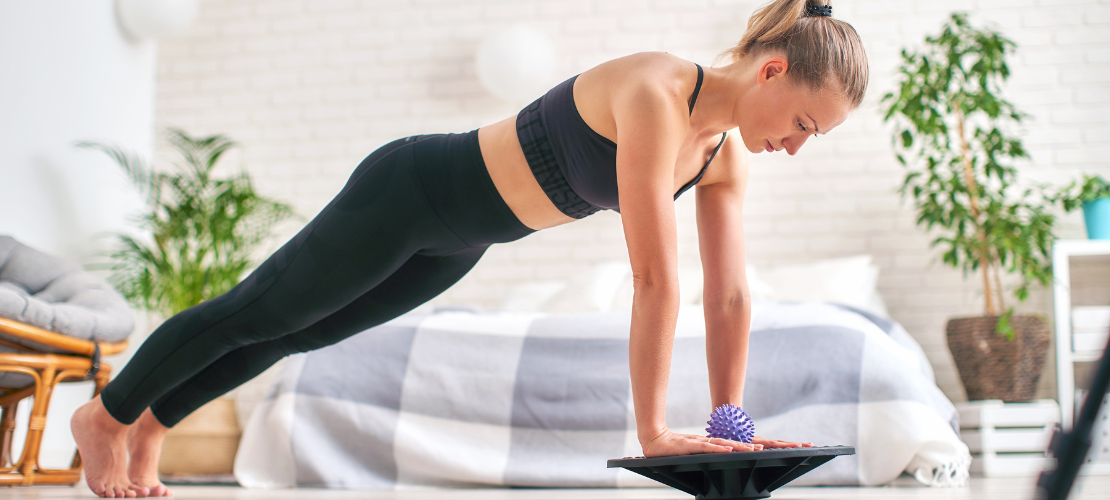
The square or round Freeman board rests on a half-sphere, which is also its only point of contact with the floor. The angle of tilt ranges from 16 to 20 degrees. It is an accessory suited to all ages. How do you choose from the models on offer? We put the question to sports coach Chantal Lobbes: 'My first tip is to leave the cheapest models on the shelf. Invest in quality and follow the advice of a specialist retailer or physiotherapist. Then choose a board with a wooden or PVC platform that is large enough for you to stand on comfortably, and that can support your weight without breaking. The average price for a basic model is around 60 euros.' During your sessions, you can combine balance and strength training with a variety of exercises.
Why it is good for you
- Muscles of the upper and lower body are put to work: abdominals, thighs, hips, legs, back, calves, arms and shoulders
- Improved proprioception: this is the ability to know whether the body is moving or not, without having to look
- Strengthened balance and coordination
- Strengthened core muscles
- Stabilising muscles, such as those in the ankles, are put to work
- Strengthened pelvic floor, because weakening pelvic floor muscles are often synonymous with urine leakage
Use of the Freeman board is often recommended by gynaecologists to strengthen and firm up this area of the body, which is weakened by pregnancy or menopause. The balance exercises on this board make the pelvic floor contract, which then firms it up. This is built up gradually. It helps to counter the incontinence problems that usually occur during a fit of sneezing or coughing.
Precautions
Like any piece of exercise equipment, the balance board can lead to injury if used incorrectly. It may therefore be advisable to learn the correct movements at a fitness centre with the help of a coach, in order to avoid any risk of falling. Anyone with problems with their ankles, hips or knees would be better off not using the board, as these parts of the body are placed under considerable strain. Take care too if you lose your balance easily. If in doubt, consult your doctor or specialist.
Want to receive the best of Fifty & Me in your inbox? Then sign up for the newsletter.
© Image: Shutterstock
 Travel
 Beauty
 Beauty