
Want to boost your career? Meet three inspiring women!
Translated from French. Original title: “Envie de booster votre carrière ? Voici 3 femmes inspirantes !”
Nathalie Vleeschouwer
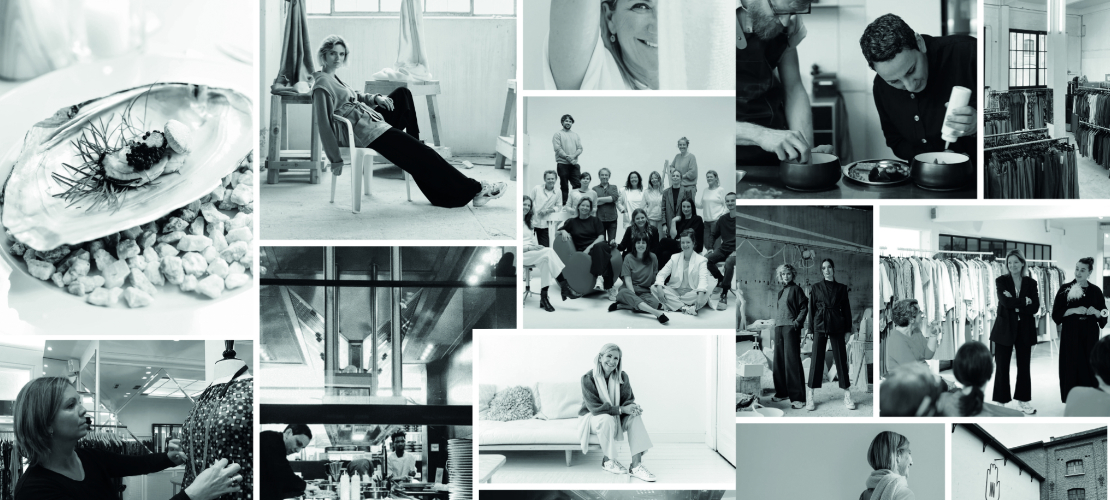
Fashion designer Nathalie Vleeschouwer (54) is the founder of two successful Belgian fashion labels: the maternity brand Fragile and her eponymous ready-to-wear label, Nathalie Vleeschouwer.
Can you tell us a little about yourself?
I always say that I have two jobs: I'm a designer and I'm also the managing director of this brand. It's an unusual combination, and a rather particular one in our industry. Thirty-two years ago, I launched the maternity brand Fragile and, from there, I branched out by creating my own label. I felt I had been through everything maternity wear had to offer and had travelled the world with my product. Perhaps it was down to my age, or to the way society perceives maternity clothes. But I felt less invested, and I simply wanted to design clothes for women.
Have you always known that you wanted to work in fashion? What held you back? And was that feeling ultimately justified?
Perhaps it was the business side that stopped me from creating my own brand? Starting something new is always an adventure and a major commitment. It doesn't happen overnight, and it takes many years to build something. It involves far more than simply designing a collection, and you have to put a great deal of energy into marketing. Not to mention the financial investment, which is substantial too. Once you start something, you have to persevere, and there are times when things don't go quite as planned.
At some point, you went on to create your own brand. How did that feel?
It's wonderful, and I've never regretted it. Thanks to the launch of my Nathalie Vleeschouwer brand, our company is enjoying success again. Meanwhile, Fragile continues as an integral part of Nathalie Vleeschouwer. But the golden age of maternity wear, when the mother-in-law-to-be would come along to help choose the trousseau, is over. Young people handle their finances differently from before, and buying clothes is no longer a priority but rather a practical matter. The Nathalie collection is very practical precisely because it can be worn for a long time.
How does it feel to succeed in an industry with so much young talent?
"There's nothing wrong with it – quite the opposite, I'm 100% behind it, because that's how I started out in the past. But I was lucky that my father worked in a similar industry. That said, what I've learned, and I often hear it, is that young people like to team up to get started, which often doesn't work. For my part, I had to do it alone, take everything on myself and work day and night. When you set up a business with others, the responsibility is often shared. In my case, it was my only source of income, so I had to find ways of earning money, falling down and getting back up again. But I believe in that 'leap into the unknown'. I admire those who do it, and they certainly shouldn't be discouraged. And if you fail, so what? At least you'll have tried. It's a very American way of looking at things, and we should adopt it rather than look down on bankruptcy. It allows us to learn from it and to improve.
What advice would you give to women who are also thinking of starting their own business?
I think you should only do it if you realise the commitment it involves. It's a bit like bringing a child into the world. Once it's here, you never let go: it occupies you day and night, and the launch demands an enormous amount of commitment. You have to have the will and the ability to give it everything, and be prepared to make sacrifices. I've known years when we had to give up weekend parties with friends and family because we had to work or go to trade fairs. You'll also need to be able to count on the unconditional support of your partner because, after all, you're in this together. A few years ago, my sister wanted to open a shop but her partner was hesitant. I told her not to do it, because it would only lead to pointless arguments. You both have to want it.
So surrounding yourself with the right people seems essential
Absolutely. I've always surrounded myself with good advisers because there are also areas I haven't mastered. I work with a good accountant for my administration and a lawyer for contracts. It's a tough world and competition in business can be fierce. But we women now have the opportunity to build a career, whereas previous generations, like my mother's and her friends', didn't have that chance. I have a distinct feeling that women are currently getting better and stronger in business, even if it isn't always noticeable because they don't show it as much as men do. But behind the scenes, I see a lot of female talent and perseverance across all generations, just like my team of 32 women and four men, young and not so young. I'm terribly proud of them, and it's fantastic to see how much they support one another and all pursue the same goal. It fills me with happiness and gives me so much energy. And whatever my workload or however tired I am, that energy is the reason I hope to carry on doing this job for a long time to come.
Isabelle Arpin
The renowned Isabelle Arpin (52), of French origin, is the chef of two restaurants in Brussels: Isabelle Arpin and Ciao, located in the private members' club The Mérode. She has also launched a high-end "slow food" catering service under the name La Bonne Etoile. She is one of the few female chefs in Belgium to have been awarded a Michelin star. She can be described as optimistic and radiant, just like her gorgeous dishes.
Have you always wanted to work in gastronomy? What held you back? And was that feeling ultimately justified?
In fact, I didn't originally plan to become a chef. I studied economics and law and worked in finance. It was while helping a chef friend in his kitchen, around the age of 25, that I fell in love with the profession. It's an exciting job in a very particular world that allows you to travel and discover new things. I then reconsidered my career plans and decided to become a chef, partly thanks to the support of my business partner Dominika Herzig.
How did it feel to finally make that decision?
I didn't ask myself too many questions – you just have to do it. I think the problem is precisely that many people don't dare. I don't see why you couldn't change careers at fifty. We're still young, and we can work until we're 70 and well beyond. It's a fresh start, a new life. Very often, it's even better to launch yourself later in life because you have more experience and more self-confidence, and you've learned from your mistakes.
Experience and self-confidence. Do you think there are other advantages to starting later?
You're more financially secure and you have a wider network. People trust you more, and you may already have built up a good reputation as someone who works hard. Some people are ready at 25, others at 40.
What do you think of people who start out very young?
It's a question of whether you feel ready to start something. I will always encourage young people in that and advise them. For both Dominika and me, sharing knowledge and experience is very important because it helps us to improve and move forward.
Do you have any advice for women who want to start a business later in life?
Go for it and work hard, don't hesitate. It requires structure and strategy, but sometimes you simply have to follow your instinct. Sometimes you'll have to change your plans, because of external factors such as the economy, or because you change your mind. But motivation must always remain your common thread.
Have you had any regrets in your career?
I never regret anything.
What are you most proud of?
My parents. They have always believed in me and made me who I am. I'm adopted, and they gave me so much confidence. Perhaps that's why I love myself just as I am and dare to venture into the unknown. Everything always works out and I always see the good in people. Dominika and I support each other through everything and try to pass on as much knowledge as possible to our team. Culinary knowledge, but also values and standards. They've become my family and they encourage me to improve.
Your career is going from strength to strength. What if someone else saw theirs crumble?
Try again and learn from it. When you fail in Europe, it's often seen as a failure. But there's nothing wrong with failing – on the contrary, it's part of entrepreneurship. If you don't try, you'll always regret it and spend the rest of your life wondering: what if…? If your business idea works as you imagined, that's great, but if not, you'll never regret not having tried and you'll bravely move on to something else.
Liesbet Allaer
Liesbet Allaer (50) has entrepreneurship in her blood: after her studies, she opened a fashion boutique, which she closed after 10 years to join her husband in exporting flowers and plants around the world. After 15 years, it was time for a career change, and in 2019 she launched her own knitwear brand, Leselles.
Can you tell us a little about yourself?
Sometimes I feel as though I've already lived ten lives, thanks to my different careers. The idea was born when my children went off to boarding school and I had more time. At the time, I was still running a flower and plant export business with my husband. But I was missing the creative challenge, and the idea came to me to move on to something else. It was now or never, and I launched my online shop with a pop-up. A 500 m² concept store, by women, for women, ranging from fashion to home décor, from skincare to cosmetics, flowers, plants… in short, everything that can make us happy. Including scarves made from leftover wool, which I had knitted in my friend's knitting workshop, and which quickly proved a resounding success. Today, our knitwear is available at several retail outlets in Belgium and the Netherlands, and I'm ambitious to expand worldwide.
What was your turning point?
Approaching fifty, I think. I still wanted to start something of my own in which I could fully express my creativity. And then I realised that our export business could carry on without me but not without my husband. If he were suddenly to disappear, everything would come to a halt for me too. It was that frightening feeling that made up my mind.
Did you always feel that you wanted to go in this direction? What was stopping you?
The years flew by and we were busy with our family and the business, everything went so fast. It was when the children left for boarding school that I had far more time, and I started to brood on it.
How did you feel when you made the decision?
So good! And especially now that it's such a success, despite the Covid crisis.
Have you ever had any regrets?
No, absolutely not. Although, in the meantime, I've found that the fashion world is tough and there's a lot of competition from young people. But I'm amazed to see that 24-year-olds are prepared to take these risks and go for it. I notice there's a young generation that probably asks itself fewer questions than I do. Of course, I have the advantage of being more experienced and probably a little more financially secure, but they dare more.
Does that make you doubt yourself?
No, it's not that. It's going well, Leselles continues to grow and the response has been positive. The only thing, though I think this is true for everyone, is that production remains a real challenge. Brands made in China have suddenly come back to Europe and demand exceeds supply. But we're doing the best we can! Our creative team is in Antwerp and our production is in Portugal. Until recently, it was my mum who sewed the labels onto every piece that came in. It often sounds like a cliché, but my kitchen table was covered in scarves for quite a while. But that's no longer possible, and my family also needed to get a home back instead of a knitting workshop.
What advice would you give to women who may be feeling the same way?
I often tell my two daughters: whatever you do, do it with passion and shine! And then the rest will follow naturally. Believe strongly in yourself. But everything also starts with a solid business plan and strategic plan. Think big, and put your vision, your mission and your dreams on paper. The people around you must support you and believe in you, because you need it. I was lucky that my husband is an entrepreneur and that feeds into everything. When we're on holiday, for example, we inspire and encourage each other to move up to that next level. Our daughters, on the other hand, are from a different generation and see things differently, but that's just as inspiring. In short, you see, everything is still possible – you don't need to be in your twenties.
 Beauty
 Beauty
 People