
How breathing exercises can transform our lives
Translated from French. Original title: “Comment les exercices de respiration améliorent notre vie ?”
A vital function… forgotten
Breathing is the first act we perform on entering the world, and the last when we leave it. In between, we breathe on average 20,000 times a day, often without even being aware of it.
Yet the quality of that breathing has a direct influence on our physiological, emotional and mental balance. Simply slowing down, lengthening or giving rhythm to our breath changes our inner chemistry within seconds.
This is what a wealth of research in neuroscience and physiology demonstrates: breathing differently means acting on the autonomic nervous system, the one that regulates our stress, our sleep, our digestion and our heart rate.
A direct link with cortisol
Cortisol, nicknamed "the stress hormone", is naturally higher in the morning and can be heightened in times of tension. When it becomes chronic, it wears down the immune system, disrupts sleep cycles and increases irritability.
Yet slow, deep, controlled breathing exercises can significantly reduce cortisol levels within minutes, as several clinical studies have shown (notably those carried out at Stanford and Yale University).
Controlled breathing activates the vagus nerve, the keystone of the parasympathetic system, the one that induces calm, digestion and regeneration.
What conscious breathing can change
From the age of 50, when the metabolism slows down and stress can creep in insidiously, breathing becomes a valuable tool for regulation. It works on several levels:
- Emotionally: it quietens recurring thoughts, reduces anxiety and strengthens mental clarity.
- Physically: it lowers blood pressure, improves digestion and eases muscle tension.
- Cognitively: it improves concentration, supports working memory and heightens alertness without overstimulation.
- Existentially: it creates an inner space, a feeling of being present to yourself, which fosters serenity.
3 simple techniques to get started
1. Cardiac coherence (3-6-5)
Breathe in for 5 seconds, breathe out for 5 seconds, for 5 minutes, 3 times a day. This scientifically validated method synchronises the heart rate with the breath, and acts as a natural stress regulator.
2. Abdominal breathing
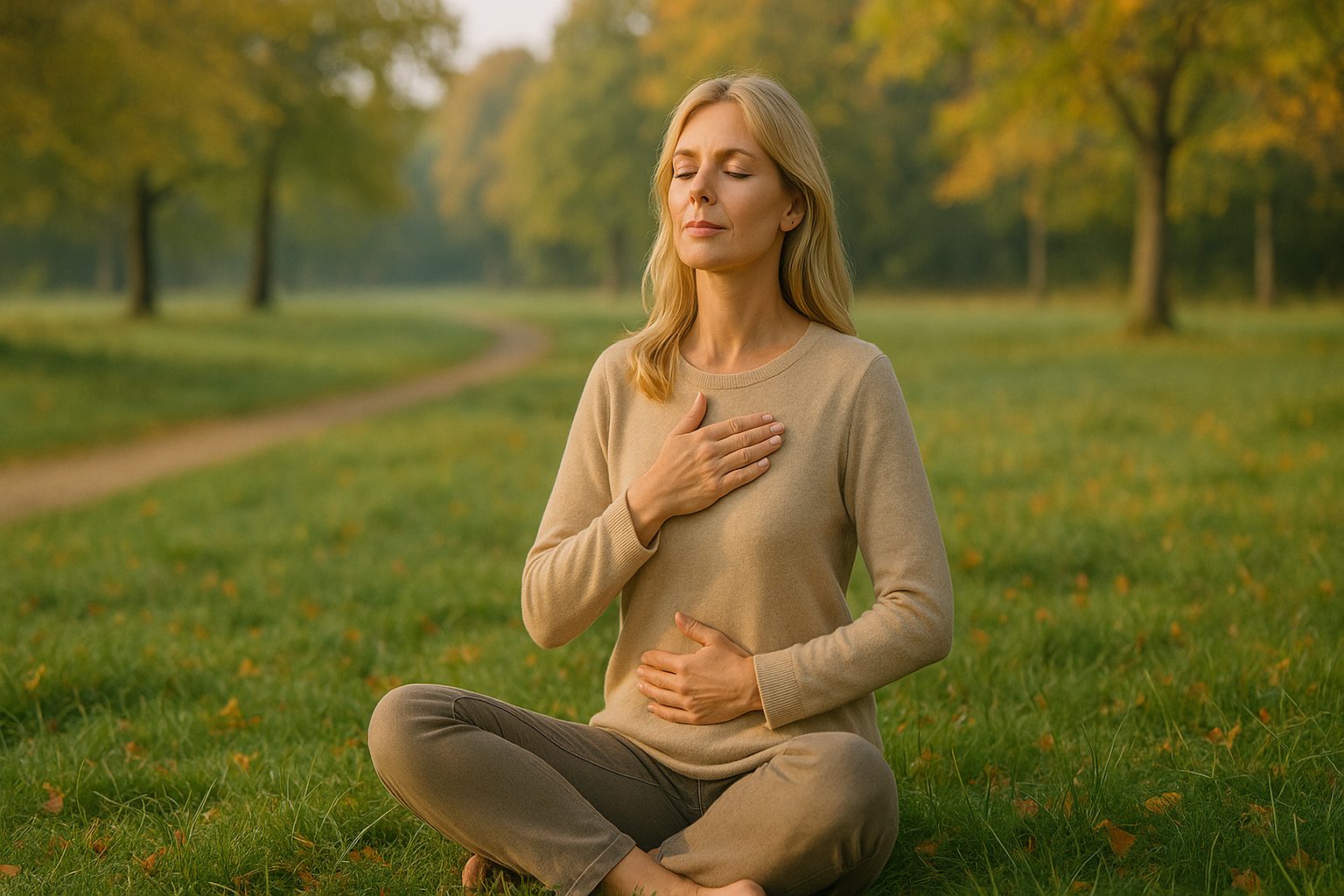
Sitting or lying down, place one hand on your stomach and the other on your chest. Breathe in slowly through the nose, letting the stomach swell, then breathe out gently through the mouth. Practise 10 conscious breaths on waking or before a difficult moment.
3. Alternate nostril breathing (nadi shodhana)
Originating in yoga, it involves alternating the inhalation and exhalation through one nostril and then the other, to balance the two hemispheres of the brain. Ideal for moments of transition or before going to sleep.
Breathing: a gentle art, a quiet power
We often think that to feel better, we have to do more, move more, control more. What if real change came from less? Less tension, less agitation, less resistance.
Breathing requires no equipment, no performance, no appointment. It is available, free and faithful, at every moment. All we have to do is remember that it is there.
Relearning how to breathe is not a new-age luxury. It is a life skill. A form of inner independence that reconnects us with ourselves, with our body, with our capacity for presence.
And what if, in the end, the first step towards a calmer, richer, more joyful life… was simply to catch our breath?
 Health
 Travel
 Beauty