
Finding the Right Balance with Your Grown-Up Children
The right balance, the right distance: what exactly are they? It would be far too simple if we could define them. Not only are they unique to each person and each relationship, but this right distance, this right balance, must be tamed afresh at every encounter. A fruitful bond brings neither intrusion nor rejection… Although, sometimes, we have to go through rejection to weave a healthier bond and, with it, a more harmonious distance. This is particularly true of the ties between parents and their children once they have grown up.
Translated from French. Original title: “Le bon équilibre avec ses enfants devenus adultes”
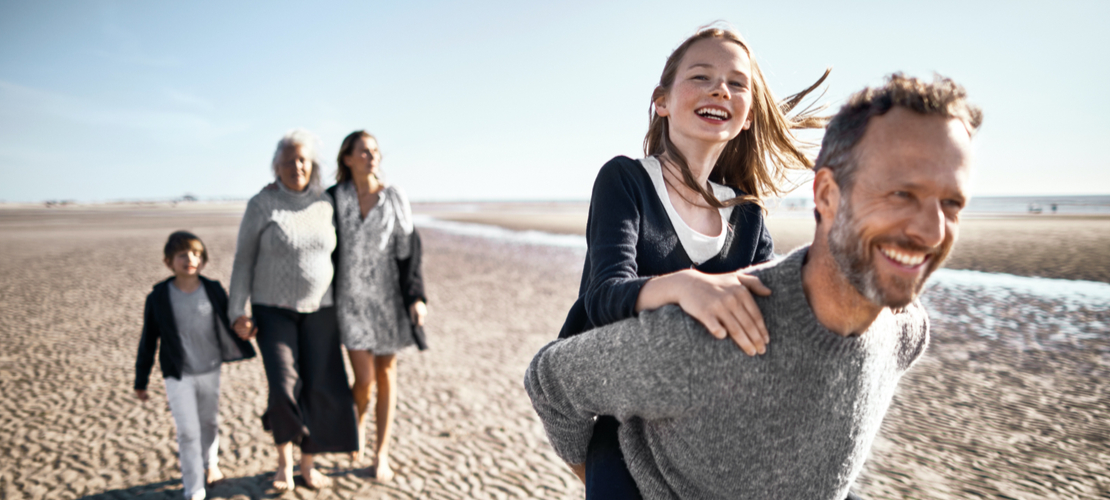
The right balance is not found through guilt-tripping
Philippe is bitter. He would like his children, now young adults, to come and see him more often or at least to phone and ask how he is. "After everything I've done for them…" A sentence that only widens the gap.
His wife, Corinne, does not share his view. She has always cultivated the closest of relationships with her children, and she welcomes the rightness of this stage of life. In her eyes, her children need all their energy to build their lives and spread their wings in every direction: love, work, friends, travel, children… So she is the one who calls them when she feels it has been a long time since she last heard from them. Not to make them feel guilty ("are you still alive???") but quite simply to ask whether everything is all right.
The right balance is not found through intrusion
Ever since her son left home, Carole, who has always been a mother hen, has wondered whether Quentin will be able to manage on his own. She never misses an opportunity to ring him or to bring him something to eat, for fear that he is not feeding himself properly. Careful, intrusion! And a lack of trust… Unless it is she who needs to nourish her own self-confidence. Her role as the mother who is always "on hand" has taken quite a knock.
Charles, divorced for 3 years, found it hard at first to see his children only one week in two. But having to manage this "space in between" has, paradoxically, allowed him and his children to particularly appreciate the moments they spend together. Today, his daughter lives with her partner. She is starting out in her professional life. Charles understands that she needs her energy to build her life and therefore needs to see her dad less! He understands, but all the same, "I'd like to see her more often. That's life…", he sighs. Yet he also admits that this stage has opened the door to his own personal and romantic space. Off to new adventures! For him too…
The right balance comes from the pleasure of meeting, not from need
If the only thing motivating a visit is "need", we quickly fall into the trap of a mercenary relationship, to the detriment of the feelings of affection that belong to the bond. A parent needing help, or a youngster needing laundry done… On one side there can then be the impression of always feeling "useful", and on the other the (unconscious?) fear of being press-ganged once again, a prisoner of a bottomless need for recognition! It was Jacques Salomé(1) who coined the phrase "I did everything for you… I was suffocating for you", the implication being: you owe me eternal gratitude!
Winning one's autonomy and learning to detach is a long road (to liberation?). From the essential fusion around birth, children and parents spend some twenty years learning to live with separation. Fusion, dependence, interdependence, independence… to arrive in the end, when all goes well, at a relationship between adults whose watchword is respect. Recognising each other as "other", even though we belong to the same tribe!
Discovering the free bond. The wounds of childhood, and of the child before an all-loving and/or all-powerful parent, must be able to be spoken and healed before we become adults who respect one another. Adults who reach the "same level", a salutary face-to-face.
Putting some distance between you? Sometimes essential to reach balance. Distance goes hand in hand with experience…
Travel, travel
Just out of the nest, children need to build themselves away from their parents' presence, even if taking charge of everything is not necessarily easy. The perfect solution, in fact? Travel… Many young people today, thanks to travel, Erasmus or otherwise, have already had the chance to move away from home, to take flight and test their own resources. Without mum or dad. Besides a new country and different customs, it is they who discover and reveal themselves. The conquest of the new world begins with oneself! And fear can be part of the landscape. Their own, but also that of their parents.
And what if it were all just a question of love?
Taking the step of no longer meeting your parents' expectations in order to be loved. A significant stage in the conquest of the right distance and of "right love". A father who gives is only natural; a father who expects a return on his investment is a "merchant haggling" over love. It is yet another lesson, and a considerable one, to question our own ties, demands, guilt and contortions in the face of love. That aspiration shared by all human beings…
Yes, but what kind of love? Jean-Yves Leloup (2), who has translated sacred texts from Greek into French, devised a "ladder of love" whose rungs are to be climbed or descended depending on circumstances. Where French has only one word to express "to love" or "love", Greek invites every nuance, whether in romantic feeling or in parent-child relationships. Between the "porneia" love, the devouring love of the newborn, and the free, unconditional "agapè" love, there are 8 rungs… Do they confine us or lift us up? And what if asking ourselves about the quality of our bonds invited us towards an evolution of consciousness? A transcendent love. One that runs through us, makes us vibrate and propels us beyond ourselves.
From dependence to freedom
No need to deny yourself the pleasure. Women in their fifties are also delighted to regain their freedom. The children are forging their own path? Hurray, mission accomplished! Freedom, inspirations, aspirations… New forms of fertility appear. All while keeping that "free" bond, that bond of belonging that is knitted and unknitted according to our mutual wishes.
Means of communication (social media, WhatsApp…): friends or foes of the right balance?
Chantal (who is not friends with her children on Facebook!) nevertheless loves WhatsApp. One of their children created a "family" group, and all the little bits of news and photos pass through it and spark brief exchanges that nourish the bond. The snag is Paul, her husband, who refuses to buy a smartphone… Chantal is therefore the go-between, but Paul feels a little left out. No comment!
It is wonderfully nice when grandchildren join the family. Photos and videos circulate and feed the tribe's ties. Without heaviness. Without untimely intrusion. It also helps to know the rules of the game. As we get older, we like to have a quick reply to our posts, which is not necessarily the strong point of the younger ones, who have so many other means of communication to juggle.
When your child becomes a parent
Making yourself available without taking over? Quite an art… A moment of emotion when a birth turns the family upside down. We welcome the newcomer, we make room, we are moved to see our child become a parent, and everyone moves up a floor. The new grandparents tame their new role.
Neither too close nor too far? Here we go again…
(1) Jacques Salomé, psychosociologist and author
(2) Jean-Yves Leloup, Doctor of Psychology, Doctor of Philosophy and Orthodox priest, translated the sacred texts from their original languages, Greek and Hebrew. See the article "Les métamorphoses de l'échelle amoureuse" at www.jeanyvesleloup.eu
 Health
 Travel
 Beauty