
Welcome to Northern Ireland
To really get to know a place, we have always felt it essential to understand not only its history but also its traditions and the customs of its people. If there is one thing that defines Irish society, it is the love its people have for gardens. It is even part of their Celtic heritage. Celtic culture, with its close ties to nature and spirituality, has undoubtedly shaped the Irish mindset. Celtic symbols and traditions are often woven into garden design and into the practice of gardening itself. They are the point of union between the Irish people and their land.
Translated from French. Original title: “Bienvenue en Irlande du Nord”
The many gardens scattered across Northern Ireland (there are more than 300) are, for the Irish – and for visitors too – not only spaces of natural beauty and tranquillity but, above all, a connection with the land and a source of calm and wellbeing. That said, no two gardens are alike. Each has its own story and serves, in a way, as an original thread that helps visitors better understand the complex history of this territory.
© IRLANDE_Hillsborough Castle
Brook Hall Estate and Gardens
Let us begin with Brook Hall Estate & Gardens, on the banks of the River Foyle near the city of Derry-Londonderry, around a hundred kilometres west of Belfast. We enter this 18th-century estate past a plantation of willows that you might take for a source of firewood. But willow bark, known more precisely as salix, is the basis for the synthesis of acetylsalicylic acid, better known as aspirin!
This garden is the work of people passionate about botany and horticulture. David Gilliand, of the sixth generation of the Gilliand family, is the current owner of this superb estate, acquired by his family more than a century ago. In the grounds surrounding a Georgian-style manor house, you will find an arboretum of surprising richness. Since 1930, successive owners have planted tree species from around the world here: oaks, maples, beeches, cypresses, willows, pines… making this place, ranked among the finest arboretums in the UK, not only a space of aesthetic pleasure but also an educational and scientific one.
A tribute to Nature, from generation to generation
Make the most of your visit to explore the walled city of Londonderry. Encircled by 1.5 km of ramparts dating from 1613-1618, this city, considered the second largest in Northern Ireland after Belfast, lies on the border between the two Irelands. It was the scene of painful events in the 1960s to 1980s that pitted republican nationalists against loyalists (see box). In its working-class district at the foot of the ramparts, Bloody Sunday took place, an event that left its mark on people's memories and is remembered on many house façades.
If you happen to be there at the beginning of May, do not miss the jazz festival. The whole city resonates with concerts in bars, clubs, theatres and public spaces. An ode to peace in the birthplace of John Hume, winner of the Nobel Peace Prize in 1998.
www.brovokhall.co.uk
© IRLANDE_Brook Hall Estate and Gardens
Drenagh Estate & Gardens
Next, we head for Drenagh Estate & Gardens, near the small town of Limavady, north of Londonderry. Like the garden at Brook Hall, this one is the work of two passionate men: Conolly Mc Causland, the current owner, and Daniel Coombes, his head gardener. From a garden that had been left to fall into neglect and was then vandalised in 1970, they have created a true marvel, a veritable hymn to nature.
The estate, which has been under continuous restoration for several years, is divided into several parts: a walled garden (see box) devoted mainly to growing vegetables and fruit for wedding celebrations, a 19th-century Italian garden that invites romance, a rhododendron garden currently being refreshed, and a remarkable conifer arboretum, which has become open to the public for the first time in three generations after several years of work. This arboretum, open for strolling, surrounds a pretty 19th-century manor house, the Orangery, dedicated exclusively to welcoming newlyweds and their guests. The place is so magical that it must be booked more than a year in advance. Take note, those of you who are interested.
www.drenagh.com
Giant's Causeway
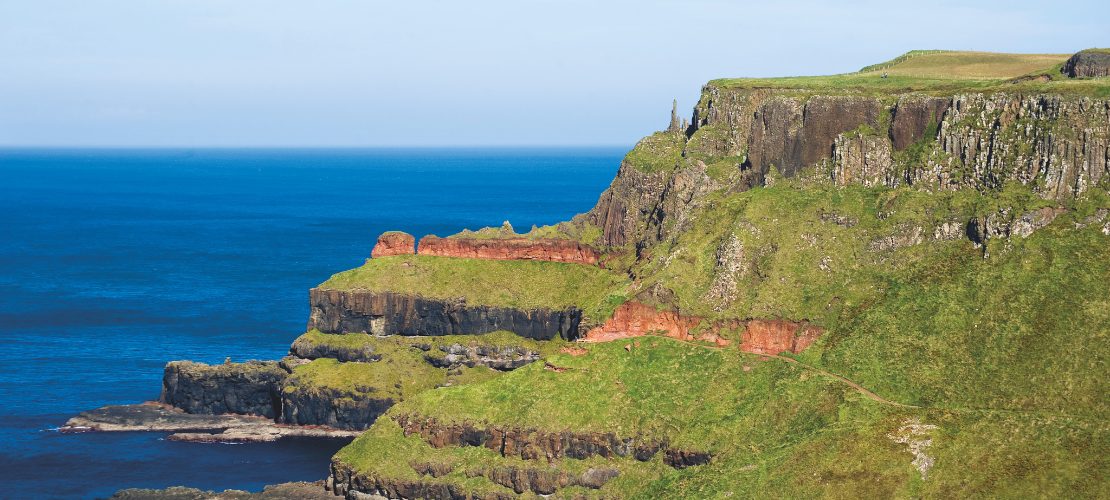
Before reaching Glenarm Castle on the east coast, whose gardens won first prize in the Historic Houses Gardens awards in 2023, we pass the Giant's Causeway, an exceptional natural site.
According to legend, two rival giants lived on either side of the sea, one in Scotland, just across the water, the other in Ireland, and they loved to provoke each other. One day the Irish giant built a stone causeway linking Ireland to Scotland so that the Scottish giant could come over and fight him. Once on Irish soil, the Scottish giant was so impressed by the size of the Irish giant that he took fright and fled back to his own country as fast as his legs could carry him, destroying part of the bridge behind him for fear of being followed.
And so the Giant's Causeway was born: a formation of basalt columns, sometimes more than 10 metres high, the result of volcanic activity that took place some 50 to 60 million years ago. These unique hexagonal columns are entirely natural, formed by the rapid cooling of molten lava on contact with the sea.
Amateur birdwatchers can spot many species of seabird on the cliffs, such as the petrel, cormorant, fulmar, guillemot, redshank, puffin and even the razorbill.
The legend adds a mystical, mythological dimension to this exceptional geological site, which was made famous in 1739 thanks to a woman, Susanna Drury, who painted several canvases of it and exhibited them in various public places in Ireland and England.
The Giant's Causeway is today one of the most popular attractions in Northern Ireland, and a visitor centre of fine architecture helps visitors better appreciate the originality of this coastline.
www.nationaltrust.org.uk/giantscauseway
© IRLANDE_Chaussee des geants
Glenarm Castle
After following the Atlantic coast for nearly an hour, we arrive at the gardens of Glenarm Castle. Among the oldest gardens in Ireland, those of Glenarm Castle were originally intended to supply fresh produce to the MacDonnell family, owners of this remarkable 17th-century manor house in the Jacobean style. Fifteen to twenty gardeners worked there all year round. It must have been a large family…
Since then, the purpose of the gardens has evolved. Still partly kitchen gardens, they have been turned into orchards and, thanks to the construction of long glasshouses in the main part, have made it possible to grow soft fruit, apricots, grapes and nectarines.
The walled garden (see box) has been carefully restored by Lord and Lady Antrim, the owners, to make it a centre of horticultural excellence, with plantings of many varieties of tulips (Apeldoorn, Angelique, Queen of Night, Ice Cream, Blue Parrot, Prinses Irene…) and vibrant flowers that bring colour from spring through to autumn.
As well as its gardens, Glenarm Castle is also known for hosting a variety of events throughout the year, including craft fairs, concerts, gardening festivals and even weddings. It is an important place for the local community and a popular tourist destination in Northern Ireland.
www.glenarmcastle.com
© IRLANDE_Glenarm Castle & Garden
Hillsborough Castle and Gardens
Twenty kilometres south of Belfast stand the royal residence and royal gardens of Hillsborough. We step into another world. This is where King Charles III and his family stay when travelling in Northern Ireland. This 18th-century manor house was originally the property of the Marquess of Downshire and was bought by the British government in 1922. Since then, it has been used for official functions, including receptions, conferences and state visits. Queen Elizabeth II, Prince Philip and the royal family have stayed here, as have, on several occasions, Winston Churchill, George W. Bush, Margaret Thatcher, Tony Blair… The castle even played a central role in the peace process begun in Northern Ireland in the 1980s. The gardens were then private and visited only by the castle's guests. In 2014, Historic Royal Palaces took over the management of the castle and gardens and launched an ambitious project to restore the house and gardens to their former glory. The royal gardens have therefore been open to the public for only a few years, following extensive work. The result is breathtaking.
Strolling along the paths is absolutely magical. Wandering beside the streams, you are utterly bewitched by the beauty of the place. Everything here is enchanting.
We understand why Hillsborough Castle & Gardens has become a major tourist site in Northern Ireland, attracting visitors from around the world not only for the history of the castle but above all for the beauty of its gardens.
hrp.org.uk/hillsborough-castle
©IRLANDE_Hillsborough Castle
Mount Stewart
The last stop on our journey through the land of marvellous gardens: Mount Stewart, 30 km east of Belfast. Mount Stewart is much more than a simple estate. It is a place of beauty, history and inspiration that is unquestionably worth the detour. It was in the early 20th century that this property, associated with the Stewart family since the 16th century, reached its heyday. First the Londonderrys' second home, it was turned by Lady Edith Londonderry into a sought-after retreat where, each summer, she entertained friends and family for sailing, riding and swimming, and to explore the region. She was so enchanted by the place that she decided to live there all year round. She then made it an influential cultural and political centre, welcoming leading figures of the day.
Her passion for gardens led her, from 1920, to create within her estate a number of individual gardens made up of a whole series of lush flowerbeds planted with species from around the world. The enclosed gardens became true architectural jewels in their own right.
Once accessible only to the family and friends, these gardens underwent a thorough three-year restoration a few years ago. Now open to the public, they offer visitors a wonderful opportunity to explore a rich landscape of farmland and woodland walks, with monuments and buildings scattered across the estate. Many animals find refuge here, including the native red squirrel.
The gardens of Mount Stewart are today the most visited in Ireland.
Whether you love show gardens, grand ceremonial gardens like the royal gardens, or more modest ones created and tended by passionate people, Northern Ireland and its hundreds of gardens will not leave you indifferent. They are true national treasures, both witnesses to the complex history of their regions and a hymn to the enchanting nature that is omnipresent in Celtic mythology.
www.nationaltrust.org.uk/mount-stewart
©IRLANDE_Mount Stewart
Why are most gardens in Northern Ireland "walled gardens"?
Do not be surprised to find mostly walled gardens in Northern Ireland. These gardens are often associated with historic estates, manor houses or castles, where walls were used for both practical and aesthetic purposes. This gardening practice is linked to the history of horticulture in the country. Ireland, like England, has a long tradition of landscaped gardens and sophisticated gardening techniques dating back to the medieval period and the Renaissance. Gardens were then an expression of social status and wealth.
Enclosing a garden with a wall did not mean protecting it from possible vandalism or theft but was rather an effective way of sheltering plants, flowers and vegetables from the often cold prevailing winds. The climate in Ireland is not always the mildest… What is more, the heat stored by stones exposed to the sun, and the reflection of that heat, were a clever way of encouraging plant growth.
©IRLANDE_Hillsborough Castle
Ireland and the United Kingdom: a complex history
From the 16th century, Ireland was occupied by the English. In the years that followed, this occupation led to numerous rebellions, the most famous of which was undoubtedly that of 1798, which was savagely suppressed by the British. This repression was the starting point for many nationalist movements that fought for their country's independence from the United Kingdom. This climate of permanent tension led to the Irish War of Independence (1919-1921) and, in 1922, to the partition of the country into two parts. In the south, the creation of an independent, sovereign state, the Republic of Ireland (Éire in Irish), with Dublin as its capital; in the north, the creation of a territory comprising the six counties of Ulster, attached administratively and politically to the English Crown. It is this territory, an integral part of the United Kingdom, that is more commonly known as Northern Ireland.
For 30 years, from the late 1960s until the early 2000s, Northern Ireland went through a period of internal conflict marked by brawls and violence. This period, which the British call "the Troubles" (the term civil war was never used), pitted nationalist Catholic communities, who wanted Northern Ireland reunited with the Republic of Ireland, against Protestant unionists in favour of keeping their territory in the United Kingdom.
These tensions, latent since the partition of the country in 1920, often had their origins in political, socio-economic and societal differences between communities. They degenerated into armed conflicts that "hit the population very hard and left deep scars in every family, causing the deaths of more than 3,500 Irish people." The tragic event of 30 January 1972, known as Bloody Sunday, which cost the lives of 14 unarmed civilians, was the catalyst. The British army had opened fire on demonstrators marching peacefully for civil rights and to protest against the internment without trial of republican activists. The event provoked considerable outrage not only in Northern Ireland but also internationally, and was memorialised in the song Sunday Bloody Sunday by the Dublin-based Irish rock band U2.
The conflict, which it would be wrong to reduce to a clash between religious communities, came to an end in 1998 with the signing of the Good Friday Agreement. This agreement established a political framework for government and reconciliation in Ireland. Power within the Northern Ireland government is now shared between unionists and nationalists, and a process of disarming paramilitary groups has begun. But have the tensions disappeared altogether? Unfortunately not, but Brexit may indirectly help to change the picture. Northern Ireland, like the Republic of Ireland, was overwhelmingly opposed to Brexit and, because of its attachment to the United Kingdom, finds itself having fiscal, economic and societal reforms imposed on it that a large part of the population disapproves of. At the same time, we are gradually witnessing a transformation of society, which is becoming majority Catholic… In short, Ireland has not stopped making the headlines.
©IRLANDE_Hillsborough Castle
Practical information
Ryanair and Aer Lingus flights to Dublin from Zaventem or Charleroi (3 flights a day), with a bus connection to Belfast.
Contact details for Tourism Ireland: www.ireland.com.
Hotel in Londonderry: Bishops Gate Hotel: www.bishopsgatehotelderry.com.
Hotel in Belfast: Room 2 Belfast: www.room2.com/belfast/sustainability.
Would you like to receive the best Fifty & Me articles in your inbox? Sign up to the newsletter!
© Illustration: Causeway coastal route
 Travel
 Health
 Beauty