
Hidden Greek islands worth discovering
Each island can be reached from Athens and has its own distinctive features and history: a different accent, culinary variations and a dominant patron saint. And yet they are strongly united. Apart from the Orthodox faith that binds them, the islanders have had to learn to rely on the sea for their supplies, and they live largely on imports. Even so, plenty of fresh vegetables and fruit grow on their land, and they produce their own olive oil, cheeses, honey and drinks (wine, for instance!).
Translated from Dutch. Original title: “Verdoken eilanden in Griekenland die het ontdekken waard zijn”
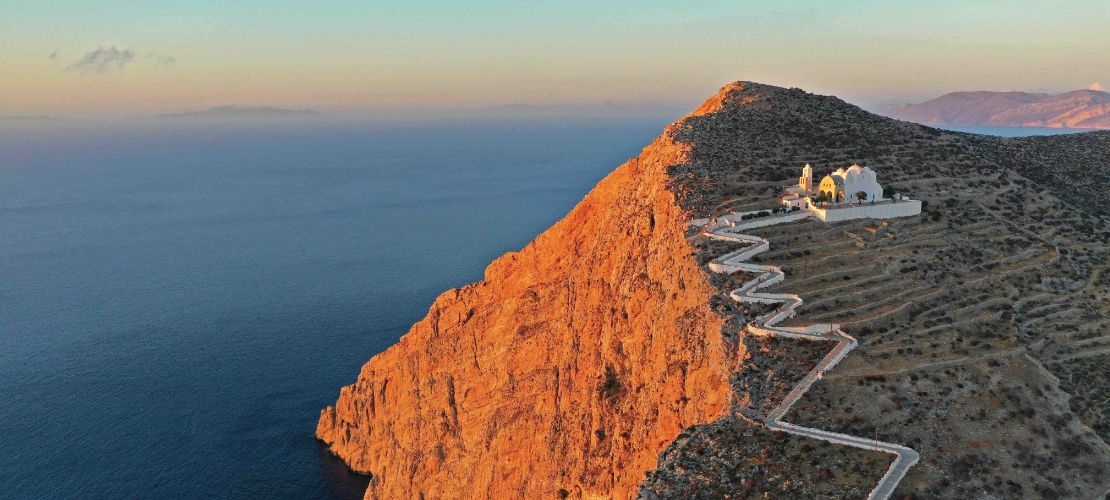
On the islands you feel a family bond, something you miss in a city. Each has its own relics from antiquity, medieval monasteries, chapels, buildings and churches. Another hallmark is that time stands still here. It is, after all, common knowledge that modernity has not yet fully made its way onto the islands. People cherish the beauty of the sea and savour the beneficial wines, the Greek plants and herbs. Life is different.
© Katerina Katopis
A selection of the most beautiful Greek islands
No, the Greek islands are not limited to white-and-blue houses and the (dazzling and unique) sunsets of Santorini. Islands such as Mykonos are bare of vegetation, while others, Andros among them, are lushly green. The mountainous landscape of Naxos is often covered in snow during the winter months, while archipelagos such as the Sporades, the Cyclades and the Dodecanese are characterised by golden sandy beaches and crystal-clear blue water. Limnos has endless beaches of fine desert sand on one side of the island, while the other part is dotted with lakes and colonies of bright pink flamingos. The only constant is the deep blue sea surrounding the island.
© Katerina Katopis
With their small churches and picturesque villages, Serifos and Sifnos are representative of the DNA of the Cycladic islands. Serifos has a wild beauty, with imposing rocky landscapes and peaceful beaches. According to mythological legends, the island was once even the home of the Cyclopes. At Agios Sostis, a single strip of land stretches out into the sea, creating two beaches with clear water. One is sandy and covered with scrub, while the other is strewn with smooth, round pebbles. The beaches are unspoilt and free, so they are not overrun by tourists. Sifnos offers a showcase of traditional Cycladic architecture, with whitewashed houses and stone-paved lanes. The island is teeming with restaurants with the most extensive menus. Omega 3, in Platis Gialos, is known for its delicious seafood.
© Katerina Katopis
Further south we reach Milos – where the famous statue of Aphrodite, the Venus de Milo, was found, and which can be admired today in the Louvre. The Chora, the term the islanders use for the central town of their island, sits on a hill and is clearly visible to anyone approaching the harbour. Many islands chose to build their capital on such a summit to protect their inhabitants from attack. The water around the island is exceptionally clear, and with a snorkel you dive into a colourful world of fish and coral. A trip through the rocks and caves of Sarakiniko is an absolute must.
© Katerina Katopis
We end in Astypalaia, also known, because of its shape, as the 'butterfly of the Aegean Sea'. The island has a rich history, as the buildings from the Byzantine era and the countless Venetian influences testify. Its most recognisable feature is the windmills. Looking for a unique experience? Then visit the stalagmite and stalactite caves, the archaeological museum in Chora or the unmissable beaches.
© Katerina Katopis
The book covers many more islands – each more beautiful than the last – which you need to discover by boat to admire them as they deserve. A true collector's piece on the secrets of the Aegean Sea.
Greek Islands, Assouline Editions, assouline.com
Want the best Fifty & Me stories delivered to your inbox? Then sign up for the newsletter.
Header image: © Katerina Katopis
 Travel
 Health
 Beauty