
Is AI our new ally for ageing well?
We thought it was reserved for cars, Silicon Valley engineers and chats with ChatGPT. Wrong! Artificial intelligence has already moved into our bathrooms, onto our wrists and well beyond. And at 50 or over, it may just have a few favours to do us.
Translated from French. Original title: “L’IA, notre nouvelle alliée pour bien vieillir ?”
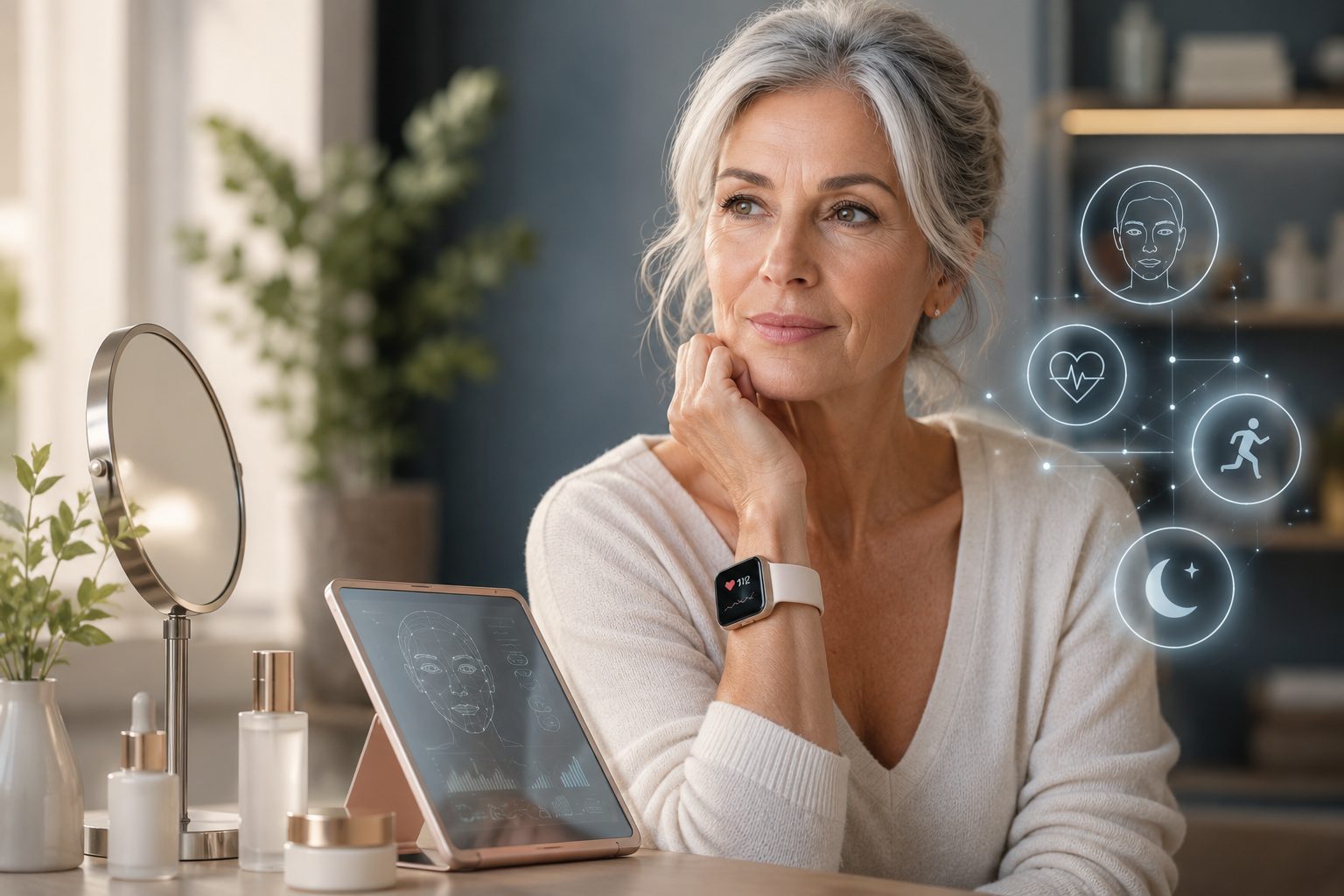
Because as the years go by, one thing becomes obvious: we don't all age in the same way. One woman's skin feels tight while another's is covered in age spots; some sleep like babies while others count sheep at 3 a.m.; and our best friend's exercise routine isn't necessarily the one that suits us. Luckily, AI's great speciality is precisely tailoring things to the individual.
Beauty: a prescription for every woman
Gone, or almost, is the jar of cream stamped "50+" that is supposed to solve all our little skin worries on its own. Thanks to thousands, even millions, of data points, some tools can now analyse the particularities of our skin to suggest more targeted care. Hydration, age spots, blemishes, evenness of skin tone… Professional devices are becoming veritable skin detectives, able to see what our mirror doesn't necessarily tell us.
The same revolution is under way in make-up. Virtually trying out a new colour, finding the shade of red that best flatters our complexion or testing a hair colour without ever having to ask "what on earth was I thinking?": AI makes our choices easier, too.
And ultimately, perhaps that is what we like best after 50: being seen as an individual woman rather than as an age bracket.
Our bodies under the scanner
Personalisation is also making its way into the gym. Some machines compile different physical data in order to suggest sessions suited to each person's abilities and goals. And here, the message changes. It is no longer necessarily about chasing calories burned. After 50, preserving muscle strength, balance, stamina and mobility becomes a genuine investment for the years ahead.
Even our watches are getting in on the act. Sleep, activity, heart rate, recovery… they gather the information and AI translates it into trends that are easier to interpret. Handy for discovering that our famous "I'm on the go all day" sometimes deserves a little qualification. Or, conversely, that the day when we thought we had done "nothing" was actually rather active.
Ageing better rather than looking younger
This is no doubt the most interesting promise of this technological revolution. The aim is no longer simply to correct what we dislike, but to anticipate and keep track of changes. In beauty as in fitness, smart tools seek to understand better how we function so as to help us adapt our habits. Not to win an imaginary war against wrinkles or turn every walk into a performance, but to stay in good shape, remain independent and look after ourselves with greater precision.
Dr AI? Not so fast…
Still, an algorithm, however brilliant, has neither intuition nor human experience. An app can analyse an image of our skin, but it doesn't replace the dermatologist. A watch can spot an unusual variation, but it doesn't make a diagnosis. And a machine can personalise a workout without knowing our whole story. The right attitude? Take AI for what it is: a tool, not a guru.
After 50, perhaps we know better than before that the body is not a machine to be optimised. It changes, surprises, sometimes slows down, and also reinvents itself. And that is precisely what makes it alive.
So yes, let's make the most of artificial intelligence when it helps us to understand these changes better, anticipate certain risks or simply take better care of ourselves. But without asking the impossible of it.
Because ageing well is not about outwitting the years, but about continuing to live fully in those still to come. And if AI can help us do that, all the better. As long as we never forget that the most precious data will always be the kind no algorithm can measure: our emotions, our intuition, our history, our desires, our contradictions, our ability to build connections, to make choices and to give meaning to what we experience… In other words? Our humanity.
 Beauty
 Beauty
 People