
Swiss cheese and wine: the perfect pairings
Swiss cheese belongs first and foremost to a canton: Fribourg, Graubünden, Valais, Jura, Appenzell, Thurgau… and every region of Switzerland is proud of its cheese. In this small country, almost every village has its dairy, while there seems to be a farm around every corner. Small cheese dairies with just four or five employees can be found everywhere. This is also why Swiss cheeses are so rich in distinct characters, each with its own personality. For a very long time they were associated with powerful red wines, but cheeses are increasingly being paired with white wines, as the tannins in red wine are often a poor match for cheese. Our experts Éric Boschman – a sommelier with numerous awards to his name – and Julien Hazard – master cheesemonger and affineur – have found the best wine and cheese pairings for a gourmet, comforting winter.
Translated from French. Original title: “Les parfaits accords vins-fromages de Suisse”
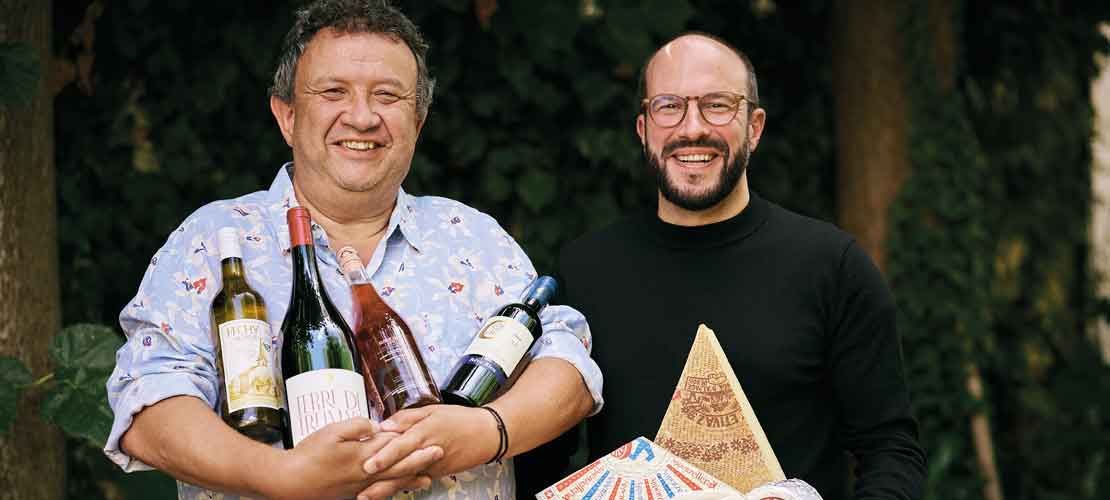
Le Gruyère AOP – Terre de Treimars
Éric Boschman:
Grape varieties: Syrah, Marselan, Caladoc
Estate: Les Davids, located on the border between the Lubéron and the Côtes du Ventoux
Produced on around twenty hectares, these wines are both fruity and structured.
To accompany Gruyère AOP, this 2018 vintage in magnum seems to me to provide the necessary mass of tannin, but also a great deal of finesse, with a lovely acidity on the finish.
Julien Hazard:
Gruyère AOP owes its finesse and its distinctive taste to top-quality raw milk from cows fed on grass in summer and hay in winter, and to the expertise of master cheesemakers and affineurs. No fewer than 400 l of fresh milk are needed to make a wheel weighing around 35 kg. This Gruyère AOP was matured for five months in damp cellars, which gives it its typical taste. The texture is fairly supple and rich, with floral aromas and a slightly salty finish.
Appenzeller® – Rêve bleu
Éric Boschman:
Grape variety: Muscat bleu, from the area around Baulers, right next to Nivelles
Estate: Domaine du Chapitre
Rêve bleu is made in a slightly unusual way, which gives it a little residual sugar on the palate, though only very slightly. We are a long way from the Australian versions and other late-harvest wines of that kind. There is just a touch of roundness here, which softens the full-blown spicy power of the cheese.
Julien Hazard:
Appenzeller® is one of Switzerland’s greatest cheese specialities. The most full-flavoured cheese in Switzerland has been made by hand for 700 years, following an ancient tradition. The gentle hills between Lake Constance and the Säntis massif, covered in healthy, generous pastures, provide the ideal conditions for the natural production of the raw milk used to make this cheese. The production area is very limited. The wheels are brushed for at least three months with a brine made from mountain herbs, known as “Sulz”, the recipe for which is still a closely guarded secret today. This cheese is recognisable by its regular, smooth rind in shades of brown and orange, which conceals a fine, melting interior. Matured for five months, it carries the “surchoix” (premium) label. It has an authentic taste, with incomparable fruity flavours and a spicy finish.
L’Etivaz AOP – Mas Poupéras
Éric Boschman:
Grape varieties: 20% Syrah, 80% Grenache
Estate: Appellation Côte du Rhône Mas Poupéras
Cuvée: Pour toi, je décrocherai la Lune
This wine, aged in concrete and stainless steel tanks, has a full, fleshy palate brimming with fruit – morello cherry, black pepper and notes of garrigue. That is what makes it the ideal companion for a good piece of Etivaz AOP. Etivaz AOP is powerful on the palate and the wine is rich, but not heavy. Its fruitiness will easily absorb the cheese’s robust notes.
Julien Hazard:
L’Etivaz AOP is a hard, farmhouse mountain-pasture cheese made from raw cow’s milk between 10 May and 10 October in the Pays-d’Enhaut in Switzerland. The raw milk comes from cows grazing on some 130 alpine pastures at altitudes between 1,000 and 2,000 m. Produced in chalets, the milk is heated exclusively over a wood fire in copper cauldrons. The mountain-pasture cheese par excellence, it has a fine, creamy and supple texture and a very aromatic, subtly fruity taste. This aroma-rich flavour comes from a wide bouquet of natural herbs and the smoke of the spruce fire.
Tête de Moine AOP – Tío Pepe
Éric Boschman:
Grape variety: Palomino
Estate: Tío Pepe
Tête de Moine is an aperitif classic that plays on hazelnut aromas and has a lovely acidity. There is nothing like Tío Pepe, that ultra-classic sherry made from the Palomino grape, to go with it. In my view it is almost perfect whenever it comes to an aperitif. Belonging to the same family of aromas, the wine and the cheese echo one another.
Julien Hazard:
Tête de Moine AOP takes its name from a custom once practised at Bellelay Abbey, where the prior received a piece of cheese every year for each “monk’s head”. This Swiss cheese is made in small artisan dairies. It takes the form of a small cylinder whose diameter is equal to its height. It measures 9 to 12 cm in both diameter and height, and weighs roughly 800 g. Originally made in the 12th century by the monks of Bellelay monastery, its production moved to the farms owned by the monastery when the cheese was given to the Church as a tithe. Dense, smooth and yellow thanks to the meadow flowers, it has a buttery, slightly salty taste that reveals itself when it is served in rosettes (flowers) using a girolle.
Vacherin fribourgeois AOP – La Dôle
Éric Boschman:
Grape varieties: Pinot noir and Gamay
Estate: Cave Valcombe in Sion
Cuvée: Nuit d’amour, 2020 vintage
La Dôle is one of those reds that make up all the charm of Swiss wines. It is round, easy-going and easy to drink. Almost like water, except that you should avoid driving after more than two glasses. It is the kind of bottle you like to open when friends drop in unannounced for a barbecue, or to enjoy with cheeses such as this Vacherin fribourgeois AOP. In other words, it is a wine that respects its companion without overpowering it.
Julien Hazard:
A pure product of its terroir, Vacherin fribourgeois AOP subtly expresses the full variety of aromas of the flora of the Pre-Alps and the plateau of the Fribourg region. Made with raw milk, it stands out for its fine texture and its melting, subtly refined consistency.
Raclette du Valais AOP – Féchy
Éric Boschman:
Grape variety: Chasselas
Estate: Cave Duprée
The slopes of the Vaud region are among the mythical places in the history of Swiss wine. Chasselas is rich here, far more interesting than what is usually said about it. To accompany this Raclette du Valais AOP, it is quite simply ideal, let’s not be afraid to say so. Its freshness and length on the palate mean that it brings both tension and a backbone that stands up to the richness of the dish.
Julien Hazard:
The richness of the flora of the Valais mountains and Alps, the Mediterranean climate and the traditional method of production give Raclette du Valais AOP a unique taste that is both fresh and full-bodied. The village cheese dairies make Raclette du Valais AOP from entirely natural raw milk in the purest tradition and following an ancestral recipe. To develop their full flavour, both fresh and full-bodied, the cheeses spend at least three months in the cellar.
Tomme Fleurette – Susucaru
Éric Boschman:
Grape varieties: Inzolia, Malvasia, Nerello mascalese, Moscadella
Estate: Frank Cornelissen
In just a few years, Frank Cornelissen has become a legend of Sicilian wine, even though he originally comes from Flanders. He very quickly understood what set the wines of this region apart from others. This Susucaru cuvée is the work of a master craftsman: four grape varieties blended in equal parts on a complicated terroir, with a stunning result. Not a soulless, colourless rosé, but a wine that makes its presence felt from the first contact with our taste buds. In Julien’s eyes and mine, it is almost a perfect pairing, for both the round, spicy notes of the wine and the suavity of the Tomme Fleurette.
Julien Hazard:
Tomme Fleurette is a soft cheese with a bloomy rind, made with raw cow’s milk. The lactic curd is creamy and smooth with a fine structure. It has an aroma of fresh milk with a slight animal note and a touch of acidity. The creaminess increases over time, with nutty flavours at the back of the palate.
Conclusion
Éric Boschman: “Gone are the days when Dad brought out a good bottle of red to go with a well-made Camembert. For some thirty years now, the world of sommellerie has been buzzing and moving to the sound of white wines paired with cheese. So dare to try a cheese and a wine, but everyone who likes to reach for white prefers to drink it with cheese. If the cheese is Swiss, so much the better!”
fromagesdesuisse.be
BIO Éric Boschman
Éric Boschman is a Belgian sommelier, born on 25 August 1964. Holder of numerous awards, including that of Best Sommelier of Belgium in 1988, he is today a leading reference in the world of wine in Belgium. A gastronome, a larger-than-life storyteller, an expert in wine as in humour, Éric Boschman has become a brand in his own right. After the École hôtelière de Namur, a few stints in some of the finest establishments and the opening of his own restaurant – which enjoyed great success right up to being awarded a Michelin star – he gradually drifted from the restaurant world towards the media, events and training courses. This passion for wine became his trademark as much as his hobby horse. In print, in gastronomic guides, in books devoted to well-known and little-known wines, as well as on radio and television… he is everywhere, the undisputed and thoroughly likeable expert who makes people love wine, beer, spirits and sometimes even water, even the most reluctant among them.
BIO Julien Hazard
Cheesemonger and affineur, born on 7 June 1981 in Liège. He became a cheesemonger by one of life’s coincidences… A political science student in Leuven, he realised that university studies were not for him. It was then that he met Fried Elsen. After ten years alongside this master cheesemonger and affineur, he opened his own shop on rue Vanderkindere in Uccle, where he can enthusiastically share his passion for cheese and good produce, with particular attention to producers and artisans who love their craft. Alone at the beginning, they now number 10. They look after the maturing of the cheese and sell to individuals in the shop, to restaurants, to other cheesemongers and, since the end of 2018, a range under their own name can be found in Délitraiteur. In 2018 he co-wrote the book Fromages d’artisans en Belgique with Michel Verlinden. He is also president of the Fédération des fromagers de Belgique.
 Health
 Travel
 Beauty