
Sun-Soaked Autumn Recipes
Translated from French. Original title: “Recettes d’automne ensoleillées”
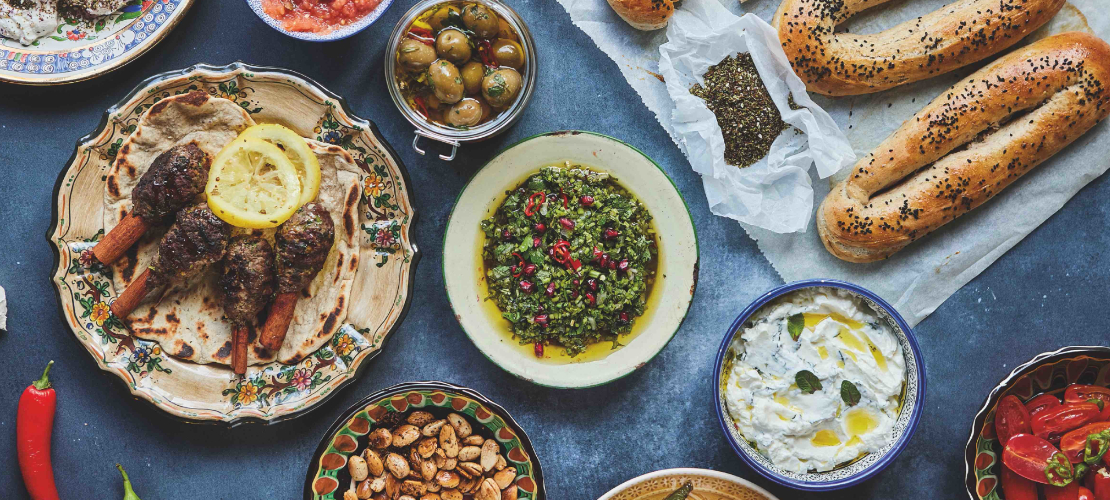
Falafels
Soak the dried chickpeas overnight in water: make sure there is at least 5 cm of water above the chickpeas so that they can absorb enough.
The next day, drain the chickpeas and rinse them in cold water. Dry them thoroughly. Roughly chop the parsley, coriander, green chilli and peeled garlic cloves.
Put the chickpeas, parsley, coriander, chilli, garlic, cumin, salt, cardamom, lemon juice and baking powder into the bowl of a food processor and pulse until the texture resembles coarse sand: it should not be too fine.
Tip the mixture into a mixing bowl, cover and leave in the fridge for 1 hour: this step helps the falafels to stay nice and compact when cooking.
Heat about 8 cm of oil in a large frying pan over a medium heat. Shape the mixture into balls the size of a golf ball: squeeze them firmly in your hands to stop them from breaking apart.
Gently lower the falafels into the hot oil, which should be at about 180 °C: test the temperature of the oil by dropping in a little of the mixture. It should start to bubble immediately. Cook the falafels until they are a deep golden brown.
Ingredients:
- 200 g dried chickpeas
- 1 large bunch of parsley
- 1 large bunch of coriander
- 1 small green chilli
- 3 garlic cloves
- 1 tsp cumin
- 1 tsp salt
- ½ tsp ground cardamom
- Juice of ½ lemon
- ½ tsp baking powder
- Sunflower oil for deep-frying
Hummus with ful
Making the hummus
Soak the chickpeas overnight in a large saucepan of cold water, making sure the water is 5 cm above the chickpeas.
The next morning, drain and rinse the chickpeas under cold water, then return them to the pan, cover with cold water and cook for 1 hour 30 minutes over a medium heat, skimming off the foam as they cook: they are done when they are tender and easy to crush between two fingers.
Remove from the heat and drain the chickpeas in a colander. Leave them to come back to room temperature.
In a food processor, blend together the chickpeas, tahini, lemon juice, garlic and salt. Add the water a little at a time: the hummus should be creamy but not runny. The texture of hummus is a very personal matter. Some people like it with a little bite rather than completely smooth.
Ingredients:
- 500 g dried chickpeas
- 250 ml tahini
- Juice of 2 lemons
- 1 garlic clove
- 1 tsp salt
- 250 ml cold water
For the ful:
- 200 g dried broad beans
- 1 garlic clove
- 1 tsp ground cumin
- Juice of ½ lemon
- 1 tsp sea salt
- 1 handful of fresh coriander
- Lemon wedges, to serve
Pickled vegetables
Sterilise the jars: wash them thoroughly, then place them in a preheated oven at 160–180 °C for about 20 minutes.
In a large bowl, mix the water and vinegar. Add the salt and sugar and stir until dissolved.
Roughly cut the vegetables into generous pieces. If you are using red cabbage, first cut it in half, then slice it lengthways into 3 cm strips. Finally, cut across the strips to the same length to form cubes.
Pack the vegetables tightly into the sterilised jars. Add a few coriander seeds and peppercorns to each jar.
Divide the water and vinegar mixture between the jars so that the vegetables are completely submerged. Seal the jars and keep them in a cool, dark place for 2 to 3 weeks… if you can wait that long.
Ingredients:
- 600 g vegetables of your choice: radishes, green peppers, chilli peppers, carrots, cauliflower, spring onions, courgettes, baby beetroot, red cabbage, kohlrabi…
For the brine:
- 250 ml water
- 250 ml white wine vinegar
- 2 tsp salt
- 1 tsp caster sugar
- 2 tsp coriander seeds
- 2 tsp black peppercorns
Labneh
Pour the yoghurt and salt into a large bowl and whisk together.
Lay a clean tea towel (or, better still, a piece of fine muslin) over a large bowl, then pour in the yoghurt and salt mixture.
Gather up the corners of the cloth and tie them with a piece of string to form a bag.
Hang the bag over a bowl and leave it to drain for 1 to 2 days at room temperature.
When the labneh is ready, carefully open the cloth and transfer the labneh to a serving dish if you are eating it straight away, or to a plastic container if you are keeping it in the fridge: labneh keeps for about 1 week.
Ingredients:
- 500 ml full-fat Greek or Bulgarian yoghurt
- 2 tsp sea salt
Mackerel ceviche
Ask your fishmonger to fillet the mackerel and remove the skin. Cut the fillets into small cubes.
Peel the red onion and slice it into thin rings. Finely chop the chillies.
Arrange the fish on a serving dish and decorate each piece with a ring of red onion and some chilli.
Drizzle with lime juice and olive oil. Sprinkle with fleur de sel and finish with a basil leaf.
Leave in the fridge for 15 to 20 minutes before serving.
Ingredients:
- 2 medium, very fresh mackerel fillets
- 1 medium red onion
- 2 medium red chillies
- Juice of 3 limes
- 2 tbsp olive oil
- 1 tsp fleur de sel
- A few fresh Thai basil leaves (or ordinary basil if you can't find Thai basil)
Chicken shawarma
In a small frying pan, dry-roast the coriander and cumin seeds until they release their aroma. Remove from the heat and grind them in a small food processor or with a pestle and mortar.
In a large bowl, mix the ground coriander and cumin, sumac, smoked paprika, za'atar, cinnamon, a few turns of the black pepper mill and the salt. Add the olive oil and stir to form a marinade.
Place the chicken thighs in the bowl and coat them thoroughly with the marinade. Leave in the fridge for about 20 minutes: the flavour will be even better if you leave the chicken to marinate for longer.
Preheat the oven to 200 °C. Take the chicken out of the fridge and arrange it in an ovenproof dish: pack the pieces tightly together, because the closer they are, the more tender the meat will stay as it cooks. Bake for about 45 minutes: check that the chicken is cooked through by cutting into the thickest part of a thigh. It should be done but not pink.
Ingredients:
- 1 tbsp coriander seeds
- 1 tbsp cumin seeds
- 1 tbsp sumac
- 1 tbsp smoked paprika
- 1 tbsp za'atar
- 1 tsp ground cinnamon
- Freshly ground black pepper
- 1 tsp sea salt
- 3 tbsp olive oil
- 8 boneless, skinless chicken thighs
Aubergine jam
Make several incisions in the skin of each aubergine. Place them in a saucepan of cold water and bring to the boil. Boil for about 20 to 25 minutes. Drain and repeat the process 3 or 4 times, always starting with cold water: these steps help to remove some of the aubergines' bitterness.
While the aubergines are cooking, prepare the syrup. In a saucepan, combine the water, sugar, lemon juice, ground ginger, cinnamon sticks and cloves. Bring to the boil, then simmer gently for 30 minutes.
When the aubergines are cooked, add them to the syrup together with the walnuts. Cover the pan and simmer gently for 1 hour 30 minutes.
Leave to cool, then pour the jam into jars. Serve it on bread to enjoy its sweet-and-savoury flavour, or with any type of cheese.
Ingredients:
- 1 kg small aubergines
- 1½ litres water
- 1 kg caster sugar
- 200 ml lemon juice
- 1 tsp ground ginger
- 2 cinnamon sticks
- 6 cloves
- A large handful of walnuts
Lebanese nights
In a medium saucepan, combine all the ingredients for the base and bring to the boil, stirring from time to time. Once the milk mixture has boiled, lower the heat and simmer for about 10 to 15 minutes until it has thickened: it should have the consistency of porridge.
Pour the mixture into a serving dish or a square baking tin measuring 20 x 20 cm and 5 cm deep. Smooth the top with a spatula. Cover with cling film and leave to cool at room temperature for 20 minutes. Then chill in the fridge for 45 minutes.
For the cream topping, pour the milk into a small bowl and mix it with the cornflour and vanilla extract.
Pour the cream and sugar into a medium saucepan. Bring to the boil, stirring from time to time to dissolve the sugar. Once the cream has boiled, lower the heat and add the milk and cornflour mixture: it will thicken fairly quickly until it reaches the consistency of a pouring custard.
Pour the cream topping over the chilled base. Leave to cool slightly, then return the dish to the fridge for at least 20 minutes.
Ingredients:
For the base:
- 1 litre full-fat milk
- 140 g semolina
- 50 g caster sugar
- 2 tsp orange blossom water or rose water
For the cream topping:
- 150 ml full-fat milk
- 30 g cornflour
- ½ tsp vanilla extract
- 500 ml cream
- 30 g caster sugar
For the sugar syrup:
- 130 g caster sugar
- 160 ml water
- 1 tsp rose water
- Juice of 1 lemon
To decorate:
- 200 g pistachios
Vanilla and black sesame ice cream
In a medium saucepan, pour in the milk and sugar. Bring almost to the boil, stirring from time to time.
Remove from the heat and leave to cool. Once the milk is at room temperature, stir in the cream and vanilla extract. Leave in the fridge overnight.
In a small frying pan, dry-roast the sesame seeds for 2 to 3 minutes until they release their fragrance. Leave to cool on a plate.
In a small food processor, combine the sesame seeds and honey. Blend for about 10 minutes. If the honey is too thick, add a small teaspoon of lukewarm water to help it blend.
The next day, when the ice cream base is well chilled, pour it into the ice cream maker and follow the manufacturer's instructions.
When the ice cream is ready, pour half of it into the freezer container, add a layer of sesame honey, then cover with the rest of the ice cream. Take a metal skewer, push it into the ice cream and make circular movements along the length of the container so that the honey, sesame seeds and ice cream swirl together. Return to the freezer or enjoy straight away. If you have any sesame honey left over, it is delicious on toast.
Ingredients:
- 330 ml full-fat milk
- 150 g caster sugar
- 360 ml cream
- 1 tsp vanilla extract
- 70 g black sesame seeds
- 200 g good-quality runny honey
- 1 tsp lukewarm water
PHOTOS: SNIR GUETA
Street food, le coeur de la cuisine méditerranéenne, Simona El-Harar, Éditions Racine.
 Health
 Travel
 Beauty