
How to Get Rid of Pesticides on Fruit and Vegetables
Spring and summer are the seasons when we eat the most fruit and vegetables. They are essential foods for staying in good health, but they can also carry poisons which, although present in limited quantities, are harmful to our health. How can you remove as much of the pesticide residue as possible? Here's what you need to know.
Translated from French. Original title: “Comment enlever les pesticides sur les fruits et légumes”
Some fruit and vegetables are more affected than others
To reduce the risks to your own health and that of your children, who are encouraged to eat fruit and vegetables, it helps to know which ones are most affected by pesticides. More than 50% of them are said to contain chemical residues. Unfortunately, the ones we eat most often are also the ones most affected by fungicides and pesticides, as shown by the list drawn up by the American Food and Drug Administration*, an authority on the subject. The top 10 most contaminated fruit and vegetables include strawberries, apples, pears, tomatoes and spinach, but also grapes, lettuce and cherries. To give one example, an apple will have received more than 35 chemical treatments while growing, including the dangerous fungicide fludioxonil. Conversely, some fruit and vegetables turn out to be less affected. This is the case for avocados, sweetcorn, broccoli, asparagus and cauliflower.
How can you remove pesticides?
There are several ways to get rid of a large share of pesticide residues, the most obvious being to peel your fruit and vegetables. It is an effective solution, certainly, but it also reduces the nutritional value of the produce concerned. Many of the elements that are good for our health are found in the skin of fruit and vegetables, such as antioxidants, fibre, the vitamin C in pears, or the ursolic acid and quercetin in apples, which are excellent for muscle health and immunity. And not all fruit and vegetables can be peeled anyway. So what can you do?
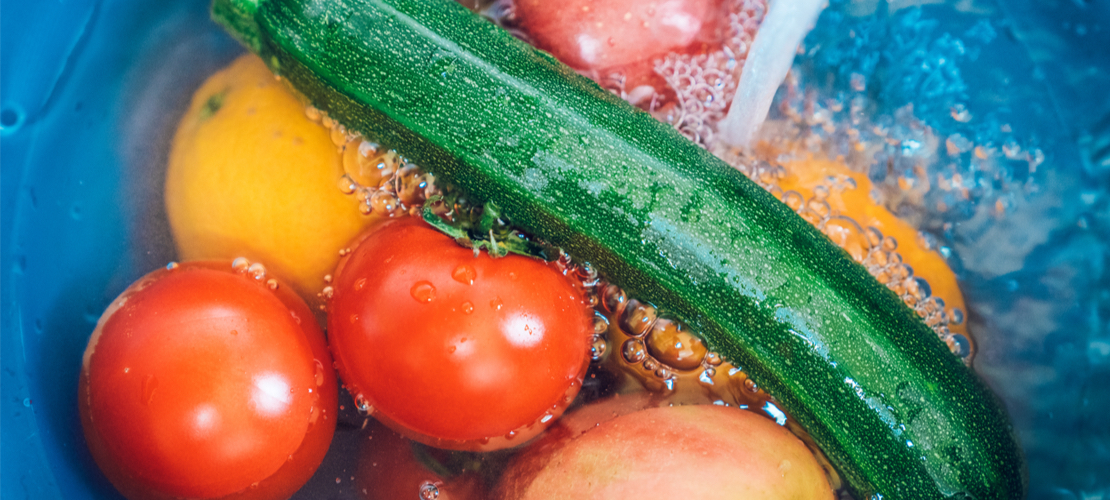
There are other ways to make sure that as much toxic residue as possible is removed. The simplest and quickest, before eating fruit and vegetables, is to rinse them under running water for at least 5 minutes. This wash removes some 40% of the pesticides present. Another old wives' remedy is to blanch your fruit and vegetables for one minute in boiling water, then rinse them straight away in cold water. Soaking your fruit or vegetable in a mixture of water and white vinegar before rinsing it thoroughly in cold water is also effective. A final option is to soak fruit and vegetables in a mixture of water and bicarbonate of soda for 15 minutes, then rinse them in cold water.
Since it is not possible to remove every trace of pesticide, nutritionists still recommend eating a varied range of fruit and vegetables.
Finally, the most natural and economical solution remains growing your own fruit and vegetables in the garden. They are better, both for your health and for your purse.
https://www.fda.gov/food/chemicals-metals-pesticides-food/pesticides
 Health
 Travel
 Beauty