
Arabelle Meirlaen: the plant-based secrets of a starred chef
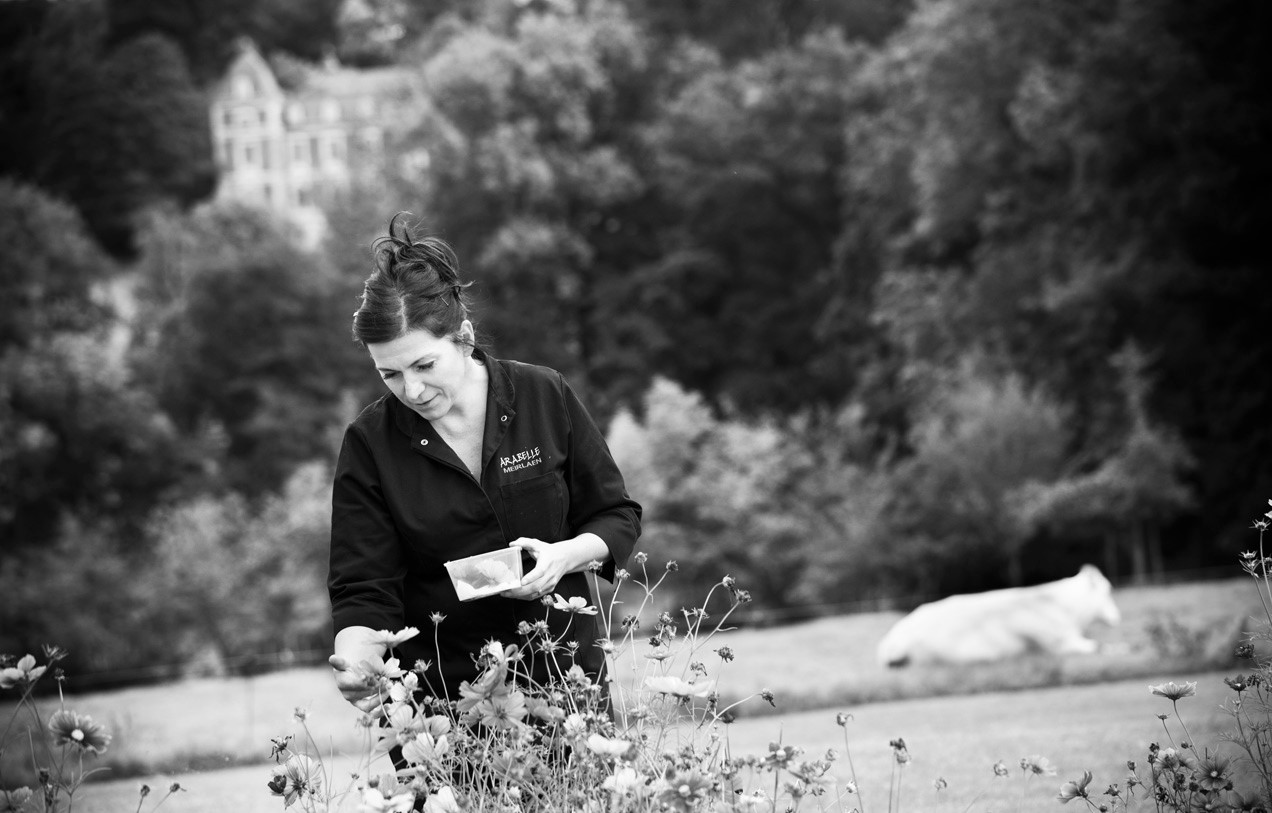
Arabelle Meirlaen. When I started mixing with Michelin-starred chefs, hearing them talk about nothing but innovation and performance did not convince me to follow that path. What excites me is learning to know myself. My garden is a place of exploration. It is where I tune in completely to my body and how it reacts. My dad, who is 91 now, was a farmer. He never took anyone's advice, and certainly not mine. He always used to say, ‘I eat what feels good to me.’
Translated from French. Original title: “Arabelle Meirlaen : les secrets de la cuisine végétale d’une cheffe étoilée”
You were one of the first Belgian female chefs to display a star on the front of your restaurant. Some people praise your discretion, while others are surprised by it. What drives you?
A. M. I see life as a perpetual quest. Every time I discover something new in my vegetable patch or while foraging, it feels as if I have found treasure. We don't talk enough about how important it is to work with plants properly. Some are toxic, so you constantly have to read up on them to stay on the right track. When I began to immerse myself in the world of herbalism, I had to admit that it was hard to reconcile with my wish to serve elegant, flavourful dishes. Once again, I had to experiment, over and over.
So your region is one huge playground.
A. M. After 15 years in the centre of Huy, we were lucky enough to move to the countryside, in the middle of farms, far from the noise and pollution. I collect birch sap in the woods next to the restaurant, which is also our home. It is also around the house that I find elderflowers, poppies, oxalis… When you work at a pace as intense as mine, nature, our large garden, and our hens and bees make me feel as though I am on holiday every day.
You are an accomplished woman, married to Pierre (the restaurant's sommelier, Ed.) and mother of two daughters aged 18 and 16. Did you want to pass your search for balance on to them?
A. M. In my profession, you have very little free time. So I tried to guide them without imposing anything. At home, we eat simply and without forbidding ourselves anything. When my girls were little, I prepared blended vegetables for them with good oils and sprouted seeds. A good foundation to build on. Our younger daughter has just started training at a hospitality school, but we have never pushed her towards anything.
What is the most important thing you have learned over the years?
A. M. When you go through harder times, such as a dip in energy, you have to know how to let go in order to come back stronger. Among other things, I have learned to delegate. I also try not to explain everything or intellectualise everything. The dogmatic talk of certain nutritionists stifles me.
What are your secrets for well-being?
A. M. Listening to music, spending time with my daughters, discovering the world… Until now, I have mostly done that through conversations with foreigners who introduced me to their cuisine. Now I would like to go and meet them where they live. But my real place of renewal is my garden. I see it as a return to my roots. I also like to elevate our heritage, such as when I repurpose Val-Saint-Lambert glassware to create surprising presentations, a tribute to this Liège craft that is so close to my heart. What I love about cooking is its ability to convey real emotions.
There is a lot of talk about the stress of earning a star. You seem to handle it quite serenely. Is that down to maturity?
A. M. To last, you first have to feel good in your own skin and never force anything. I used to want to change my whole menu in one go. I realised that didn't suit me. I like to compose each dish at my own pace, respecting the ingredient, the way I want to eat it and the members of my team, while striving to develop everyone's potential.
You hate labels.
A. M. For a long time, people called me ‘Madame Fleur’. It irritated me (she smiles). So I wanted to show that you could create very interesting things from these flowers: flavoured waters, infusions, vinegars, condiments that let me add fragrance to my sauces and broths. My cooking is described as powerful and flavourful, which proves that flowers are only waiting to develop their own potential. Eating well is not about constantly thinking. You just have to take the time to listen to who you are.
www.arabelle.be
 Health
 Travel
 Beauty