
All you need to know about champagne!
But why do we celebrate with champagne? It's a long story, and rather a lovely one. It all begins with Clovis, the man from Tournai, who launched the franc on the royal market. Good old Cloclo married the devoutly Catholic Clotilde. The girl took spiritual matters seriously, and she knew that a Salian in the hand is worth two in the bush, though not at just any price. It was she who persuaded her dear husband to go and be baptised by good old Rémy who, though without a family of his own, was also, incidentally, Bishop of Reims. What on earth does the realpolitik of the dim and distant past have to do with champagne? Well, Rémy was Bishop of Reims, and that city lies in… Champagne.
Translated from French. Original title: “Vous saurez tout sur le champagne !”
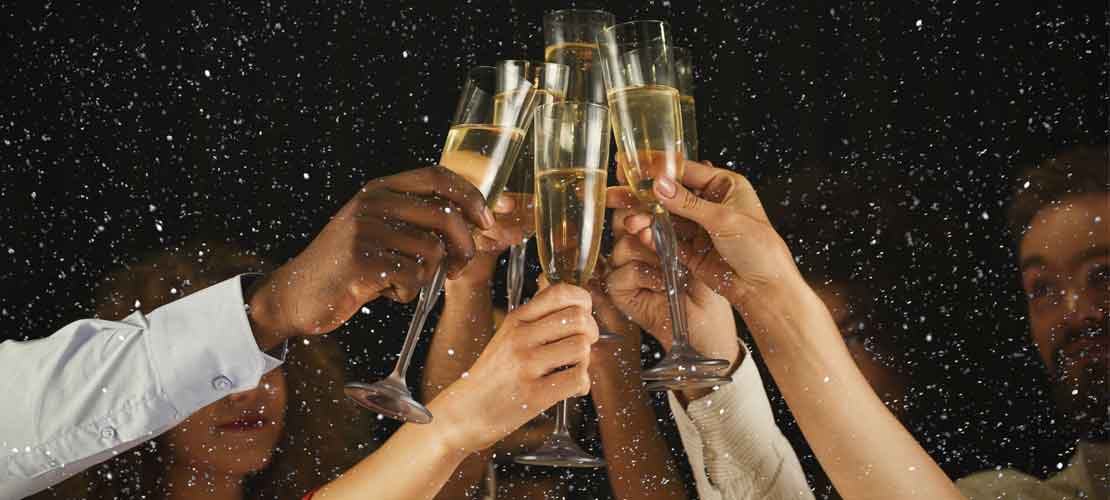
Champagne used to be red
True, back then the wine of Champagne was mostly red and only sparkled in spring, when it refermented in the barrels. Nothing like what celebrities and the glitterati knock back to show how happy they are to be among the people who matter, at least some of the time. I'll grant you that, but what Clovis had just done was to be repeated by every French king who followed him, right up to a certain little firebrand who placed the crown on his own head in Paris. In between, more than a thousand years went by. Around each coronation, especially in the troubled times of the late Middle Ages, the part of Europe we live in enjoyed several months of relative calm. The vassals, cousins and other friends of the future king needed time to travel in style to the land around Reims. Then, once there, the affair was hardly dispatched in three minutes: they ate, drank and, to put it briefly, made merry for days and weeks on end. Always with champagne. That is how this wine became synonymous with celebration, pleasure and a mark of success.
In the grand scheme of history, it is only very recently that a colourless or pink sparkling drink has been made in the region. Until the 17th century, it was red only, or almost. But that is another story. Contemporary champagne marketing simply leans on historical references, not those of the families who founded this or that house, but those lodged in our collective unconscious at the moment we express our joy. In American films, it is customary to scream hysterically and throw yourself into everyone's arms to show you're happy. My dog wags his tail. As for me, I open my wine cabinet and take out a bottle of champagne. Depending on how great my joy is, the cuvée will differ. In the real world, champagne is also a way of honouring people. It is hard to imagine a prestigious reception without champagne, unless funds are short or you have an exceptional local product to hand, but on the whole it is THE solution. Whichever champagnes you drink, drink them well, and may your celebrations be beautiful!
5 tips for enjoying champagne at its best
1. Flute or not?
There is no need to invest in 10 different kinds of glass! For Loire whites, Burgundies, Languedoc reds, young Bordeaux and mature Rhône wines, generally speaking, if you choose a single wine glass, it will do for whites AND reds.
You can use that same glass for bubbles… But if you want a dedicated glass, go for a tulip. Choose one that is wider below and narrower towards the rim. It allows the wine to open up perfectly. The flute "tightens" the acidity, and the coupe is meant for holding cufflinks on a side table or Mont Blanc cream, but certainly no longer champagne.
2. What temperature?
The colder a wine is served, the more its acidity comes to the fore. Serve it too cold and you won't taste its aromas. Serve it too warm and it may lack acidity and "pep". The ideal is to keep the bottles in the cellar and have ice ready in the freezer. Plunge the bottle into ice for about fifteen minutes to reach the ideal temperature. For exceptional vintage champagnes, cellar temperature is perfect.
3. Should you decant it?
The higher a wine rises in class, the more air it needs. Decanting is therefore permitted, and even recommended, for vintage champagnes and young special cuvées. The more time has left its mark on the wine, the less advisable the decanter becomes.
4. Can you keep it once the bottle is open?
Forget the little silver spoon dropped into the neck of the bottle. It's an urban legend! Like all other wines, champagne fears oxygen above all else. The bottle should therefore be resealed as quickly as possible with an airtight champagne stopper that lets no oxygen in and no carbon dioxide out. But honestly, apart from in care homes and in Scotland, can you think of many places where an open bottle of champagne goes unfinished?
5. Neat or not?
A good sparkling wine needs nothing added… A bottle of champagne is the result of several years of hard graft by the producer, and it is indecent to spoil it with a dash of cassis or, even more depressing, a frozen cuberdon to cool it down. If you don't like champagne, drink something else; the choice is wide.
Our selection of 9 champagnes from wine merchants
Au Chemin des Vignes in Brussels (rue d'Idalie, 27 in Ixelles)
Egly-Ouriet "Les Prémices" 58 €
17/20 The most affordable cuvée from this magnificent house, and the wine is superb as always. Structured, racy, very well made. Serve at cellar temperature.
Larmandier-Bernier Rosé de Saignée 67 €
17/20 Rosé de saignée, a micro-trend in the region, is a rather demanding style of wine to produce, especially if you want consistent quality. The goal is more than achieved here. Heavens, it's good! Everything is about the fruit, and it's joyful. In my view, given time, it could develop around Pinot aromas and gain in power.
"Le Cotet" Extra-Brut Blanc de Blancs Jacques Lassaigne 69,9 €
18/20 As an aperitif, it comes close to perfection. Straight, lively, with a slight saline touch on the finish. Happiness is easy at moments like this. And given the extra-brut style of the cuvée, it has a little something that makes you come back for more, which I rather like.
Laherte Frères "Les 7" 85,45 €
17/20 Snow White's favourite champagne, because it reminds her of home. Seriously, though, the 7 are the seven grape varieties permitted in the appellation, just for information. Beyond that, this is a complex, full, dense wine, surprising for its unusual flavours. A must for those for whom champagne is a little more than a joyful bubble.
Larmandier-Bernier Vieilles vignes du Levant 2012 130,3 €
18/20 This house, small in size but great in reputation, makes immense wines that age like few others. Vieilles Vignes du Levant is quite simply great art. The kind of wine that makes you love wine. Avoid it as an aperitif, as it is far too rich.
Charles Heidsieck "Blanc des Millénaires" 2007 139 €
19/20 This cuvée is my fondest memory of the year 2000, when the Blanc des Millénaires was a revelation. Year after year, cuvée after cuvée, it remains, to my mind and above all to my taste buds, a very great wine.
At Cora Wine (online):
When a retailer such as this one turns to grower champagne, it's time to put it in the spotlight.
Champagne Laurent Lequart 25,99 €
16/20 Full of roundness and voluptuousness, this cuvée will be perfect at the table. A capon, a few wild mushrooms, some chestnuts, and the job is done. It's joyful and full of ripe fruit.
Champagne Forget Brimont 1er Cru 36,49 €
17/20 The family has been working the same land in Ludes and producing champagne for two centuries. This is a classic, well-balanced, long wine with a lovely freshness on the finish. As you will have gathered, I like it very much.
Champagne JL Vergnon "Conversation" Grand Cru Blanc de Blancs 38,99 €
17/20 Fifth generation, with 5 hectares of vineyards split into 20 plots. It's a veritable score that forms the basis of this well-structured cuvée, with its fine, delicate weave. It's round on the palate, and I am convinced that with a spell in the decanter it will be even lovelier. It will accompany veal, poultry and roast lobster without ever faltering. In short, a fine festive cuvée.
 Health
 Travel
 Beauty