
Your Spring Culture Guide
Translated from French. Original title: “L’agenda culture du printemps”
Your spring culture guide in pictures
Will the spark ignite?
© Pers.
The new exhibition at Kazerne Dossin immerses you in the world of universal human rights, exploring their roots in history, law, religion, philosophy and nature.
No place could be more fitting for an exhibition on human rights than the Dossin barracks in Mechelen, where, during the Second World War, 25,490 Jews and 353 Roma were ruthlessly deported to the extermination camps, and where most of them never returned. The exhibition aims to shine a fresh light on the idea of "hope" carried by the Declaration of Human Rights. It shows where these rights come from, how they came about, who they matter to and why. Divided into three distinct parts, it begins with the Second World War and the countries that drew up the Declaration in 1948. The second part sets out to show the foundations on which its instigators based their work, using examples drawn from ancient laws and religions. It ends with a reflection on human nature and its impact on our well-being. Finally, the third part demonstrates that good intentions are not enough because, even today, human rights are being violated on a large scale: women, African Americans, children, the climate... This third section gives a voice to inspiring pioneers and activists past and present, including some well-known Belgians, who speak about their personal fight.
The exhibition also includes routes specially adapted for children and young people.
Universal Human Rights, until 11 December at the Dossin barracks in Mechelen. Info: www.kazernedossin.eu
A world full of poetry
Arnaud Nazare-Aga. © ASE.
This touring exhibition is being held to mark the 75th anniversary of the publication of The Little Prince in France. Since then, the book has been translated into 457 languages and dialects and, in France alone, has sold more than 11 million copies. There is every chance, then, that you read it at school too. The exhibition lets visitors experience the book live, as it plunges you literally into the poetic world of Antoine de Saint Exupéry (1900-1944), aviation pioneer and member of the Resistance, and of his endearing hero. The voice of the French writer's mother accompanies you throughout the route. Spread over nearly 1,500 m², the exhibition features spectacular staging, enhanced by a series of projections and audiovisual montages, testimonies from the author, his family and his friends, and personal objects that belonged to him.
Antoine de Saint Exupéry. Le Petit Prince parmi les Hommes. Until 30 June at Palais 2 of Brussels Expo. Info: www.expo-petitprince.com
Concealing and revealing
Fashion has always swung between hiding and showing. What is allowed today was not yesterday, and vice versa. Sometimes it is the sight of an ankle that is taboo, sometimes a bare back. How do designers approach these norms? We put the question to Eve Demoen, curator of the Fashion Museum in Hasselt.
Margiela collection 2009. © Marleen Daniëls.
Why did you choose this theme?
Eve Demoen: "Before I answer, I'd like to clear something up: DressUndress is not a lingerie exhibition and does not deal exclusively with nudity, but with the relationship between fashion and the body. The health crisis underlined, once again, that fashion and society are inseparable. After a period when comfort was the priority – homewear and activewear – and when we had to hide behind a mask, the body needs to be on show again. At the latest Fashion Weeks, the catwalks made it clear that nudity was back. We saw bikini tops, crop tops, sheer lingerie, bare breasts, suggestive cut-outs and miniskirts that left little to the imagination."
Guest curator Muriel Scherre is a somewhat controversial figure.
"We did indeed ask Murielle Scherre to curate the exhibition. Let me remind you that she created the sustainable lingerie brand la fille d'O and, as such, the human body is her daily business. What's more, she never shies away from debate and campaigns for an inclusive approach to the body, fighting against the beauty ideals she considers sterile. Her designs dress a realistic and diverse body, with cellulite, wrinkles, freckles... However, as she has experienced herself, this unadorned body remains subject to censorship, on social media as in real life. Unsurprisingly, this censorship spurs her to keep pushing her creative limits and to denounce the mechanisms of control and injustice that govern the fashion world."
How is the exhibition structured?
"DressUndress explores, from different perspectives, the changing sense of physicality, from the end of the 18th century to the present day. Don't expect a clear chronology, but rather a story that shows what is allowed today but was not yesterday. Presented at the start of the exhibition, the delicate Empire dresses, some of them semi-transparent, show clearly that values and norms are strongly tied to their time. At the end of the 19th century, it was unthinkable to reveal an ankle, while evening gowns displayed the bosom generously. Women's curves – hips, buttocks and bust – were particularly emphasised and amplified with all sorts of accessories, such as the corset and crinolines. It would take another two decades for women to be liberated by the short skirts of the Roaring Twenties. At the root of this emancipation lies a sense of protest or revolt, which we find again in the 1960s when the Twiggy skirt exposed the knees. Today, a plunging neckline causes a stir while bare ankles pose no problem, in Western countries at least. Nudity on the catwalk causes no scandal, whereas it is punishable in the street."
Which main designers are on show?
"Vivienne Westwood, Olivier Theyskens, Walter Van Beirendonck, Schiaparelli, Raf Simons, Alaïa, Comme des Garçons, Versace, Maison Margiela, Jean Paul Gaultier... Their creations illustrate how designers have played with the (naked) body over recent decades and how it can be manipulated or altered by clothing through the interplay of concealment and exposure."
DressUndress. D'où vient la fascination pour le nu dans la mode ? Until 20 November at the Fashion Museum in Hasselt. Info: www.modemuseumhasselt.be
Esch, European Capital of Culture
Open Market Days. © Blitz Agency
The second-largest city in the Grand Duchy of Luxembourg, Esch-sur-Alzette is the 2022 European Capital of Culture, joined for the occasion by 18 neighbouring Luxembourg and French communities. It shares this privilege with Kaunas in Lithuania and Novi Sad in Serbia. The official kick-off took place on 26 February for a series of events that will run without interruption until the end of the year. Under the leitmotif "Remix culture" and its four sub-themes "Remix Art", "Remix Europe", "Remix Nature" and "Remix Yourself", the organisers have put together an ambitious programme that will blend dance, theatre, music, concerts, festivals, exhibitions, tourism, design and sport. The aim of Esch2022 is to transform the region, once dominated by the mining industry, into an attractive tourist destination. With no fewer than 160 projects and 2,000 events, the region will certainly be worth a detour this year.
Esch2022, European Capital of Culture, until 22 December in Esch-sur-Alzette and 18 neighbouring communities. Info: www.esch2022.lu
Fascinating
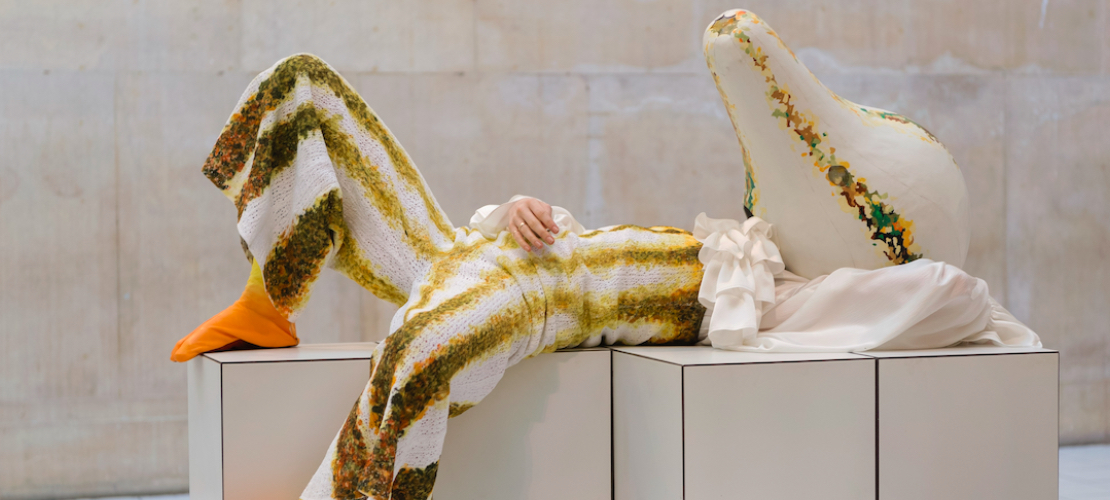
Mash Up is a retrospective exhibition that aims to be as complete and meticulous as possible in surveying the work of Anthea Hamilton (b. 1978). The British artist stands out for her great freedom, her exceptional creativity and inventiveness, her very strong visual aesthetic and her cross-cultural methods of making. Although Hamilton has been exhibited several times in recent years, this project is the first opportunity to show the public essential and defining works combining sculpture, performance and installation, and to lead visitors into surprising and unfamiliar territory. Around 70 works that have marked the artist's career are on show, along with a series of new creations.
Anthea Hamilton, The Squash. Courtesy the artist, Thomas Dane Gallery & Kaufmann Repetto. © Foto Seraphina Neville.
Mash Up, Anthea Hamilton, until 15 May at the MHKA in Antwerp. Info: www.muhka.be
Domitian the Roman
Domitian ruled the Roman Empire in the first century AD, a period often regarded as its golden age. Yet his name remains little known and, in antiquity, he was seen above all as a tyrant and a thoroughly mediocre emperor. Nearly 2,000 years after his death, the exhibition looks at the eventful story of his life. Through archaeological masterpieces, spectacular animations, films and depictions of ancient Rome, visitors discover this "forgotten emperor". It is a kind of quest to find out who he really was as a politician, general, lover and self-proclaimed "god on earth".
© Pers.
Dieu sur terre, l'empereur Domitien. Until 22 May at the National Museum of Antiquities in Leiden, the Netherlands. Info: www.rmo.nl
Nostalgia for the cafés of yesteryear
I can still remember those famous cafés with their long brown benches from the 1970s and 1980s, and perhaps you can too, and your parents certainly can. Sadly, they are disappearing one after another, along with their wonderful regulars who were content with a half-empty glass of beer because what they really came for was company. The ladies would order a coffee before filling their bags with beer sausages or chocolate bars. The men smoked Gauloises (unfiltered) or St Michel with impunity. To feel like Elvis or Tom Jones, all it took was a small coin in the jukebox. On Saturday nights, everyone danced to the strains of a Decap organ or a band.
In the newly published photo book, Harry Gruyaert (b. 1941) evokes the warmth, friendship and conviviality of these invariably smoke-filled cafés with their steamed-up windows.
Harry Gruyaert, Café Belgica, 101 pages, €23.58. Published by Gallery Fifty One. www.gallery51.com
Timeless beauty
Try it for yourself: put this book on your coffee table, and we bet your guests will praise your culture and good taste. And rightly so, because since its founding in Milan in 1919 by Mario Buccellati – nicknamed the prince of goldsmiths – the prestigious high jewellery brand has combined tradition and craftsmanship with unrivalled creativity. From its very beginnings, it could count on an international clientele, including the royal families of Italy, Spain and Egypt, and even the Pope and his entourage. Buccellati draws inspiration from a range of styles, from motifs of ancient Greece and the Etruscans to Venetian lace, by way of references to the Renaissance. This book, richly documented from a historical point of view, tells and shows the marvellous evolution of the brand across four generations of devotees.
Buccellati: A Century of Timeless Beauty, 294 pages, €195. Published by Assouline. Assouline.com
Long live spring
In the park at Beervelde, spring means a genuine celebration. For three days, 240 hand-picked exhibitors offer a multitude of plants, flowers, garden decorations and antiques, workshops and regional gourmet products. In autumn as in spring, more than 20,000 visitors flock to the Plant Days, an event whose reputation reaches well beyond our borders. Among the many wonders is the way the exhibitors take inspiration from a general theme each time to decorate their stands joyfully. This year's theme is "The Three Musketeers", a fine opportunity to introduce visitors to the Gers, or Gascony, the native region of many musketeers and of the most famous of them all, d'Artagnan. Not forgetting the beautiful Milady de Winter, with whom he shared a bed, but who was also his sworn enemy!
© Pers.
Les Journées des Plantes de Beervelde. On 6, 7 and 8 May in the Beervelde Park. Info: www.parkvanbeervelde.be
Taking a work of art home
The Affordable Art Fair hosts 75 Belgian and international galleries presenting the work of some 600 artists, both emerging and established. The prices are affordable, which is by no means a synonym for worthless, as every participant has been carefully selected by a committee of experts for their originality, artistic quality, technique and artistic intention. Displaying prices is compulsory, so that you don't buy a pig in a poke. Another advantage: you can take the work you buy straight home. A "Wrapping Desk" takes care of packing it safely.
Knitting the Chaos, Maki Kuchida. © Eye Contemporary Art Gallery.
Affordable Art Fair. From 23 to 27 March at Tour & Taxis, Brussels. Info: www.affordabl
 Travel
 Beauty
 Beauty