
Vincent Lindon tips into "another world"
Translated from French. Original title: “Vincent Lindon bascule dans « un autre monde »”
Interview with Stéphane Brizé
Why did you want to tell the story of this executive?
Stéphane Brizé: The film portrays the loss of meaning in the life of a company executive who, just as his marriage falls apart, finds it harder and harder to see any coherence in a system he has nevertheless served for years. A system in which it becomes extremely difficult for him to pass down orders that come from above. Many executives told Olivier Gorce, my co-writer, and me about a personal and professional life to which they are finding it harder and harder to give meaning, because they are no longer asked to think, but simply to carry out orders. We wanted to show the consequences of the work of those who are seen as the armed wing of the company, but who are simply individuals caught between a rock and a hard place.
The film was conceived before the coronavirus crisis, but it resonates particularly strongly today, showing a system running out of steam and full of inconsistencies…
Stéphane Brizé: No one could have imagined the extraordinary health crisis we are going through. And while it can be seen as a source of chaos almost without precedent, it can also be viewed as an opportunity to ask ourselves questions. A way of turning a constraint into an advantage, so that we are not simply history's losers. Rather like when our body or our mind breaks down to stop the machine and tell us that we are failing to examine something invisible but essential, a blind spot in our lives. A metaphor, on the scale of one individual, for the disorder of our world, the profound upheavals the main character goes through will force him to question his actions, his responsibility and his place within the company and within his family.
With this story, are we looking at the tragically ordinary life of an executive?
S.B.: Philippe Lemesle, the main character of the film, operates in the victorious heartland of our modern civilisation, the place of meritocracy, the place of what we conventionally call "a great success". How do you say you are hurting when you belong to the social elite? Complaining would be both indecent in the eyes of those who have less and a sign of weakness. An unbearable feeling in the eyes of your peers. An unbearable feeling in your own eyes. In that corner of the world, you cannot, you must not, be fragile. It is forbidden on pain of being demoted and replaced by someone younger and more dynamic than you, or by someone who would not question what he is asked to do. A place of great loneliness where perhaps you no longer have a choice. The question of personal freedom is also addressed.
How can Philippe Lemesle – the character played by Vincent Lindon – submit to a system whose inconsistencies he understands?
S.B.: He doesn't understand the system's inconsistencies straight away. At any rate, he is quite incapable of putting them into words for himself. So he endures a situation in one area of his life – work – that has consequences in another – his family. At the start of the film, it is absolutely impossible for him to hear, or to admit to himself, that the staff-reduction target imposed on him by the Elsonn group will be very difficult – even impossible – to achieve. At first, he is only capable of doing what he is told. Not out of ideology, not out of a taste for brutality, but because he has taken on board the idea that the problem is not the system itself but the difficulty, or the impossibility, of its members adapting to it. Except that his industrial site, like most others in France – and even in Europe – is now reaching breaking point. Doing more with less is becoming impossible. Employees – executives and workers alike – are at the end of their tether. Philippe must therefore accept that he is not the problem before he can confront his superiors. It is the Copernican revolution he has to carry out if he doesn't want to lose everything: his family, his mental and physical health.
Is the "other world" suggested in the title the one the main character – played by Vincent Lindon – is losing, or the one he is tipping into?
S.B.: It is all of those at once. The character moves inexorably away from a world in which his place and his actions made sense towards one in which the ethics and morals that deeply structure him disappear. This "other world" is the question of choice facing the character played by Vincent Lindon, as well as the one played by Sandrine Kiberlain. The question of what we are prepared to do, personally and professionally, to be in the place that feels, very intimately, the most right. After more than a year of global pandemic, the title also sounds almost ironic when set against the "new world" that was talked about so much, and no doubt hoped for so much, a few months ago. The one that was going to, or was supposed to, be built on the rethink that this sudden crisis forced upon us.
The character's private life takes up a very large part of the film…
S.B.: What interests me is women and men, and the consequences of their professional choices on their personal lives. Here, in this film, individuals – executives – have to make decisions that inevitably cause people to suffer. They are asked to give up, little by little, a part of their humanity. And you cannot pull on that thread with impunity without risking that it will snap. None of this happens without worry, without anguish, without inner conflict. And all of that is what these executives bring home with them. Little by little, what had been a balance for years becomes an imbalance, and suddenly the whole edifice collapses.
One of the consequences for Philippe Lemesle is his divorce. But although Anne, his wife, leaves him, she still loves him.
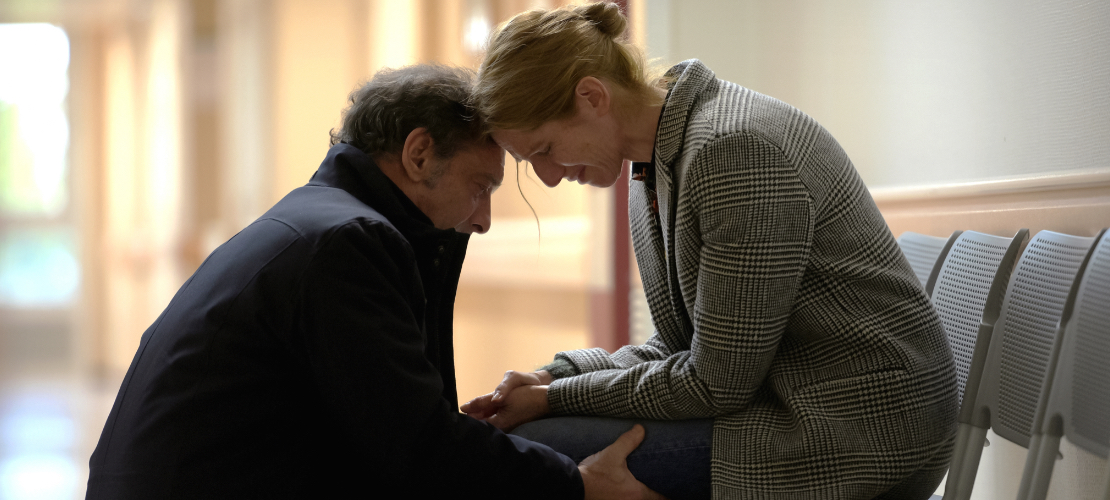
S.B.: Yes, because if she leaves the man she has lived with for more than 25 years, it isn't because there is no love left between them but because she has to save herself. She sees that her daily life has lost all coherence and so she takes the risk of leaving. The notion of courage comes up several times in the film in the character's professional sphere. But it is Anne who shows real courage. Because she leaves even though she is gripped by fear for her future. She leaves because the space of her marriage has become a place of renunciation and suffering. Having sacrificed part of her own professional ambitions so that her husband could have a very fine career, she now feels cheated. The tacit contract with Philippe, the trade-off, no longer makes sense, and she dares to break with what many would consider a comfort impossible to question. And the incredibly subtle way in which Sandrine Kiberlain reveals Anne's inner contradictions is breathtaking and deeply moving.
It is a reunion for Vincent Lindon and Sandrine Kiberlain (with whom you made Mademoiselle Chambon 12 years ago).
S.B.: A very powerful reunion, because they admire each other and hadn't acted together in all those years. And although I have made three films with Vincent since then, I was waiting for the chance to make another film with Sandrine, she is such a magnificent actress. Having the two of them together is an extra gift. Because, without giving away any great secrets, the nature of their past connection resonates in a particular way in what they have to play here. It is a privilege to have their trust and to be able to work on this material with them.
This is your fifth film with Vincent Lindon…
A film is a subject, a story and characters, but for me it is also a documentary about one or more actors. I don't believe at all in the notion of character. A character is first of all a construction of the screenwriter and then, in the end, of the audience. In between, on set, I only work with the living material in front of me. Sometimes I make films with Vincent's anger, with his doubts, with his tenderness; here I am working with his weariness and his distress. I invent nothing about an actor; I only work with what he allows me to have. An actor's talent is his capacity for availability. And Vincent makes himself immensely available to inhabit spaces and stories that I imagine, each time, to be different.
The character played by Vincent Lindon is confronted several times with the argument of courage. Is it an important notion in the workplace?
S.B.: It is even a fundamental one. With Olivier Gorce, we met Christophe Dejours, the psychoanalyst who specialises in work, who asks how so-called "normal" individuals, people one might call "honest folk", can accept without protest ever harsher demands that they know endanger their moral, mental and physical integrity, as well as that of others. Courage is then put forward as a factor of integration and respectability within the group. The courage to do what, deep down, repels us, so as not to be pointed at or, worse, cast out of the system.
So where, for you, does courage lie?
S.B.: I am not here to provide that kind of definitive answer. The situation in the film challenges a man at a point in his life when truths that seemed eternal to him are collapsing one after another. A situation that forces him to examine fears he must agree to confront in order to break with whatever is hurting him. Give up any idea of his own humanity, or flee the place of constraint and suffering, renouncing his social status along with the idea of his own strength? The story is built around that question, and the character will give his own answer to it.
"Un Autre Monde", a film by Stéphane Brizé with Vincent Lindon, Sandrine Kiberlain, Anthony Bajon and Marie Drucker. In cinemas on 23 February.
 Travel
 Beauty
 Beauty