
When depression shows on your face and body
There are mornings when the mirror is a little less kind. Your face looks tired, your eyes less bright. Your skin turns dry or reactive. Your hair loses its strength. And then there are those jeans that no longer fit quite the same, that posture that has imperceptibly closed in on itself.
Translated from French. Original title: “Quand la dépression se lit sur le visage et sur le corps”
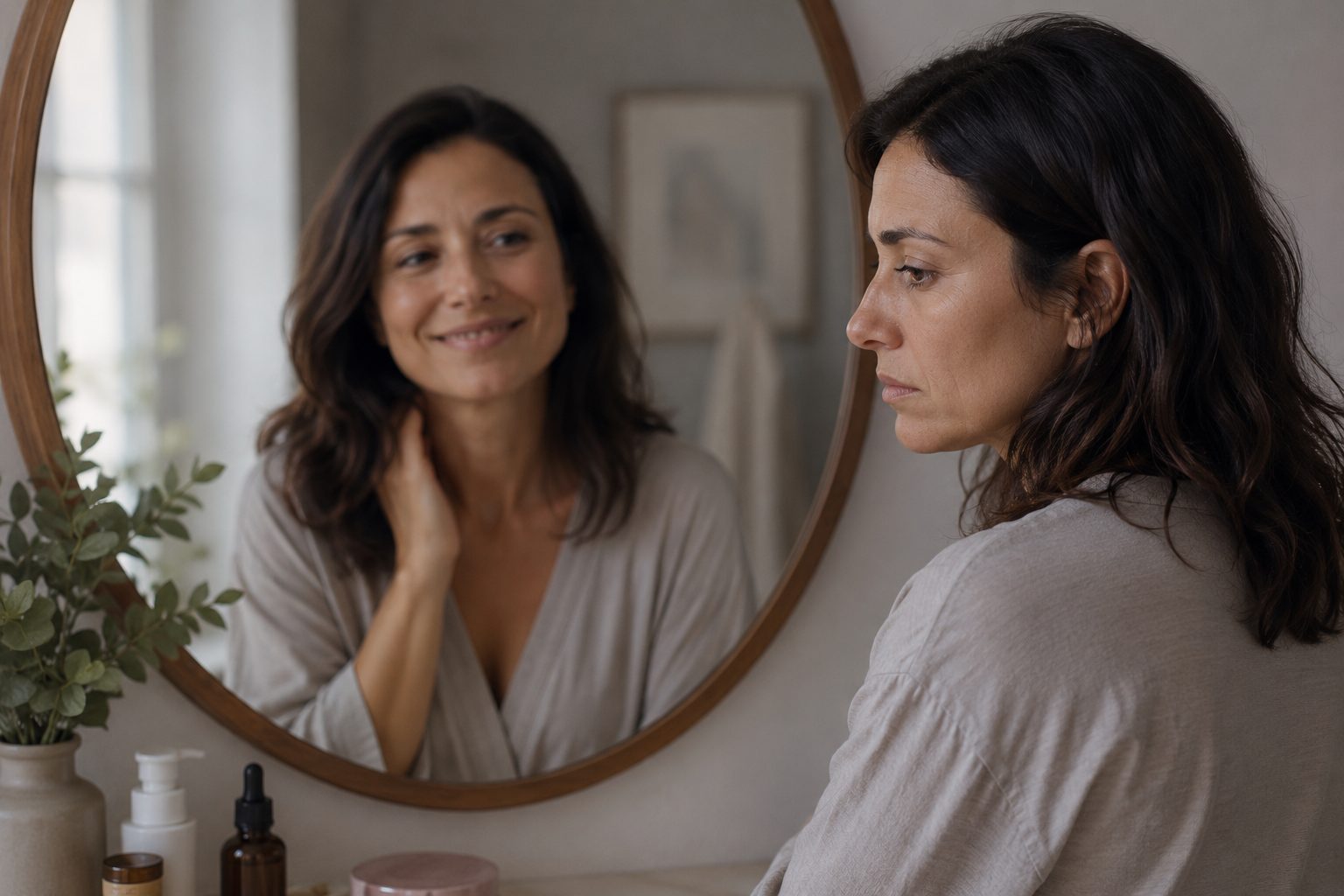
When you are going through depression, all of this can seem completely secondary. And, in a way, it is: the priority is obviously to look after your mental health. But to consider appearance entirely frivolous would be a mistake. Because our body is also our home. And wanting to get a healthy glow back, to look after your hair or simply to put on a cream you love again can become a small way of coming back to yourself.
Visible effects on the face
Depression can disrupt sleep, appetite, physical activity and daily habits. Prolonged stress also plays a part in many physiological mechanisms. And sometimes, it ends up showing. The face may seem less expressive, the features more tired. Lack of sleep naturally encourages dark circles and that crumpled look which even the best concealer in the world cannot always make disappear.
But beware of shortcuts: a tired face does not mean you are depressed, and a depressed person does not necessarily "look depressed". The illness cannot be read on a face. What matters, rather, is noticing changes in relation to your usual self.
Your skin needs gentleness too
When your mood collapses, a sophisticated seven-step beauty routine is generally not the priority. And that's just as well: our skin doesn't ask for that much. Above all, it needs gentleness and regularity. Skin that has become dry or uncomfortable will appreciate non-aggressive cleansing and good hydration. If acne, eczema, psoriasis or other persistent problems suddenly appear, it is better to speak to a dermatologist than to pile on cosmetic actives at random. And if your only victory of the day is washing your face and putting on a little cream? That is already a routine.
Hair loss, such a worry…
Seeing more hair than usual on your brush or in the shower can be particularly distressing. Significant stress, a change in diet, fatigue, hormonal changes, certain medicines or deficiencies can all contribute to hair loss. After 50, several causes can in fact overlap. Unusual, heavy or persistent hair loss deserves medical advice so that the cause can be identified. And if a treatment for depression seems to coincide with a physical change, never stop your medication on your own: talk to the doctor who prescribed it. Glamour can wait. Health cannot.
When your figure changes too
Depression can also change our relationship with food and movement. Some people lose their appetite, others eat more. Some stay active, others find it enormously difficult to get off the sofa. Treatments can also have different effects from one person to another. The result? The body can change. And this is probably where we need to be at our kindest towards ourselves.
Because at 50, 55 or 60, we have already spent far too many years hearing that we ought to lose this, firm up that and hide the rest. A body going through a difficult time does not need to be punished. It needs to be supported.
Moving does your mood good, but there is no need to turn every walk into a "get in shape" programme. Walking a little, getting some fresh air, stretching, gradually returning to an activity you enjoy: movement can first of all be a way of getting back in touch with your body.
And what about aesthetic medicine?
Peels, retinol, injections, radiofrequency, mesotherapy… There are many aesthetic solutions, and some can be worthwhile when they are properly indicated and carried out by qualified professionals. But there is one question to ask yourself before all the others: why do I want to do this?
Because this wrinkle has bothered me for a long time and I'd like to soften it? Fine. Because I hope that by transforming my face, I will make what I feel inside disappear? In that case, it may be better to wait. Aesthetic medicine can change an appearance. It does not treat depression. And in a period of great vulnerability, it is best to avoid impulsive decisions and to start by treating what is really causing the suffering.
Beauty as a small way back to yourself
And yet there is something we absolutely do not want to take away from women going through depression: the pleasure of feeling pretty. Putting on lipstick to go and buy bread. Massaging your scalp in the shower. Getting out your favourite perfume. Booking a hairdresser's appointment after weeks of not feeling like it. Putting on that jacket that instantly gives you a bit of style again.
None of this cures depression. But these gestures can sometimes accompany the return of desire. Not to become again the woman we were "before", but to gently reconnect with the woman we are today. At fifty and beyond, we know one thing: a mirror never tells the whole story. It shows skin, hair, a figure. It shows neither the battles fought, nor the difficult nights, nor the courage it takes to ask for help.
So if your reflection feels like a stranger's during a period of depression, begin by taking care of the woman behind it. The rest can gently return. And, one morning, you will catch your eye in the mirror and simply think: "Ah, there you are again."
 Beauty
 Beauty
 Beauty