
Face taping: the little tapes promising to take years off
Someone had to think of it. After massaging, pinching, rolling, gua-sha-ing and face-yoga-ing our faces, we are now being invited to… tape them up.
Translated from French. Original title: “Face taping : ces petits scotchs qui nous promettent un coup de jeune”
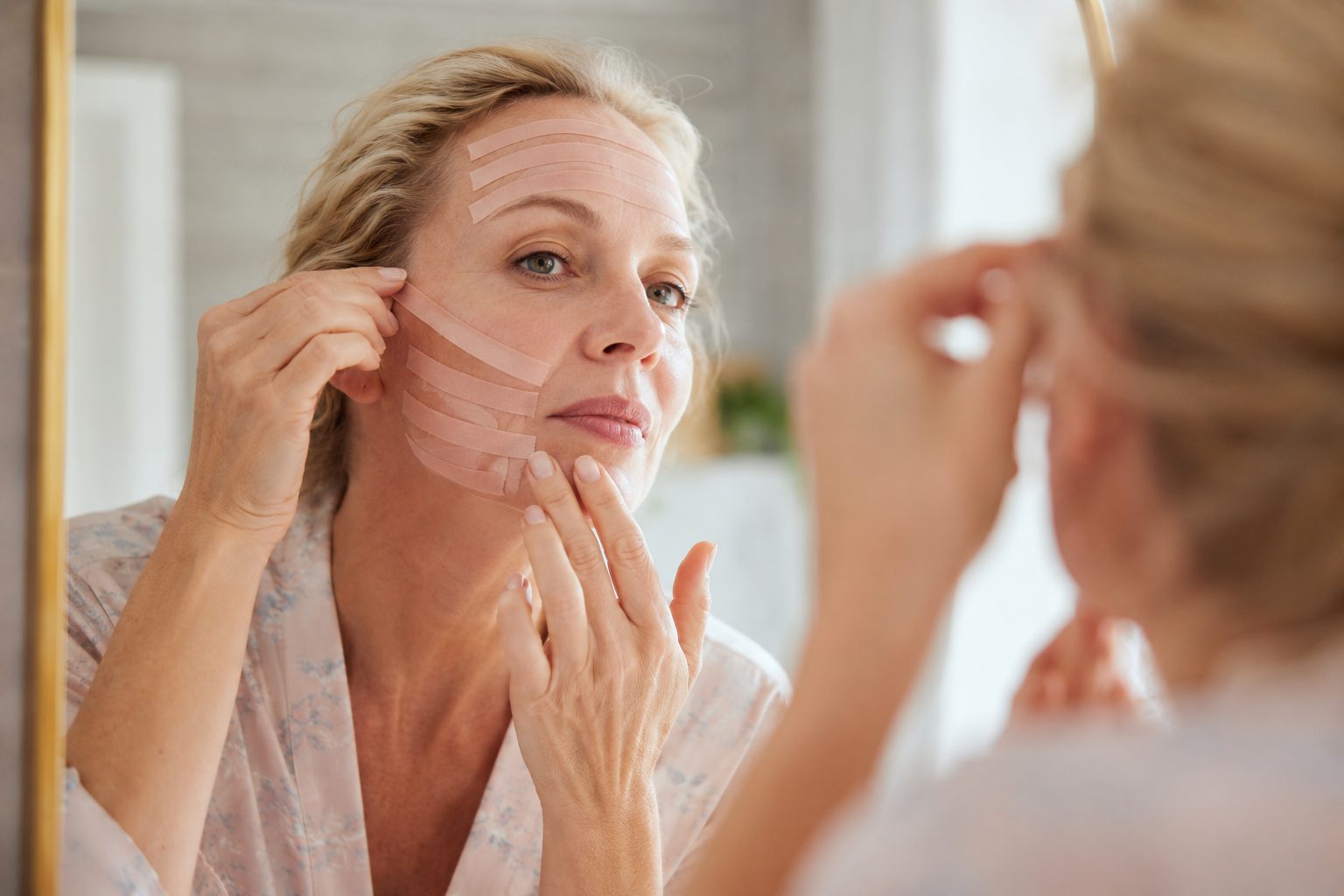
Not with the roll that's been lying in the office drawer, don't worry! Face taping uses thin, stretchy adhesive strips applied to the forehead, cheeks, around the mouth or along the jawline. On Instagram and TikTok, the before-and-after pictures are tempting enough to make you want to try it. But between a little radiance boost and a DIY facelift, there are still a few wrinkles to iron out.
But why put tape on your face?
The principle comes from kinesio taping, those coloured strips that have long been seen on athletes' shoulders and knees. Applied to the face, they are used in particular to rest certain muscles and to ease the tension linked to our facial expressions. After all, our faces work all day long. We frown at the computer, squint in the sun, clench our jaws when the day's schedule overflows… And, year after year, these movements contribute to the appearance of expression lines.
The strips gently hold certain areas in place for a few hours. When they come off, features can look more relaxed, lines less pronounced and the face a little fresher. So far, so good: sign us up.
A lifting effect
This is where the pretty dream sold on social media deserves a gentle reality check. Face taping does not firm the skin in the long term. It does not lift jowls, restore collagen or erase a wrinkle that has settled in while we sleep.
Its effect is essentially temporary. By resting certain muscles, it can give that "good night's sleep" look we love so much in the mirror. It can also fit into a routine combining self-massage and facial exercises. But let's forget the promise of a facelift without the scalpel: we are closer to a clever little freshen-up. And frankly, that's not bad at all.
And after 50?
This is precisely where things get interesting. With the passing years and the hormonal changes of the menopause, skin evolves. It often becomes thinner, drier, less dense and less elastic. And skin that has lost some of its firmness does not react in the same way as the skin of a 30-year-old. Face taping therefore seems mainly useful for expression lines and muscle tension, rather than for skin laxity itself.
And there is no point pulling harder on the grounds that the skin is less firm. Quite the opposite: the more fragile it is, the more delicate the touch should be. A strip that is too taut or badly placed can mark a crease instead of smoothing it.
Where do you put the tape?
Enthusiasts mainly target the forehead, cheeks, the contour of the mouth, the nasolabial fold and sometimes the jawline. But before turning your bathroom into a practical workshop, it is best to learn the correct placements, because the direction of the strips matters as much as their tension. To start with, a session with a facialist trained in this technique can be useful. Once you have understood the movement, there is nothing to stop you carrying on quietly at home.
Start with clean skin, free of wounds or irritation. Choose above all strips specially designed for the face and hypoallergenic: the heavy-duty tape meant for athletes has no place on our cheeks. And resist a very natural temptation: pulling. The tape is applied without putting the skin under tension. For a first go, it is also better to keep it on only briefly and see how your skin reacts. Itching, heat, redness? Take it off.
Those put off by the geometry-lesson style of cutting out shapes can also turn to pre-cut strips or certain silicone patches. Much less spectacular, admittedly, but far easier in front of the mirror.
So, shall we buy the roll?
Why not. As long as we don't ask the impossible of it. Face taping won't give us back the face we had at 30 — and between us, was that ever really the goal? On the other hand, it can become a little ritual for relaxing the features, becoming aware of facial tension and achieving, now and then, a more rested look. Before an evening out, after a particularly busy week or simply because we like looking after ourselves, the idea holds up.
At Fifty&Me, we prefer to remember this: it is less a technique for erasing our age than a new way of relaxing the face. And if a few strips of tape are enough to help us put our feet up — and raise an eyebrow — we certainly won't deny ourselves.
 Beauty
 Beauty
 Beauty