
Correct or Conceal?
A less perky eyelid. A fold that, only yesterday, seemed little more than a passing parenthesis. A fuller mouth that is no longer quite so full. Dark circles that tell the tale of a sleepless night… one we didn't even have the pleasure of enjoying.
Translated from French. Original title: “Corriger ou camoufler ?”
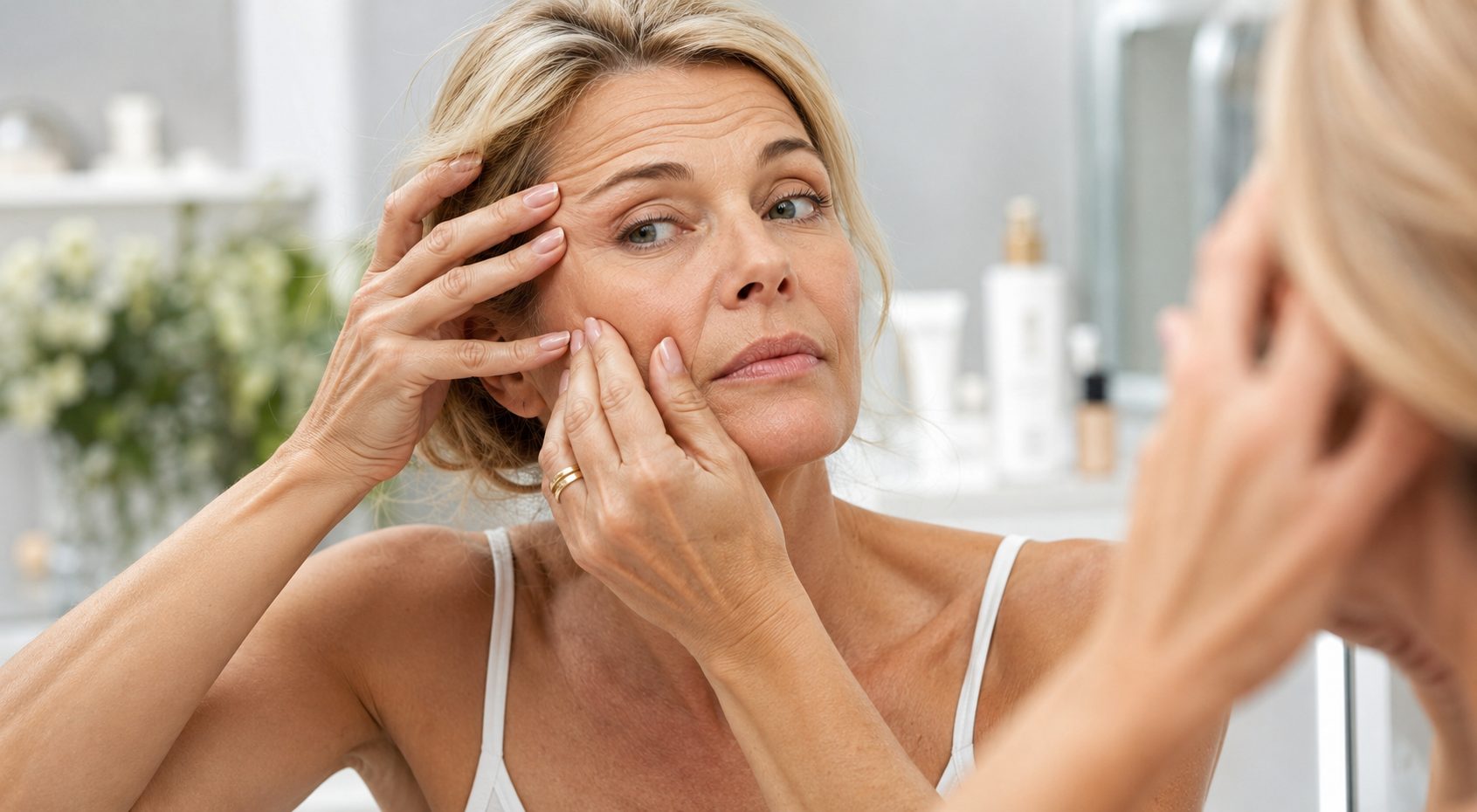
Must we really declare war on every millimetre that moves? Certainly not. You can love your face as it evolves AND wish to soften certain details. The two are not contradictory.
The nose: the one that never wants to retire
The nose has an irritating quirk: over the years, it can seem more prominent. The skin and tissues change, the tip may appear slightly lower, and a small irregularity that was once discreet can become more visible. Before imagining major works, remember that make-up can play interior designer. A subtle play of shadow and light can visually alter volumes. The key word is subtle. At 50 and beyond, we rarely want Instagram-filter contouring. Light, matte textures are often more flattering than very shiny effects, which draw the eye straight to the volumes. And sometimes the best trick is the simplest: a lovely pair of glasses. Call it diverting attention with panache.
On the aesthetic medicine side, certain irregularities can sometimes be corrected with hyaluronic acid. But the nose is an anatomically delicate area: this type of injection must absolutely be assessed and carried out by an experienced doctor. And above all, injecting is not always the right answer. Adding volume to disguise another has its limits.
The nasolabial fold that frames our smile
It starts at the nose and runs down towards the mouth. With time, it can become more pronounced. And since it has also accompanied our smiles for decades, we could almost send it a thank-you card. If it does bother us, rule number one: don't try to make it disappear under three layers of concealer. Thick products have an unfortunate tendency to settle into lines and emphasise them even more. Better to use a fine texture, applied around the area rather than built up in the depth of the fold. The aim is not to erase but to rebalance the light.
In aesthetic medicine, too, the thinking has evolved. Rather than systematically filling the line, the practitioner may try to understand why it has deepened: loss of support, changes in the volume of the cheekbone, sagging… Sound care looks at the face as a whole. Because a face is not a series of wrinkles to be filled. Thankfully.
Opening up the eyes
One fine morning, the eyeliner you've been drawing with your eyes closed since 1987 suddenly refuses to cooperate. Welcome to the club! When the upper eyelid becomes less firm, our make-up habits simply deserve a little update. Satin shades rather than very shimmery ones, a line concentrated towards the outer corner, well-defined lashes: a few adjustments are sometimes enough to give the eyes back their presence. And let's forget the odd idea that, beyond a certain age, eye make-up should be abandoned.
We don't put our mascara away on our fiftieth birthday. For those who want to go further, there are various medical or surgical approaches depending on the cause of the change observed. Botulinum toxin injections, for example, can in certain cases act on certain muscles around the eyes; however, they do not replace surgery when there is a genuine excess of skin. Here again, the right treatment begins with the right diagnosis.
Lips: less volume, but no less character
With age, lips can become thinner and their contours less defined. The temptation? To redraw the outline generously. Bad idea. A pencil close to the natural colour of the lips, used sparingly, can restore their definition. You can work lightly on the Cupid's bow and the centre of the lower lip, then choose a red or a satin balm. The goal is not to create a new mouth, but to wake up the one that's already there.
Injections can also be considered by a doctor when someone wishes to restore a little volume or redefine the contours. After 50, the most elegant result is often the one nobody notices. The ideal compliment? "You look well." Not: "Who did your lips?"
And what about dark circles?
They can be coloured, hollow, accompanied by bags… and each calls for a different response. For pigmented dark circles, colour correction can work wonders: a peach or apricot shade neutralises certain bluish tones before a fine concealer is applied. For hollow dark circles, avoid choosing a concealer that is far too light. Instead of brightening, it can accentuate the relief of the area.
As for injections under the eyes, they are by no means a universal solution. This region is complex and some faces are not good candidates. A qualified professional must, in particular, assess the quality of the skin, the anatomy and the possible presence of bags before suggesting anything at all.
Beauty is not a camouflage operation
At 30, we might have wanted to correct a detail to match an image. At 50, 55 or 60, we often begin to know exactly what we want to keep. That wrinkle? It doesn't bother us. Those lips? A touch of pencil is enough. That eyelid? Perhaps we'd like to talk to a specialist about it. And that nose? Actually, it looks terribly like our father's, and we're attached to it.
This may be the true luxury of age: no longer seeking a perfect face, but freely deciding what is worth changing, or not.
Make-up can cheat for a few hours. Aesthetic medicine can change certain things for longer. Surgery can address other needs. But no syringe, no brush and no scalpel holds the most precious power of all: that of deciding for us which woman we want to see in the mirror.
 Beauty
 Beauty
 Beauty